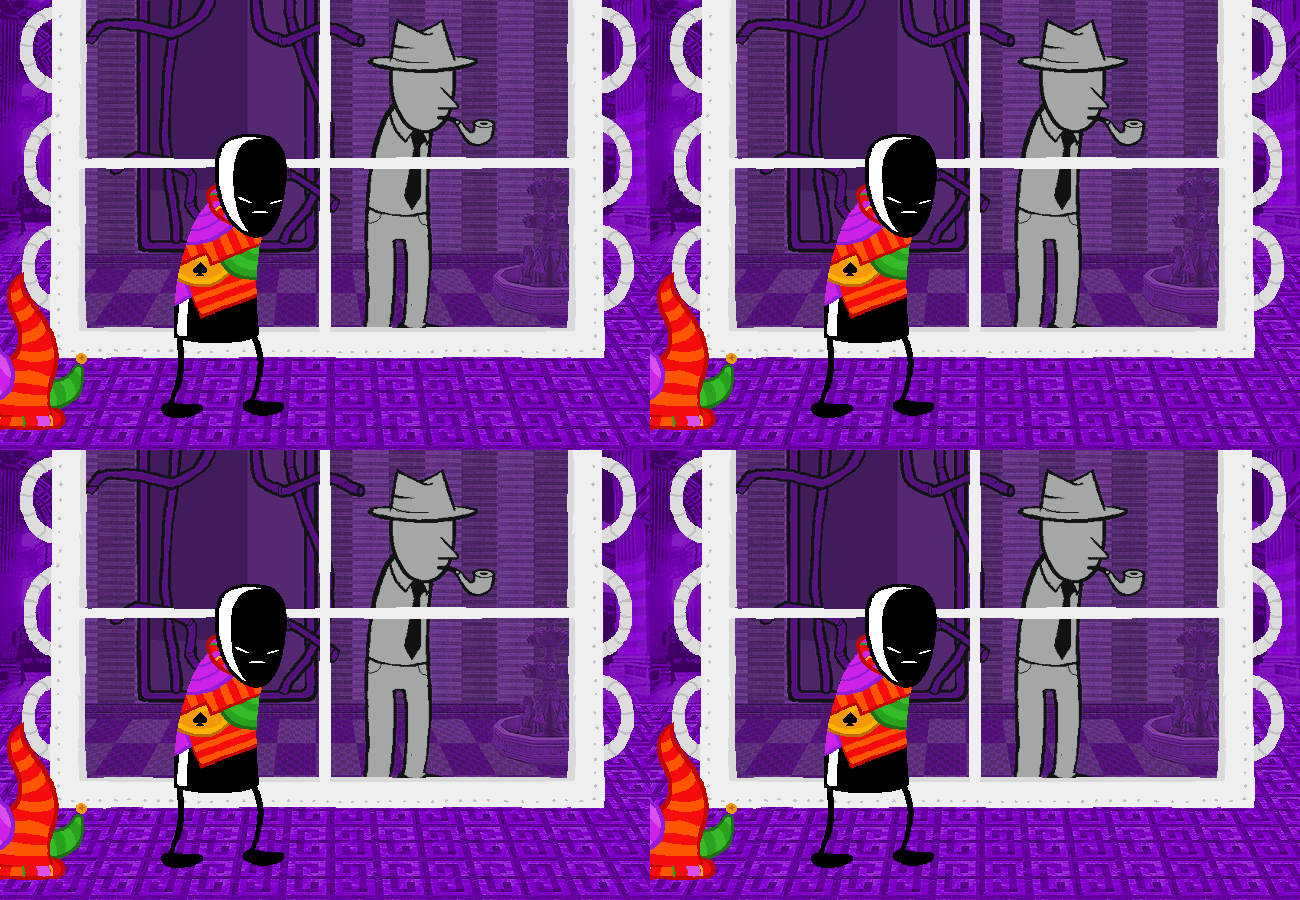
Cookie Fonster Reviews Eurovision 1956: Humble Beginnings Shrouded in Mystery

< Intro Post | 1956 Review | 1957 Review >

Note: I wrote this post after finishing my review of the season 6 finale of My Little Pony: Friendship Is Magic. That will come out Friday morning!


Introduction

The first ever Eurovision Song Contest, then known as the Grand Prix of the Eurovision Song Competition (French: Grand Prix Eurovision de la Chanson Européenne), was held exactly 67 years before the day I am writing these words—on May 24, 1956. It boggles my mind how long Eurovision has existed. The contest is 44 years older than me, and it was first held when my grandparents were teenagers. Two grandparents who lived in Germany and might have known of the contest; two grandparents who lived in the United States and probably had no way to know it existed.

There are innumerable ways the Eurovision of then differed from the Eurovision of today. Imagine if you could tell a European in 1956 that people all over the world can watch the contest using telephones, or that the contest has so many countries that it now spans five days, or that Australia is now a competitor. But what I find most striking is how much of the first contest is lost to the sands of time. We don’t know any rankings besides the winner, we don’t know who most of the commentators are, we don’t know if some contestants are still alive*… but most importantly, we don’t even have video footage of the contest, except the winning song’s reprise. I wonder if anyone in 1956 was a huge enough Eurovision nerd to keep track of all information on the contest they could, then preserved the papers they wrote it on when the Internet age began? If anyone like that is alive today, their claims would be hard to prove.

Putting aside the incredible evolution of technology, here are some basic facts about Eurovision 1956. It was broadcast on radio and TV, though most people consumed it via radio. It was hosted near the center of the seven participating countries in Lugano, Switzerland, and in an excellent example of early installment weirdness, each country sent two songs. It’s one of two Eurovision Song Contests with no songs in English; half the songs were in French, and the others were in German, Dutch, and Italian.

Now what are we waiting for? Eurovision 1956 review, let’s begin! I’ll list the songs in order of broadcast.

* French Wikipedia claims Mony Marc is dead, while Spanish Wikipedia claims she’s alive. Perhaps because little is known about her, she has no English Wikipedia article.

Continue reading

Cookie Fonster Reviews Every MLP Episode Part 2: The Ticket Master + Applebuck Season + Griffon the Brush Off

Introduction

< Part 1 | Part 2 | Part 3 >

Season 1, Episodes 3-5


Season 1 Episode 3: The Ticket Master

In five words: Season’s overarching gala arc introduced.

Premise: Princess Celestia gives Twilight Sparkle two tickets for the Grand Galloping Gala, but she can’t decide which of her friends to give the second ticket to because they all have different reasons for wanting to go.

Detailed run-through:

The episode starts with Twilight Sparkle helping Applejack gather apples, then Spike burps out a letter from Celestia inviting Twilight to the Grand Galloping Gala, plus two tickets. Both ponies are excited to go to the gala, while Spike insistently dismisses it as girly nonsense he wants no part in. His dismissal is humorously performative and reminiscent of the many people who are in denial about being a brony, like I was for years. More on Spike’s hammy denial when I get to the end of the episode.

Continue reading

Cookie Fonster Critiques Homestuck Part 11 Rewritten: Magical Dreams and Retroactive Clowns

Introduction / Schedule

Part 10 | Part 11 | Part 12.1 >

Pages 952-1051 (MSPA: 2852-2951)

Act 3, Part 3 of 5

Link to old version

Right now my priority for this blog is my main Homestuck post series I started in 2015 where I’m currently on Act 6 Act 5; this post is a bit of a divergence from the plan I’ve laid out. I finished my newest post a few days ahead of schedule, so I decided to do a rewritten post to release on Friday instead. I mostly did it as a bit of a breather from the absurd romance drama I sped through.

Who’s this guy?

At the curb of Act 3’s halfway point, it’s time for us to meet Spades Slick’s lookalike.

Spades Slick?

Got a nice ring to it.

But you know your own name. And that damn well ain’t your name.

Jack Noir’s naming is done a bit differently from other characters. He doesn’t have a naming box; rather, he’s meta-aware of Hussie’s fingers typing his name. The book commentary here is worth reading:

Jack at this stage is the villain. Villains in Homestuck tend to be meta-villains. That is, they exist much closer to the surface of the story’s meta-bubble, and often interact with the way it’s told. For instance, Jack Noir is the original owner of the 4th wall. (See next page.) As a universal bureaucratic game construct, he can keep tabs on everything going on in the session, including just outside the story.

Though Jack Noir is a meta-villain, there are limits to this, possibly tied to his personality. It could be the scope of his ambition never includes messing with the story itself. His desire for power lies entirely within fictional parameters. Later, there are much more flagrant meta-villains, in Doc Scratch and Lord English. They live on the surface of the meta-bubble, and at times badly puncture it. All iterations of Lord English in total basically represent the ultimate meta-villain. Though it takes a very long time for this to become apparent, and for it to be revealed exactly what this means.

I think it’s fair to assume this villain foreshadowing and easing in was intentional. Act 3 is filled to the brim with hints at the trolls’ backstory, the alpha kids, and (much more subtly) the cherubs. Jack Noir’s higher degree of meta awareness than the beta kids is a subtle but useful way to ease readers into the times villains start taking over the narration. On the topic of characters taking over narration, if you somehow haven’t read Detective Pony *****PLEASE DO SO IMMEDIATELY*****, then come back here.

Continue reading

Cookie Fonster Critiques Homestuck Part 5 Rewritten: The Crutch of Cinematic Troglodytes

Introduction

Part 4 | Part 5 | Part 6 >

Act 2, Part 2 of 5

Pages 358-428 (MSPA: 2258-2328)

Link to old version

I was originally going to call this post “Grandmotherly Expositation Station (ft. wizards)”.
Then I was going to call this post “The Motherly Miniboss (who hates wizards)”.
But now I’ve settled on an actually good title. I need to name more posts after Dave lines.

Let’s be real here, the content covered in this post has far more focus on Rose than grandmotherly expositation. And all title pictures prior to this were from scenes focused on John so I wanted to change things up.

Another note: I’ll be referencing the old version of this post quite a bit in this one, because I’ve realized many new things related to what I talked about in that post.

What’s the first thing we see when Rose enters her living room? An enormous wizard statue. I touched upon the kids’ pattern of guardian interests in my rewrite of post 3 and I’ll go over this pattern more as we go along.

Just look at that mystical gaze. To peer into those aloof, glassen eyes is to arrest the curiosity of any mortal. To behold the wisdom concealed in the furrows of that venerable face is to know the ceaseless joys of bewonderment itself. Any man so fortunate as to catch askance his merry twinkle or twitch of whisker shall surely have all his dreams fulfilled.

You find this grisly abomination utterly detestable.

If you read this narration closely enough, it comes across as an inversion of the narration’s ridiculously dark and gloomy descriptions of the Horrorterrors (1, 2, 3). And if you read it that way, at a glance it seems like Rose just loves dark things and hates bright and sunny things. This interpretation isn’t even close to true: as I established at the start of my rewrite of post 4, what Rose has an affinity for is the complex and unknowable, which includes the Horrorterrors just as much as it includes wizards. I like how this passage still makes sense knowing that Rose likes wizards but dislikes the way her mother uses wizards to spite her, which as you know is all in her head; it’s something of a red herring for the story to imply she hates wizards.

Also on this topic, in the old version of this post I was confused about why Rose understood her friends’ inner motives and feelings but not her mother’s love of wizards. I even speculated that her mother formed a void (haha epic classpect speculation) in Rose’s knowledge. I think I know why now: Rose can easily pick apart anything complicated but won’t accept anything simple and straightforward.

Continue reading