Cookie Fonster’s Treatise on Eurovision 2002: Baltic Host, Baltic Winner

Intro Post

< 2001 Review | 2002 Review | 2003 Review >

A few hours after this post is published, we’ll find out who Ireland will send to Eurovision 2024. National final season is shaping up!!! (Please tell me they won’t send Next in Line.)


Introduction

Eurovision 2002 began a brave journey through first-time host countries, which meant a lot of smaller, less experienced broadcasters were put up to this task. The first to take on this daunting challenge was Estonia’s ETV, who hosted the contest in its capital of Tallinn. It seemed uncertain at first whether ETV could host the contest, but they pulled through thanks to fundraisers and a loan from the Estonian government.

Once they were certain they could host the contest, Estonia decided to have some fun with it and themed it upon fairy tales, as we’ll see in the postcards. It was the first contest to have an official slogan, which is “A Modern Fairytale”. The rules of the contest were mostly the same as 2001, with one small change: the recap after all the songs were performed was done in reverse order, to reduce bias towards entries performed late.

All countries that were relegated from 2001 (Austria, Belgium, Cyprus, Finland, North Macedonia, Romania, Switzerland) got to return this year, and six countries were originally going to be relegated this year: Iceland, Ireland, Latvia, the Netherlands, Norway, and Poland. However, Portugal withdrew from the contest, which meant Latvia got to participate after all. Latvia went on to achieve the unlikely feat of scoring first place with one of the least popular winners in Eurovision history.

This year as a whole is something of a black sheep. It doesn’t have many uploads online compared to others in the 2000’s—I could only find British and Spanish commentary, so I went with Terry Wogan—and most of its songs aren’t well-remembered. I’ll come in with an open mind so we can find out together if this year was as bad as everyone says. The hosts are genuinely enthusiastic this time, which is a welcome change of pace.

Continue reading

Cookie Fonster Re-Critiques Homestuck Part 12.1: Scrawlings in Puddles of Sloppy Discharge

Introduction

Part 11 | Part 12.1 | Part 12.2 >

Pages 1052-1099 (MSPA: 2952-2999)


Act 3, Part 4 of 5

Link to old version

This post (which I wrote on and off over the past few weeks) was originally going to cover the last ~100 pages of Act 3, but yesterday I decided to split the post in half because it was getting long. I also renamed my rewritten post series from “Cookie Fonster Critiques Homestuck Rewritten” to “Cookie Fonster Re-Critiques Homestuck”; the last ~50 pages of Act 3 will be covered in Cookie Fonster Re-Critiques Homestuck Part 12.2.

Picking up from where we left off, John Egbert is commanded to alchemize in a 1980’s time-lapse montage. The narration declines the “1980’s time-lapse montage” part of the command because Hussie didn’t feel it was worth making John’s per-character alchemy binge into a flash, which I think was a good decision. All four beta kids get their own alchemy binge during the first five acts, and each one brings about a delightful mix of extremely plot-relevant items and inconsequential nonsense and everything in between.

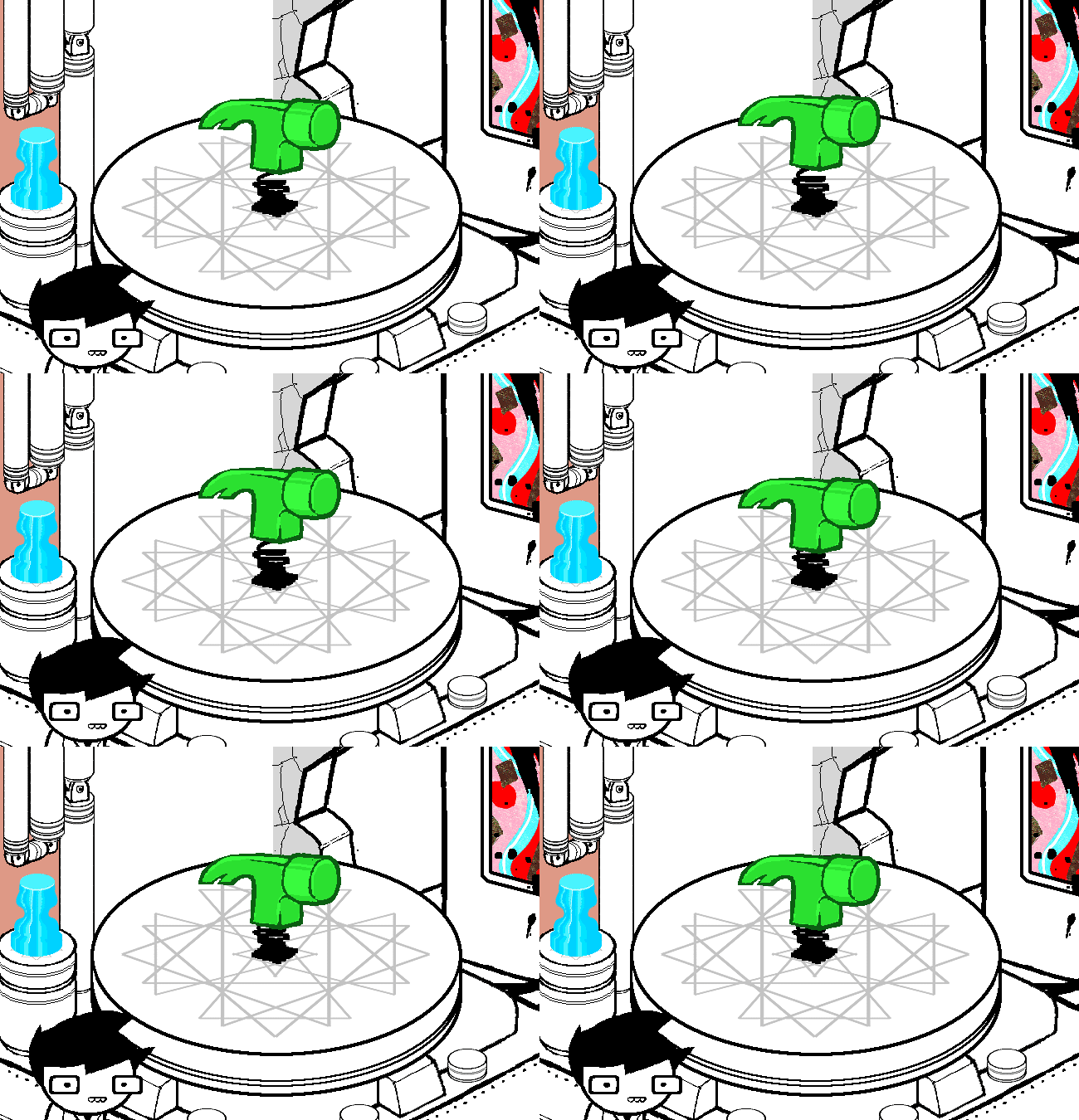
First off, John tries alchemizing “pogo || hammer” instead of “pogo && hammer” and makes a hammer-shaped pogo ride. This is a clever integration of computer science technicalities to make alchemy work in Homestuck without inevitably running into captcha cards with too many or too few holes. Here’s the book commentary on this page:

You people don’t even know what the && and || operators mean, do you? Why don’t you learn computers you dorks! Although to be fair, technically the single & and | bitwise operators are what perform the described functions. So now who’s the dork. Me. I went with the logical operators (&&,||) instead because they are more recognizable and frequently used from a pure coding perspective. So it’s this weird case where I dumbed it down for the sake of people who ACTUALLY KNOW HOW TO PROGRAM. Good grief.

I like this commentary because it shows how much care Hussie put into balancing technical accuracy and general accessibility when writing Homestuck’s early acts. The mix of accuracy and accessibility sets Homestuck apart from Problem Sleuth, a story based fully upon technical accuracy (to its own set of rules, that is).

Continue reading