ESC250 2025: My predictions and analysis of the results

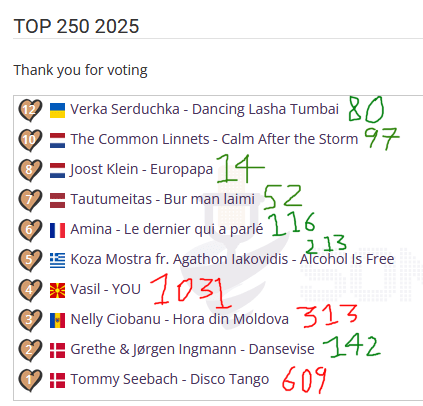
Happy new year, everyone! It’s still 2025 in Ohio as I’m writing this post, but not for much longer. I’ve decided to send off my blogging about Eurovision (for now) with something fun: an analysis of the results of the annual fan vote ESC250, specifically those for the entries of Basel 2025. The results were streamed on a French radio station on December 31, then once the stream ended the full results were published. Here are my votes with the position each song ended up in:

Here are my predictions of how high each entry would score:

Continue reading

Eurovision Side Post: Changes to My List of Winners (end of 2025 edition)

To any Eurofans reading my blog: this will be my second last Eurovision-related blog post for the time being. My last will be an analysis of the ESC250 2025 results on New Year’s Day, since I made a list of predictions of where each 2025 entry will land in the ESC250 and want to see how right I was. After that, I probably won’t blog about Eurovision (not even about past contests) until the 2026 contest happens. I’m not sure yet if I will review Eurovision 2026 or not; I’ll see how I feel in May.

Anyway, it’s time for some updates to my list of winners of each Eurovision year! My latest version of the winners list was on my 1974 re-review. Most of these updates I was gonna save for my re-reviews of each year, but I’ve decided to put those posts on hiatus.

In my 1975 round 2 review, I was going to surprise you guys by changing my winner to Turkey, Seninle Bir Dakika. I did start writing that post and here’s a snippet of what I said about my old winner, “Ding-a-Dong”: Now, I’m afraid, I’ve gotten a little tired of this song. Don’t get me wrong, I still like it, but I’ve overdosed on it so much that it doesn’t have quite the magic it used to. I’ve even had to demote it all the way from a 10/10 to an 8. Still, I think this song was absolutely the right winner this year, because it leaves a stellar first impression and that’s exactly what’s needed to do well in Eurovision. Turkey’s entry, on the other hand? Now that has massively grown on me and I curse the juries for giving it last place. That’s not how you treat a Eurovision newcomer! This song is a truly gorgeous minor key ballad whose singer gives an emotional, passionate performance.

Next up is another retcon to Turkey, and it has to do with my 8-bit cover project on YouTube (which I am still doing). When searching for entries from 1985 to cover, I realized that “Didai Didai Dai” would be absolutely perfect for an 8-bit cover, since it’s got a really nice funky beat that reminds me of Mario music. Soon after, I decided my winner of the year would be “La det swinge” no longer, but Turkey, Didai Didai Dai. It helps that MFÖ are such likable performers!

Speaking of MFÖ, my winner of 1988 is now Turkey, Sufi. For 1988 it was a real challenge picking a song to 8-bit cover, because I really don’t like most entries that year. But then I stumbled upon the studio version of “Sufi”, and what a banger it is! It’s much better than the orchestra version and once again has a cool funky 80’s beat. Now I can say that 1988 at least has one song worth listening to. Sorry, Lara Fabian!

And speaking of my 8-bit covers, I’ve changed my winner of 1992 to Finland, Yamma Yamma. Hey, don’t look at me funny—the song is catchy as hell! By Eurovision 1992 standards it’s a total banger. Not to say it’s the most amazing song in the world, but since 1992 is a notoriously weak year, I’d say it did not deserve last place.

My new winner of 1997 might surprise you. It was originally “Dinle”, then I temporarily changed it to “Sentiments songes” (whose singer Fanny Biascamano died of cancer a few days ago, 46 is much too young to die), and now I’m giving the honor to Poland, Ale jestem. It’s a song that took quite a while to grow on me, but now I utterly love the fuck out of it. It’s a mind-blowing composition that throws so many cool melodies and instruments all in the course of three minutes and is in close contention with “River” from 2022 with the best Polish entry.

And finally, let’s skip ahead to 2025. I know I had retconned my winner to “Bara bada bastu” not long ago, but now I’m changing it to what I should’ve chosen the whole time: Latvia, Bur man laimi. I’ll never forget how much the song knocked my socks off the first time I heard it, which was when I watched the Supernova semifinal, and I love it just as much today. It’s hard to think of a Eurovision song more “me” than this one. In a Discord server I asked people for fun which Eurovision entries they associate with me, and this was an answer that one person gave. Other answers I got included “Europapa”, “Alcohol Is Free”, “Funny Girl”, and “The Moon Is Rising”—the last of them because I frequently mention how much I hate it.

EDIT: Wait, I missed one. I’ll change my 1980 winner from “What’s Another Year” to Morocco, Bitaqat Hub because it’s such an awesome and unique Middle Eastern song. I also love that the lyrics are an earnest message about peace, in a way that doesn’t feel clichéd.

Alright guys, here’s my updated winner list:

  • Belgium, 3 (1957, 1976, 2003)
  • Bosnia and Herzegovina, 2 (2001, 2006)
  • Denmark, 2 (1963, 2000)
  • Finland, 6 (1974, 1983, 1989, 1992, 2010, 2023)
  • France, 3 (1977, 1990, 1991)
  • Germany, 5 (1956, 1968, 1979, 1982, 1999)
  • Greece, 1 (2013)
  • Hungary, 2 (2005, 2019)
  • Ireland, 2 (1970, 1994)
  • Israel, 1 (1987)
  • Italy, 1 (1964)
  • Latvia, 3 (2002, 2018, 2025)
  • Lithuania, 1 (2022)
  • Luxembourg, 3 (1965, 1972, 1973)
  • Moldova, 1 (2009)
  • Monaco, 1 (1960)
  • Morocco, 1 (1980)
  • Montenegro, 1 (2015)
  • Netherlands, 7 (1959, 1967, 1969, 1971, 1998, 2014, 2024)
  • North Macedonia, 1 (2020)
  • Norway, 3 (1966, 1993, 1995)
  • Poland, 1 (1997)
  • Portugal, 2 (1984, 2017)
  • Serbia, 4 (2004, 2008, 2011, 2012)
  • Sweden, 2 (1958, 1996)
  • Switzerland, 2 (1986, 2021)
  • Turkey, 4 (1975, 1978, 1985, 1988)
  • Ukraine, 2 (2007, 2016)
  • United Kingdom, 3 (1961, 1962, 1981)
  • (18 winners; hoping my math is right!)

See you again on January 1! And remember, people: Fuck the EBU.

Iceland is skipping Eurovision 2026; here are my thoughts

Today, Iceland became the fifth country to quit Eurovision 2026 over Israel’s participation. They were on the fence about it for a few days, but now they’ve made their choice, helped no doubt by all the protesters outside the RÚV headquarters. There was just no way the Icelandic public would want their country participating in Eurovision during these circumstances.

And that’s actually so fucking sad. I mean, I’ll give a heartfelt takk to RÚV for doing the right thing, but it’s sad that it had to come down to this. All the countries that love Eurovision the most are leaving. The Netherlands and Spain both have massive Eurovision fanbases, and while I don’t know much about how popular the contest is in Slovenia, I do know the country has a knack for sending fan favorites even if they don’t score well on the night, and that a lot of the country’s best-known musicians took part in the contest. I know from my trips to Malmö and Basel that the Irish are absolutely obsessed with Eurovision, and I can tell the Icelanders are just as obsessed if not more. Most of Iceland’s recent entries have been great, interesting songs, even some I wasn’t too kind to in my blog posts. “Með hækkandi sól” from 2022 has massively grown on me the past few months, and even the fan unfavorite “Scared of Heights” from 2024 is growing on me because a friend of mine frequently mentions how much he loves it (hi if you’re reading this!).

Iceland is the country many fans believe would’ve won in 2020, and even the country where much of the Eurovision movie was filmed. Till this point, they had never missed a Eurovision year except in 1998 and 2002, which was just due to the relegation system. The fact that a country that loves Eurovision this much is leaving the contest is not fucking normal. It proves that the EBU has made a shamefully wrong decision. Why is the EBU doing this? Why the FUCK is the EBU doing this??? WHAT THE FUCK DO THEY HAVE TO LOSE BY JUST BANNING ISRAEL ALREADY LIKE THEY DID WITH RUSSIA? Answer: they have nothing to lose and everything to gain. But nooooo, they want to do everything the hard way. I don’t fucking understand why they prioritize keeping Israel in over four, now five other countries.

I mean come on, even Eurovision legend Johnny Logan thinks Israel should be banned from the contest, because he’s actually a sensible person unlike those fuckhead idiots at the EBU. Noa, one of the singers of “There Must Be Another Way” from 2009, also believes her country should skip the next contest in solidarity with all the suffering civilians. That’s exactly what I wanted Israel to do since late 2023. That’s exactly what they should’ve done and Eurovision would’ve never been constantly on the brink of disaster. No one would have thought the worse of Kan if they decided to just read the fucking room!

Maybe there’s no point in me ranting about this, since I’m sure plenty of other people are doing the same. But as someone who became a massive Eurofan since 2023 and made a lot of great friendships thanks to the contest, I need to get these thoughts off my chest. The EBU can’t just fucking spam the phrase “United by Music” everywhere and pretend everything’s OK. It was a great slogan at first but now the EBU just uses it to rationalize their shitty, cowardly decisions.

I genuinely did not think it would be possible for any Eurovision year to be a greater trainwreck than 2024. I was wrong. Eurovision 2026 is still five months away and it’s already turned into a worse shitshow. The next contest is going to be an absolute fucking disaster and then the EBU will either have to REALLY change things or face even more countries dropping out. Will future Eurovision contests recover from this? I don’t fucking know. The best thing I can hope for is that Eurovision 2026 is just an ultra-dark spot in the contest’s history and the EBU will then have no choice but to get their shit together. But I don’t know how on earth the contest can regain the trust of fans after all these blunders. We’ll just have to see what happens.

Fuck the EBU. Fuck the EBU. Fuck the EBU. Fuck the EBU. I can’t say it enough times. Fuck the EBU.

My thoughts on the EBU’s decision on Israel participating in Eurovision 2026

Fuck the EBU. Fuck the EBU. Fuck the EBU. Fuck the EBU. Fuck the EBU. Just imagine me repeatedly saying that a hundred times. Or more, if you like.

Today, the European Broadcasting Union made the immoral decision to allow Israel to participate in Eurovision 2026, even though that country is still bombing the shit out of Gaza, even though they manipulated the televote with some help from their government in both the past two contests, and even though four broadcasters (RTVE from Spain, AVROTROS from the Netherlands, RTÉ from Ireland, RTVSLO from Slovenia) said they would withdraw from the contest if Israel is allowed in. And these four countries did indeed quit the contest for 2026.

Muchas gracias, RTVE. Dank je wel, AVROTROS. Thank you and go raibh maith agat to RTÉ. And najlepša hvala to RTVSLO for being the first broadcaster to threaten to withdraw. You guys have so much more spine and integrity than the EBU. Fuck the EBU, by the way. Fuck the EBU. Israel’s broadcaster Kan are incredibly fucking selfish as well, to insist on participating in the contest despite how much of a shitshow it would be for everyone else.

I’m at a loss about this decision. It is so obviously wrong on so many levels to do this, and I am pissed off and disgusted at the EBU for doing this. Even if I had a full-time job that could pay for it, I will not go to Eurovision 2026. Not just because the EBU made an immoral decision, but also because I believe there will be a huge amount of protests against Israel participating in 2026, and I would not feel safe being surrounded by so many. I don’t think there will be quite as many protests as there were in Malmö 2024, since Malmö is such a Muslim-heavy city, but there will be a lot nonetheless. I felt very unsafe surrounded by all those protests when I went to Malmö and I’d much rather not go through a repeat of that in Vienna 2026. There would simply be no way to ignore the elephant in the room if I go to the next contest. I have no idea yet if I will even watch the show at all. Maybe I’ll just watch the songs and rank them on my own, and not engage with the Israeli entry at all.

Honestly I’m starting to question why I even went to the contest in 2024, when I knew ever since October 2023, when the war in Gaza began, that Israel participating would turn it into a massive shitshow. I don’t regret going there—I’m glad I got to see all the entries from that contest live (semifinal 1 in a rehearsal, semifinal 2 the live show), and I’m glad I got to meet and make a handful of friends there, except for one person I spent most of the trip with who was a complete asshole to me. I’m similarly glad I went to Eurovision 2025, which was a much happier experience for me, despite the show ending on an extremely sour note where the country that should’ve been banned almost won.

The EBU has such a fucking obvious double standard it’s unreal. Back in 2022, they were quick to ban Russia when only two broadcasters (ERR and Yle) outright said they would not participate if Russia is allowed in. To be fair, there were more that made it clear they felt Russia should not be allowed in, but still, the EBU has a big double standard and is willing to bend backwards to keep Israel participating even if it causes four other countries to leave the contest, probably because they’re scared that if they don’t do that they’ll be called antisemitic.

I’ll say it a few more times: Fuck the EBU. Fuck the EBU. Fuck the EBU. Fuck the EBU. Fuck the EBU. Fuck the EBU. Fuck the EBU. Fuck the EBU. Fuck the EBU.

Fuck the EBU.

Cookie Fonster Plows Once Again Through Eurovision 1974: The Year Hosted in My Birthplace

Intro Post

< 1973 Review | 1974 Review | 1975 Review >


Introduction

Yes, I was actually born in Brighton, England, which is where Eurovision 1974 (the year of my dad’s birth) took place. But I do not consider myself British at all. My parents just happened to be spending a year abroad in England and returned to the United States when I was three months old, and I haven’t been back to the UK since.

Luxembourg had hosted and won Eurovision 1973, but unsurprisingly for such a small country, they refused to host Eurovision twice in a row. Spain who came second place also declined to host, so the EBU asked the ever-eager BBC to hold their horses as they looked for other countries who could do it. Israel’s IBA offered to do it, as did the BBC’s rival broadcaster ITV, but the IBA lagged behind many European broadcasters in technology, and ITV participating meant the BBC wouldn’t be able to. So the BBC bidded to host after all, and after getting the offer they chose to put on the show in the Brighton Dome. The arena normally had 2100 seats, but half of them had to be temporarily removed to make way for commentator booths and other equipment, which means this is another show with a rather small audience.

As with the previous contest, 17 countries took part this year, but we have a little swap-out. Greece made their debut whereas France dropped out because of their president Georges Pompidou’s sudden death. This year has a mythic place in Eurovision lore because it has a lot of songs that tie in with real-world events in some way, not to mention two very big names: Olivia Newton-John representing the UK, and the winners, ABBA from Sweden. But what I’m interested in is, do the songs this year hold up? We’re about to find out together.

Before I dive into the songs, there are some clever details in this year’s production I’d like to point out. For one thing, I like that the producers picked one good-looking font and used it throughout the show. The font is called Optima Bold and looks remarkably timeless. It fits well in a 1970’s show and wouldn’t be out of place in something produced in 2025 either. The logo for this year’s contest is also timeless and cleverly designed: a bird holding a microphone circled by the text “EUROVISION SONG CONTEST 1974”. The postcards are fabulous too: first they show a bit of the participating country, then footage from the contestant’s rehearsal, and finally them having a good time exploring Brighton. They cram a lot of material into 40-ish seconds and do it really well.

Did I forget anything? Oh right… Katie Boyle hosted this contest, making it her fourth and final time presenting Eurovision. She still holds the record for most times having hosted Eurovision; the only other people who have hosted multiple contests are Jacqueline Joubert (1959, 1961) and Petra Mede (2013, 2016, 2024). Unfortunately, this time around Katie looks like she’s afraid something disastrous will happen throughout the show. If you read up a little bit on this contest, you’ll know why that is: it’s because she wasn’t wearing underwear beneath her dress. I watched the show with British commentary done by David Vine.

And one more thing: the voting system got reverted to “each jury has 10 members who can give a point to one song each” for one last time. Surprisingly, no country scored zero points this year. Instead, four countries tied for last place with three points each: Norway, Germany, Switzerland, and Portugal.

Continue reading

Cookie Fonster Recounts Eurovision 1973 Again: The Year Where Fans Fixed the Audio

Intro Post

< 1972 Review | 1973 Review | 1974 Review >


Introduction

Vicky Leandros’ victory brought Eurovision to Luxembourg for the third of four times. This time, the show took place in the Grand Théâtre de Luxembourg, which has 943 seats in the main theatre and 400 in the studio. That is a tiny audience by modern standards, the kind you might see in a smaller country’s national final. I think this gives the show an intimate feel, compared to those with grandiose arenas such as 1968 in the Royal Albert Hall. This intimate feel is further helped by the orchestra surrounding the performers in a circle, which I think looks just plain awesome. Unfortunately the show has no postcards this year. We only get a picture of each singer taken during a rehearsal with their name on the bottom to introduce each song, and they often have unflattering expressions.

Eurovision 1973 is a year of many firsts. It was the first year to have at least one female conductor (for Sweden and Israel), the first that explicitly let countries sing in any language they wanted, the first where at least one song used a backing track (“Power to All Our Friends” from the UK), and the first year where Israel participated. Austria and Malta from last year skipped this contest, meaning it had a total of 17 participating countries. Because this was Israel’s first time participating and came just a year after the horrific Munich massacre, the contest had extreme security measures in place, especially for the Israeli delegation. According to Swedish conductor Monica Dominique, two men with machine guns guarded both sides of the stage throughout the television broadcast.

The intro to the show is pretty simple: an opening film with little clips of the contestants set to an orchestration of “Après toi”, a glimpse at Vicky and Leo Leandros in the audience, then the presenter Helga Guitton introducing the show in French and English with a pinch of German and a few words in Luxembourgish. I watched the show with German commentary uploaded to YouTube just a few weeks ago, but I made sure to check out the versions of each song with strings created by awuga. The orchestra had major sound issues this year which caused the strings to be mostly inaudible on TV, although when I first watched the year I just thought the orchestra was brassier than usual.

The top three of this year are all quite iconic: Cliff Richard with “Power to All My Friends” at third place, a very famous Spanish song called “Eres tú” at second, and the winner was Luxembourg with “Tu te reconnaîtras”—the second of five times the host country won.

Continue reading

Cookie Fonster Relistens to Eurovision 1972: Vicky Gets Her Revenge

Intro Post

< 1971 Review | 1972 Review | 1973 Review >

Sorry this post took so long! I got sidetracked by other projects, that’s all. It’s quite exciting to see Romania and Bulgaria return after multi-year breaks to Eurovision 2026—let’s hope they send honest efforts and not flops. But I’m still very much worried about the elephant in the room that is Israel’s participation. I still firmly believe that country should be banned from 2026. It’s pretty clear that the EBU is trying to procrastinate dealing with this issue as long as possible. We’ll see what happens, I suppose. I don’t see any of the countries that said they would boycott the contest if Israel participates backing down from this position, especially not the Netherlands who are a huge financial contributor, because AVROTROS has been more stubborn than any other broadcaster regarding Eurovision ever since the Joost Klein incident, and for very good reason.

Unfortunately I probably won’t go to Vienna for Eurovision 2026, unless maybe I get a high-paying job very soon and get lucky regarding vacation days. Even then, it would be much wiser to save up money for later trips. I need a new job very badly, but even if I do have one I might need to watch next Eurovision from home.


Introduction

After having won Eurovision 1971, the tiny country of Monaco originally wanted to host the next Eurovision contest, but the country had no concert hall or TV studio big enough to host the show. The second and third place countries, Spain and Germany, both declined to host, so the BBC stepped in and offered to stage the event in either Blackpool or Edinburgh. In the end, Edinburgh had the honor of hosting the event, making this the first Eurovision in Scotland, and the only Eurovision hosted in a part of the UK other than England. The show took place in the Usher Hall, which has a modest 2200 seats. You won’t hear much of a Scottish accent from the presenter, Moira Shearer—her accent is total Received Pronunciation (RP), just as much as our good pal Katie Boyle.

This year had the same 18 participating countries as 1971, and the same 1-5 star voting system as well. The winner was Luxembourg with the iconic song “Après toi”, the UK scored yet another second place, and Germany scored a third place two years in a row although they still had yet to win. In last place came Malta for two years in a row, which led them to skip the next two years.

Last time I watched the contest with German commentary, but this time with British commentary done by Tom Fleming. He begins the show narrating the history of Scotland as though he’s a movie narrator. The orchestra plays an arrangement of “Un banc, un arbre, une rue” in homage to Monaco as the camera pans down to the audience, all dressed in fancy suits but with a little splash of color. Then Moira Shearer enters this year’s glamorous stage and gives the usual efficient British-style introduction to the show in English and French. Sadly the show doesn’t have postcards this year, but it does have cute little photos of each competing artist on the big screen before each song begins.

Continue reading

Progress on updating my Homestuck posts, continued

The latest shitstorm of drama involving Andrew Hussie (not gonna go into it here) has made me realize, I still need to fix a bunch of shit in my old Homestuck posts and these articles aren’t going to fix themselves. So I will continue from this earlier post and write a progress log, mostly just for myself.

By the way, Andrew Hussie is a complete and utter asshole. I knew this already, since 2020 if not earlier, but it still shocks me how much of a dick he is to fans. Especially the ones who made it possible to read his comic after the website fucking broke!

Changelog:

  • August 12, 2025: Updated the images for posts 34 to 36. I’m making progress, people.
  • August 13, 2025: Updated posts 37 to 38. I should say the pesterlog in part 37 where Tavros reveals he killed Jade’s grandpa is one of my favorite scenes in Homestuck because it’s peak cringe comedy and Jade handles the whole thing like a champ. Especially the part where Tavros starts fucking hitting on her. Now with all that said, developing feelings for someone you met online after just a day is a real thing that happens. That doesn’t make Tavros’s confession any less embarrassing.
  • August 14, 2025: Updated posts 39 to 40. “The Miracle of a New Beginning” is such a banger post title.
  • August 15, 2025: Updated posts 41 to 43. Karkat imagining Jade’s selfcest is just the most Karkat thing, isn’t it?
  • August 16, 2025: Updated post 44. Fuck, it’s annoying to have to keep fixing the GIFs.
  • August 18, 2025: Updated posts 45 to 46. In part 45 (released a few days before Act 7) you can see me holding out hope for the final update being something it simply wasn’t. Since then, I’ve come around on Act 7. And part 46 is a tipping point for my blog, I feel. My analysis of John and Vriska’s conversation was more intensive and earnest than any till this point. I was quite self aware with the line, “I’ll probably look back on THESE posts and think they could’ve been a lot better, but for now, as far as I’m concerned they are supreme masterpieces that I am totally in love with.”
  • August 20, 2025: Updated posts 47 to 48. Holy shit, this is tedious.
  • August 22, 2025: Updated posts 49 to 50. “Hey, didn’t this comic have something to do with a clown killing people? I really can’t remember with all of John’s gushing about Liv Tyler and how gorgeous she is.” is a banger quote.
  • September 5, 2025: Updated posts 51 to 53. Now I’ve begun with the Doc Scratch intermission, my favorite part of Homestuck! Some long-ass posts where I need to fix the images coming right up.
  • September 7, 2025: Updated posts 54 to 55. These are some of my best Homestuck posts before the two-year hiatus, even though I wrote them when I was 17.
  • September 8, 2025: Updated posts 56 to 58. Doc Scratch’s ancestor exposition (in part 58) is one of my favorite parts of Homestuck to reread, whereas Mindfang’s exposition is one of my least favorite parts to reread.
  • September 9, 2025: Updated post 59, the Cascade post. That was a real pain in the ass, but hey, I got to rewatch Cascade for fun. I didn’t need to screenshot the flash all over again, I just once more used the readmspa.org storyboard.
  • September 15, 2025: Updated posts 60 to 61. Fuck, Act 6 Act 1 is fucking boring and I wrote the most pointless walls of text about it. You know how Caliborn insists Dirk is the only good alpha kid? I’m sort of that way with Roxy now. She’s fucking awesome.

Cookie Fonster Picks Apart Eurovision 1971 Again: A Duet That Slowly Won Me Over

Intro Post

< 1970 Review | 1971 Review | 1972 Review >

Introduction

There are some Eurovision years I’m passionate about and am looking forward to reviewing again. But before I reach them, I need to get through some of the contest’s dullest years, such as Eurovision 1971. I remember it not being a terrible year, just one with no songs I’m passionate about. This year was the first of seven to be hosted in Ireland; it took place at the Gaitey Theatre and was hosted by Bernadette Ní Ghallchóir. This production was a huge undertaking for RTÉ at the time, but the Irish have always known how to put on a good Eurovision show.

All the countries that skipped 1969 or 1970—Austria, Finland, Norway, Portugal, and Sweden—returned this year, and the island country of Malta made their debut, though they weren’t successful in their first few years. This made for a total of 18 participating countries. The winner was Monaco for the first and only time, then in second place came Spain and Germany in third. The newcomer Malta landed at the bottom both this year and the next year, which discouraged them from further participation for the next two decades.

I’ll paste my description of the voting system from round 1: This contest completely redid the voting system, presumably to appease the countries that were mad about the four-way tie two years ago. This time, every country had a pair of jury members (older and younger than 25 years respectively), who each gave songs 1 to 5 points, and the points were all added up so that every country got no less than 34 points. I think that’s a cumbersome system with the obvious hole that a country could vote others low so that they’d comparatively score higher, but somehow it was in place for three years in a row. Plus, rating anything numerically is dumb because number ratings mean different things to different people. I’m also not a fan of this voting system because it means far fewer juries decide how many points each song gets, but I get why it was done: to make the voting more transparent and assuage the unhappy countries. It was temporary anyway.

The show opens with an opening film of a man riding a horse-drawn carriage through the streets of Ireland and welcoming the guests to the Gaitey Theatre. It’s a tiny venue with a capacity of only 1145 seats, which I suppose was the best Ireland had at the time. Then the presenter introduces the show in Irish, French, and English, and the songs kick off. I love the pattern of the hosts introducing the show in Irish each time the show came to Ireland, and I hope it continues should Ireland win again. When speaking English, Bernadette sounded like she was trying to hide her Irish accent, but it slipped through a fair amount anyway. This year had postcards similar to last year: once more tours of each participating country. This time, the producers didn’t cheat and film four different postcards in Paris.

Last time I said I watched the contest with Austrian commentary, but it seems in retrospect it was a mix of Austrian and German. The YouTube upload I used this time is listed as having entirely German commentary, and I’ll trust that.

Continue reading

Cookie Fonster Dives Back into Eurovision 1970: The Year with Female Terry Wogan

Intro Post

< 1969 Review | 1970 Review | 1971 Review >


Introduction

After Lenny Kuhr won Eurovision 1969 in a completely deserved landslide, her home country of the Netherlands hosted Eurovision 1970 in its capital city of Amsterdam… wait, why are there only twelve countries? Were some of them mad about something that happened last Eurovision? Oh right, there were four winners that year due to a tie, and several countries were so pissed about the result that they dropped out of the next contest. Norway, Sweden, and Finland up north all dropped out, Austria had originally planned to return in 1970 but joined the Nordic boycott, and Portugal skipped too but still organized Festival da Canção that year. Clearly the Portuguese just loved that annual festival too much.

Out of the four winners of 1969, one of them had to be chosen to host the show. Spain and the UK, as the hosts of the last two years, were out of the running, so a random draw was held between France and the Netherlands. This meant that the Dutch broadcaster NOS put on the show this year, which conveniently matches my headcanon that Lenny Kuhr is the rightful winner of 1969.

The opening film starts with a series of graphics captions with text welcoming the audience to Eurovision 1970 in Dutch, English, and French. It’s set to some eccentric dissonant music, which I feel is more of what the 1969 interval act should have been, because it’s weird and surreal but still sounds like music, then stops being dissonant as it progresses. We get a view out of a plane, some exploration of canals and cyclists and all that fun Dutch stuff. I have a soft spot for those old touristy opening films, they just make me feel good.

After the opening act concludes, the presenter Willy Dobbe gives an introduction so absurdly short (just saying “welcome to Eurovision 1970 in Amsterdam” in French, English, and Dutch) that it almost feels a little rude, but maybe that’s just my perception. Immediately after her introduction begins, we get the postcard for the first entry. Since this contest had only 12 countries participating, to fill the time we get little opening films called postcards to introduce each singer. Eurovision in the 1970’s and early 80’s would feature postcards on and off, then every year from 1984 onwards used those things in many different formats. I love Eurovision postcards and even once did a blog post ranking them all up to 2024.

I always thought this contest was only archived with Irish commentary, but the Dutch commentary is on YouTube as well. I’m still watching with Irish commentary though, because I remember the RTÉ commentator Valerie McGovern being absolutely hilarious, and because I don’t speak Dutch. She is the “female Terry Wogan” referred to in this post’s title. It’s a shame this is the only year she ever commentated Eurovision, but she was lucky to have commentated when her country won. While 1968 and 1969 are fully available in color, the archived broadcast of this year has a few sections in grayscale. I wonder if the majority of this broadcast being in color would make the grayscale portions easier to colorize?

Oh yeah, this year is the first of seven times Ireland won Eurovision. They won with 32 points, the UK came second with 26, and Germany third with 12 points—all three were women singing cutesy upbeat songs. There was one zero-pointer, Luxembourg with a song I remember nothing about.


Continue reading