
Cookie Fonster Makes Sense of Eurovision 2025 (Final): My New Favorite Year

Intro Post

< 2025 Semifinals | 2025 Final

Almost two weeks after the grand final, and my review of Eurovision 2025 is finished! Warning: it’s long as hell.


Introduction

My new favorite year, you say? Yes, indeed so. The song lineup of Eurovision 2025 is nothing short of spectacular: out of 37 songs, there are ten that I’ve given a 9/10 or higher, 17 that I’ve scored an eight or higher, and 23 that are at least a seven. Only eight songs this year are below a five (songs I neither like nor dislike). As is usual in Eurovision, most but not all of the right songs qualified, and thankfully the Big Five and host all sent honest efforts, which makes this an exceptionally good grand final. The one problem: the results of the grand final absloutely fucking sucked.

I usually list the top three in the intro of my Eurovision final posts, but this time it’ll make me feel better to list the top five. The fifth place was predictable enough: Italy with yet another male ballad, but it was more likable than their usual ballads for reasons I’ll discuss later. Now in fourth place came the song I wanted to win: “Bara bada bastu” by KAJ, the first Swedish Eurovision entry to actually be sung in Swedish since 1998. Fourth place would normally be a good result, but it’s a cruel joke when you look at the actual top three.

The third place is incomprehensible to me: a joke entry from Estonia with as little musical merit as “Irelande Douze Pointe” or “Flying the Flag (for You)”. Israel sent a sequel to last year’s “Hurricane” and ran another massive ad campaign, which got them a terrifyingly close second place and even a televote win. I will rant about them exploiting Eurovision soon enough. And as for the winner, the juries think that opera vocals automatically make a song good, so they boosted “Wasted Love” of all fucking songs to the top and gave Austria their third victory. That song winning was a nightmare scenario for me already, but the other top three made for a worse nightmare than I could possibly conceive of.

Now the good news is, aside from the top three, almost every entry in the grand final has something to like about it. In fact, there are so goddamn many songs worth swooning over, I’m not prepared and neither are you. And plus, I am absolutely over the moon about my country’s entry: Germany finally sent a song in German for the first time since 2007, and a great one at that! That might end up being the longest review in the post, but we’ll see soon enough.

And now to discuss the opening of the show, which I watched live in the St. Jakob-Park football stadium for a public viewing, seated next to my mom and her friend. My mother only joined me for Eurovision on the day of the final, just so you know. The show begins with a hilarious video skit where the three presenters realize the trophy hasn’t arrived yet and debate over what to do. As the most comedic of the hosts, Hazel offers to make a trophy from her water bottle and aluminum foil, then drops it and says “at least it doesn’t break”. I love this little jab at Nemo breaking the Eurovision trophy last year so much. Then the trophy goes on an epic journey to the Eurovision stage, soon to be delivered by Nemo themself in the hopes it doesn’t get broken. The entire opening film is humorous, yet it amazes me with the production at the same time.

The opening act is your usual abridged rehash of “The Code” (sure, why not). Then comes the flag parade, set to a medley of dancey Swiss hits and some kickass percussionists. Everyone in the parade is carrying just one or two big flags, but they’re all having fun doing it and many of their personalities shine through. The goofy brothers from Iceland, proud and confident Erika from Finland, the classy guitarists from Italy, modest Zoë from Switzerland, it goes on. And finally enter not two, but three hosts: Hazel Brugger and Sandra Studer from the semifinals, now joined by Michelle Hunziker. No Swiss-hosted contest is complete without a quick introduction in all of Switzerland’s languages, so the hosts do that and then present us the second audience in the football stadium.

For this blog post, I watched the grand final with German commentary done by Thorsten Schorn. My German grandma said she found the commentary on the grand final hilarious, so let’s hope she’s right!

Continue reading
Cookie Fonster Makes Sense of Eurovision 2025 (Semifinals): Calm After the (Shit)storm

Intro Post

< 2024 Final | 2025 Semifinals | 2025 Final >

I started this post at my German grandma’s house on May 18, wrote parts of it at various airports and on flights, then finished it back at home! I hope you enjoy it, and you better get hyped for my grand final review.


Introduction

The time of year has come and passed, and Eurovision 2025 has just ended! I was originally going to wait a few weeks to write my review, but the contest had so many results that pissed me off, I decided I need to get my thoughts off my chest as soon as possible. Now the reason the results piss me off is because this year had an absolutely stellar lineup of songs, but not a single one of the top three actually deserved to be there. Two of them are songs I actively dislike, and one I find listenable enough but came from that country—you know, the one that gets a disproportionate amount of votes from their ad campaigns—at the expense of far better songs. But I’ll get into more detail in the grand final post.

Eurovision 2025 was the third edition of the contest hosted in Switzerland, after Lugano 1956 (the first contest) and Lausanne 1989. Four Swiss cities bidded to host (yes, technically the past tense is supposed to be “bid”, I don’t care), and those were Basel, Bern, Geneva, and Zurich. On August 30, 2024, the host city was chosen as Basel (first time in the German-speaking part of Switzerland) and the venue as the St. Jakobshalle: an arena with 8000 seats, and a full capacity of 12,400 when you include the standing audience. I was in this exact arena during semifinal 2, and I have quite a lot of stories from the trip to tell in this and the next blog post. But the main focus of these posts is the songs, not the trip. I will soon start making a YouTube video about my trip to Basel, and it’ll probably be 30 minutes to an hour long. For now, just know I had a fabulous time and the trip completely surpassed Malmö 2024 for me.

The semifinals were presented by a duo of women like last year. As the show points out, we yet again have a brown-haired Eurovision veteran and a younger blonde-haired Eurovision newbie. The veteran is Sandra Studer, who competed for Switzerland in 1991 scoring fifth place and provided commentary in Swiss German most years from 1997 to 2006. The newbie is Hazel Brugger, a TV host and comedian known for her dry wit. A third host, Michelle Hunziker, would join them in the final.

This is the third contest in a row with 37 competing countries. It was supposed to be 38 at first, but that number seems to be cursed. Montenegro returned after last competing in 2022 (and before that, 2019), only to get a dead last place. Moldova was originally going to compete too and even organized a national final to be held on February 22, but on January 22, they dropped out of the contest and canceled the selection, because of the heavy criticism of the entries chosen. A real bummer, because they had had perfect attendance since 2005 and would normally bring something fun to Eurovision.

So in terms of drama, how did the contest compare to last year? It went pretty well actually! I didn’t hear of any feuds between delegations or contestants during the show; it seems like they all got along and everyone was on their best behavior, including the Israeli delegation. In addition, I could tell that Israeli fans felt much safer in Basel than they did in Malmö. Not until the results did anything resembling a shitstorm erupt, but that’s a matter for my grand final review. One other difference from last year is a change to the qualifier reveals sequence: for all reveals but the last, the countries are narrowed down to three before we find out who qualified. I’ll discuss my thoughts on this change later in the post.

Since the German entry this year is a song I properly love, and better yet, a song that’s actually sung in German, I’ve decided to watch all three shows with German commentary. ARD hired last year’s German commentator for the show, Thorsten Schorn. I can tell he’s gradually finding his footing as a commentator and developing his own style that’s a little different from Peter Urban, more actively humorous. I have 11 non-qualifiers to get through in this post. Most of the NQ’s are understandable enough, but one was a major fan favorite that had zero reason not to qualify.

Continue reading

Cookie Fonster Reviews Every MLP Episode Part 83: Not Asking for Trouble + Discordant Harmony

Introduction / Navigation

< Part 82 | Part 83 | Part 84 >

Season 7, Episodes 11-12

Whew, I finished this post the day before I leave for Eurovision 2025! And after I come home, I’ll be preoccupied making a video about the trip, then a pair of blog posts reviewing the contest. I’ll review the non-qualifiers in the first post and the finalists in the second, as per usual.


Season 7 Episode 11: Not Asking for Trouble

In five words: Yaks are being needlessly stubborn.

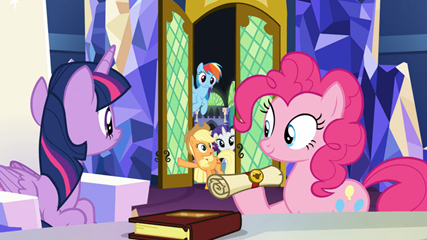
Premise: The yaks have returned! Pinkie Pie is sent on a mission to Yakyakistan which gets buried amidst an avalanche, but the yaks refuse to accept external help to solve this mess.

Detailed run-through:

To begin this episode, Pinkie Pie sprints across Ponyville screaming “oh my gosh” over and over, because Prince Rutherford, the leader of the yaks, invited her to an event called Yikslurbertfest (inspired by Oktoberfest?) in Yakyakistan. Rarity asks what in the world Yikslurbertfest is, and Twilight Sparkle apparently knows it’s a sacred yak holiday. I’m a bit surprised Twilight knows it, but also can see why: she probably read it in the pony equivalent of a Wikipedia spiral, which I guess is a regular encyclopedia spiral.

Pinkie Pie claims she subtly hinted to the yaks that she wanted to attend this event, which means she sent a huge amount of letters begging for her to go. Twilight Sparkle officially declares Pinkie Pie the friendship ambassador to the yaks, and then Pinkie sets out for Yakyakistan.

It’s bittersweet to see Gummy now, because he reminds me of my toothless cat who I had to put down in February.
Rest in peace, Mini.

Continue reading

Small update on fixing old posts

Today I started fixing the broken images on my Homestuck blog post series (starting from part 1) and uploading from my own computer, because the MSPA web domain keeps being more and more broken. Mostly so I have something to do while bored in the last few days before my upcoming trip. That’s all!

Wait, that’s not all. I’ve decided to add a changelog.

  • May 8, 2025: Updated Homestuck posts 1-14 and 1-2 (rewritten). Shit, I kind of want to resume the rewritten posts, but now’s not the right time.
  • May 9, 2025: Updated rewritten Homestuck posts 3-9 (rewritten). After I finish the rewritten posts, I’ll fix the Problem Sleuth posts. How many goddamn times now have I had go through my entire Homestuck blog post series and fix shit?
  • May 10, 2025: Updated Homestuck posts 10-16 (rewritten), completing the rewritten Homestuck posts, then did the Problem Sleuth posts which were basically a failed experiment. Also, I found out a way to fix an annoying problem with GIFs in my posts, where the last frame appears for only one frame. Compare these two images:
Continue reading

Cookie Fonster Re-Scrutinizes Eurovision 1968: The Result That Shocked Europe

Intro Post

< 1967 Review | 1968 Review | 1969 Review >

This is going to be my last Eurovision blog post before I leave for my trip to Eurovision 2025! When I get home, my plan is to make not just a blog post, but a full-fledged video about how the trip went, then write a pair of blog posts reviewing each song in the contest.


Introduction

Though the United Kingdom had hosted Eurovision twice already, 1968 was their first opportunity to host right after winning, and they were clearly intent on pulling off another win. Eurovision 1968 was hosted in the Royal Albert Hall in London, a concert hall opened in 1871 with a seating capacity of over 5000. It’s an impressively sized audience for its time and there are multiple floors of seats, as you can see in the broadcast. I bet it must have been an unforgettable experience in the arena! The show had the same presenter as the last two British contests, Katie Boyle, and it’s most notable as the first Eurovision contest to be broadcast in color. This means we’ll finally get to see what horrific color choices some contestants have been making. And hopefully a few nice outfits too.

The contest featured the same 17 countries as last year: all the previous participants over the years but no Denmark. The voting system is the same as last year too: each county has ten jurors who vote for one country each, but never their own. In third place came France with a returning winner, in second came the UK with the legendary Cliff Richard, and beating him by one point we have Massiel from Spain. This is the first year where Spain won the contest and the only year where they were the only winner, which means that of the countries that have already won, Spain hasn’t won in the longest. The result came as a shock to Eurovision viewers, even more to Cliff Richard himself, and it led to a bunch of conspiracy theories.

The show begins with an upbeat orchestral reprise of last year’s winner “Puppet on a String”, and as usual I enjoy the arrangement a lot. Then enters Katie Boyle to introduce the show in her usual British fashion, and after just five minutes the songs begin.

The BBC broadcast the contest without commentary this year, but unfortunately we don’t have a copy of the uncommentated broadcast. On YouTube, I could find full commentary from Norway and Sweden in color, Spain in grayscale, and a few snippets of France’s commentary in color. Last time I watched it with Norwegian commentary, so this time I’ll watch with the other commentary viewable in color, which is from Sweden and done by Christina Hansegård. I wonder how much of it I’ll understand? I picked up on a decent amount of the language throughout the middle third of 2024, partly due to my Eurovision trip that year. I think I caught her saying that the contest will be broadcast in color in seven countries, among them Sweden? See, I’m fairly good. The trick is a little something called context clues.

Continue reading

Cookie Fonster Uncovers Eurovision 1967 Again: The Year Where the Host Spoke Russian

Intro Post

< 1966 Review | 1967 Review | 1968 Review >

Only ten days left till I go to Basel for Eurovision 2025! The trip is pretty much all I can think about right now. I’ll try to get at least one more round 2 review done before I leave.


Introduction

The host didn’t do the whole show in Russian of course—she spoke other languages too. I’ll get to that in a moment.

After Udo Jürgens gave Austria their first victory, Eurovision 1967 came to Vienna in the Großer Festsaal der Wiener Hofburg, a hall in the palace that was once the summer residence of the Habsburg dynasty, and is now the residency of the president of Austria. Austria went all out showcasing their culture in the show, as much as they could in a grayscale broadcast. We begin with the theme song “Te Deum” arranged in the style of a Johann Strauss waltz, then a piece composed by Strauss himself. Following that, Udo Jürgens conducts an orchestral arrangement of “Merci, Chérie”, and I love how happy he looks.

The contest featured a lineup of seventeen countries, one less than the last year because Denmark began an eleven-year break from Eurovision. That’s because the director of TV entertainment in their broadcaster thought Eurovision was a waste of money, sadly. The voting system was changed back to how it was from 1957 to 1961: each country’s jury gets ten votes to distribute across various countries. The top three were all power players of 20th century Eurovision: France went back to their usual high results with a third place, Ireland scored their first ever second place, and the UK won for the first time with a Europe-wide hit, “Puppet on a String”. The only nul-pointer this year was Switzerland, and they deserved it because their song is fucking awful.

As a presenter, we have the Austrian actress Erica Vaal, and she was pretty awesome. She opened the show with a friendly yet professional speech in German, which was neither too long nor too short. She continued with the same speech in French, English, Italian, Spanish, and Russian. I give hats off to her for that speech, especially because of the Russian part because she didn’t need to do so but did it anyway, and made viewers in the Soviet Union feel welcome as a result. Then she finished with a sweet addendum: “Ladies and gentlemen of Sweden, Netherland, Norway, Finland, Portugal, and Yugoslavia: I would have also liked to welcome you in your native tongue, but time was too short for me to learn them. But should there be another contest in the near future in Vienna, I shall do my best to also please you.” Also, her voice is quite pleasant to listen to—I went off in my last post about how much I love the sound of deep female voices, and we get even more of that here. Once she finishes her multilingual speech, the pleasantries are done and the songs begin.

I can only find two countries’ commentary on Eurovision 1967 on YouTube: the Austrian commentary and the French commentary. I’ll watch with Emil Kollpacher’s Austrian commentary once again, because I can understand the host and don’t need to hear her being talked over. Also, here’s a good point to promote my German-language commentary spreadsheet! It contains all the Eurovision commentary from the DACH countries that I could possibly find, and I’ll be sure to update it after Eurovision 2025.

I already ranked this year a few months ago when deciding what song to 8-bit cover for 1967, so the rankings for this post should be easy. I don’t expect them to change much.

Continue reading

Homestuck Fan Album Review: Fondly Regard Illustration

Introduction

First off, happy belated 4/13 everyone! This is actually my first ever Homestuck-related blog post since I finished my review of the entire comic in 2021. I tuned in to the premiere stream of this album, released for Homestuck’s 16th anniversary, and had a burst of inspiration to write reviews of all 32 songs. It’s not a tall order by my standards—I’ve done much larger music review projects before!

The concept of this album is the same as that of the Cool and New Music Team album .jpeg: the track art is made first, then someone has to compose a song based on each artpiece. I was sort of expecting the songs to be largely themed upon post-canon Homestuck media, but instead, most of them are about Homestuck itself, and I think that’s really neat. It shows that even nine years after the comic ended, fans are making new musical interpretations of its characters, locations, and story arcs. There are a few songs related to its spinoffs though. As a Homestuck fan musician myself, I know a few of these composers personally—Cecily Renns, koba, and Rainy (Andy) to name a few—but most of them are unfamiliar names to me. This shows that a brand new generation of Homestuck fan musicians has blossomed, and I love that.

Continue reading