Cookie Fonster Annotates Eurovision 1991: Possibly the Most Controversial Year

Intro Post

< 1990 Review | 1991 Review | 1992 Review >

Introduction

Here’s something that I think is important when picking Eurovision hosts: they should be properly fluent in multiple languages. There’s a difference between being able to speak a language and being fluent in it. For instance, I would say that I am fluent in English and German, whereas I can speak French but am not fluent in it. Lill Lindfors (1985) and Åse Kleveland (1986) both did a fantastic job presenting in multiple languages—Lill in six to my memory, Åse only in two.

Unfortunately, RAI (the Italian broadcaster) seemed more interested in showing off their winners than picking qualified presenters. They chose both of Italy’s previous winners: Gigliola Cinquetti and Toto Cutugno. They presented the contest almost entirely in Italian and when they had to speak other languages, they were very clumsy and stilted. They even put as much Italian as they could into the voting, even though the votes could only be given in English or French.

This isn’t the only way the contest reeked of self-indulgence. Both presenters sang their winning songs at the start* and the postcards featured each contestant singing an Italian song. I actually like that the postcards focus on the country’s music rather than scenery, but they were still overly eager to showcase Italy.

I’ll keep the rest brief, or else this introduction would go on way too long. Host city: Rome, Italy (was originally going to be Sanremo). Country count: 22. Returning country: Malta, because the Netherlands skipped. Winner: Sweden, although France tied numerically. Commentary: British.** Voting mishaps: Tons. Presenting mishaps: Plenty. Controversies caused by the winner: You bet.

* The duet rendition of “Non ho l’età” is actually rather nice.

** The only upload of British commentary I could find was on archive.org and stretched to a 16:9 aspect ratio, which drives me crazy. So crazy, in fact, that I made my own video file putting the British audio over unstretched footage of the Belgian Dutch commentary. It took hours to export.

Continue reading
Cookie Fonster Reviews Every MLP Episode Part 78: A Flurry of Emotions + Rock Solid Friendship

Introduction / Navigation

< Part 77 | Part 78 | Part 79 >

Season 7, Episodes 3-4

Sorry this post took so long! Admittedly, I procrastinated on it in favor of writing Eurovision reviews. My latest review is 1990, so I have 33 posts left to write. I wonder which blog post series I’ll finish first: Eurovision or MLP?


In five words: Twilight’s turn to attempt babysitting.

Premise: To prove herself as the Best Aunt Ever, Twilight Sparkle tries to squeeze time into her busy schedule to babysit Flurry Heart, whose parents are attending an art show.

Detailed run-through:

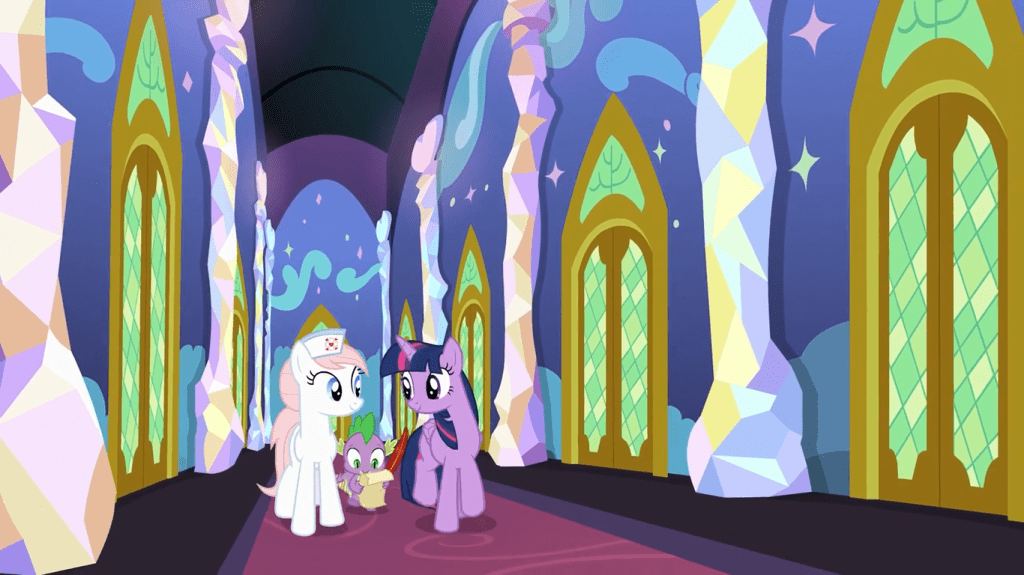
Obligatory mention that the nurse pony’s cutie mark was redesigned because her old one violated the Geneva Conventions.

This episode begins with the nurse pony telling Twilight she will have to spend the day with a group of sick foals, which she eagerly agrees to do.

This scene was probably meant to redeem the criticism that last season, Cadance didn’t look exhausted from taking care of Flurry Heart.

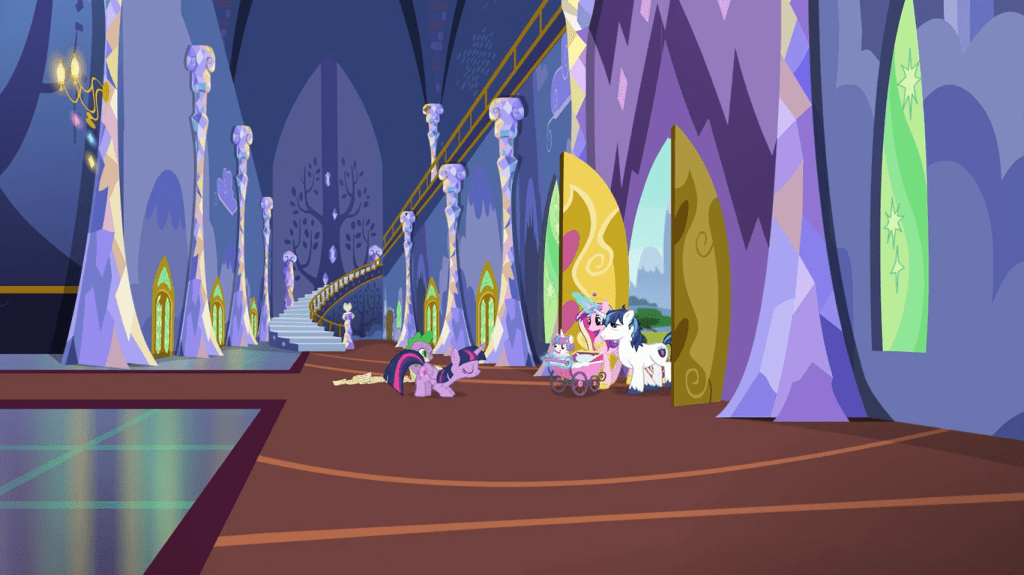
I still don’t get why Cadance and Shining Armor decided it was a good idea to drop in unannounced and tell Twilight Sparkle she has to watch over their baby. Wouldn’t it make more sense to leave her with a Crystal Empire resident, like Sunburst? And why did they just assume Twilight had nothing better to do? The best explanation I can think of is that it was a hasty decision because they were sleep deprived.

Continue reading

Cookie Fonster’s Eurovision 1990 Retrospective: The Year of Songs About Europe

Intro Post

< 1989 Review | 1990 Review | 1991 Review >

After Belgium and Cyprus, Greece today was the third country to choose their singer for Eurovision 2024: Marina Satti, a singer of ethno-pop music who some fans have wanted in Eurovision for years. Going by her discography, she’ll most likely send a song in Greek, which is exciting!


Introduction

“And welcome to the 32nd running of the Eurovision Song Stakes. Songs from 22 countries, vying to be the one to carry off the Grand Prix, and then never to be heard of again.” Oh, how I missed Terry Wogan’s British commentary.

Just as Monaco is the only country to win Eurovision but never host it, Croatia is the only country to host it but never win. Yugoslavia was still a country back then, but the contest took place in Zagreb (the Croatian capital), the presenters were both Croatian, and the intro film and most of the postcards took place in present-day Croatia. Perhaps that’s an omen for Yugoslavia’s imminent collapse? Furthermore, the contest featured a mascot designed by a Croatian animator called Eurocat.

This contest featured the exact same 22 countries as 1987 and 1989. Malta wanted to rejoin the contest, but the limit of countries was capped at 22. Luckily, Malta would get that chance next year when the Netherlands skipped, and they’ve never missed a contest since then. This year had a clear theme among its entries: songs about the huge, sweeping changes going on in Europe. Communist regimes were dismantled one by one, the Berlin Wall collapsed, and the lid holding Yugoslavia together was soon to burst. The former communist countries weren’t interested in joining just yet, but in 1993, they would start pouring in. Italy won the contest for the second of three times, having sent a song about the anticipation of European unity.

Although this contest was the first to require the contestants to be 16 years or older, the UK technically sent a 15-year-old to the contest. That was apparently allowed because she would turn 16 later in the year. Otherwise, I don’t have much to say about the contestants, so let’s begin!

Continue reading

Cookie Fonster’s Stances Concerning Eurovision 1989: Revisiting the Contest’s Birthplace

Intro Post

< 1988 Review | 1989 Review | 1990 Review >


Introduction

The final Eurovision of the 1980’s was the only year the contest returned to the country where it began: Switzerland. This time, it was hosted in the city of Lausanne. It had the same lineup of countries as 1987: every country that had ever participated except the three that start with M.

This contest featured the only victory of Yugoslavia, three years before the country’s collapse, and thus the only victory of a country that no longer exists. This puts Croatia in a strange position where they haven’t officially won the contest, but a band of theirs won for the country they used to be part of, and the contest took place in their capital the next year. This also happens to be the last contest with singers under 16 years old—two of them, in fact. The presence of preteen singers was highly controversial, so the next contest introduced the age rule. If that wasn’t enough, it’s the last contest where the final song performed won.

Fortunately, this should be the last contest for quite a while where finding commentary is a pain in the ass. I could only find it with Spanish commentary, so that’s what I’m watching. I also have an uncommentated version in higher quality so that I can better judge the songs. I know I don’t have to watch it with commentary, but postcards without anyone talking over them just feel so wrong. Plus, no matter which language the commentators speak, I can always tell when they (for example) mention ABBA or list the five singers who won for Luxembourg.

I have to say, I’m not a big fan of the previous winner singing their winning song at the start (which was also done in 1988). I liked it better when the contest opened with a reimagined orchestration of the previous winner. Plus, I didn’t come here to watch Celine Dion promote her new song, I came here to watch Eurovision! Anyway, the duo of Swiss presenters mostly hosted this contest in French, but they switched to English, German, and Italian a few times. Even a bit of Romansh, if I’m not mistaken! That is Swiss multilingualism at its finest.

Continue reading

Cookie Fonster Unearths Eurovision 1988: The Year of Francophone Superstars

Intro Post

< 1987 Review | 1988 Review | 1989 Review >


Introduction

We’re back to Dublin, Ireland for Eurovision 1988, in the same building as 1981 (the year after last time Johnny Logan won). However, it doesn’t look like the same building at all! It’s dark inside and the stage is surrounded by walls displaying a computer screen, much like 21st century Eurovision. This contest had almost the same lineup as last time, except Cyprus withdrew because their entry broke the rules. If Cyprus hadn’t skipped, we would’ve had the same 22 countries participate four years in a row.

Another way this contest resembles modern Eurovision is that it has multiple presenters. From 1957 to 1987, most contests had one female presenter; from 1988 to 2008, the norm was instead one man and one woman; and from 2009 onwards, most contests had three or four presenters. From this year on, the only solo presenters were in 1993, 1995, and 2013. As for this contest, the presenters introduced it in Irish, French, and English in order. The female presenter’s French has the weirdest Irish accent I’ve ever heard. She overenunciates the R’s and pronounces “bienvenue” as “pianvenue”, with a heavily aspirated P. After the introductions, the presenters made a lot of jokes throughout the show, with a much heavier saturation than the subtle humor of the last few years.

This contest had Switzerland’s second and latest victory, performed by perhaps the second most famous name to come from Eurovision: Celine Dion. Another famous French-speaking singer represented Luxembourg, the legendary Lara Fabian. No French-language song has ever won Eurovision since then. Switzerland beat the UK by only one point, in one of the tensest voting sequences in Eurovision history.

Just like last year, it was very hard to find commentary on this contest because all the uploads on YouTube were blocked. Through extensive research, the only two languages I could find were Greek and Dutch, so I’m gonna settle for Dutch.

Continue reading

Cookie Fonster Reviews Every MLP Episode Part 77: All Bottled Up

Introduction / Navigation

< Part 76 | Part 77 | Part 78 >

Season 7, Episode 2

Remember when I said I might write a blog post about GalaCon 2023 (my first pony con)? Well, I ended up making a video about it instead, and released it on the tenth anniversary of when I first watched MLP:FiM. You should watch it if you haven’t! If you like reading my MLP reviews, I promise you’ll enjoy this video too.

I promise I’ll speed up with my MLP reviews for at least the first half of season 7. And yes, it’ll come at the cost of slowing down another post series.


Season 7 Episode 2: All Bottled Up

In five words: Trixie drives Starlight to insanity.

Premise: While Twilight Sparkle and friends are off for a friendship retreat, Starlight Glimmer practices magic with Trixie and gets annoyed with her friend’s careless mishaps. Luckily, she can store all her anger in bottles and ignore it forever… or so she thinks.

Detailed run-through:

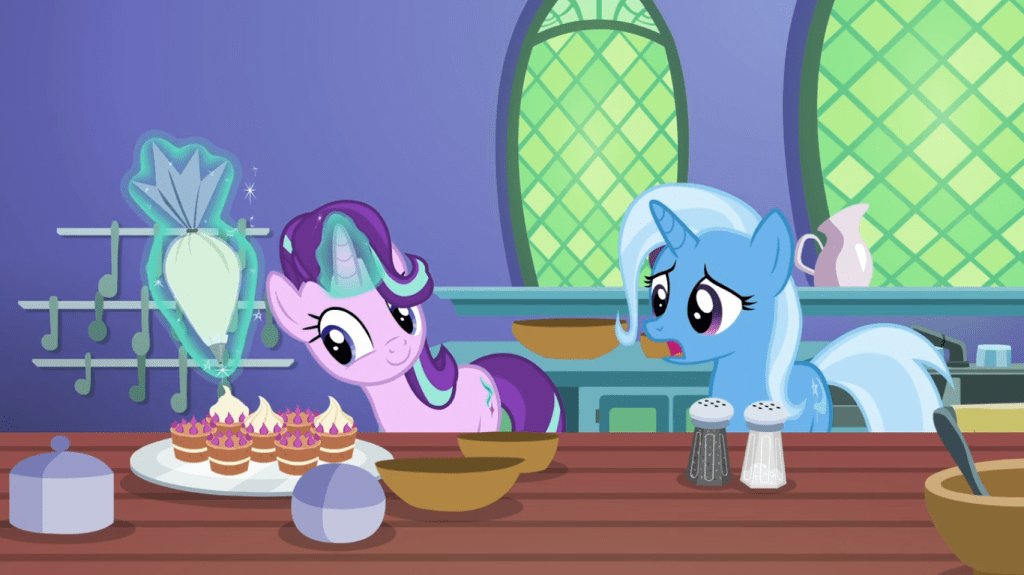
This episode begins with a slice of life scene featuring a fan favorite pair of characters, where Starlight Glimmer makes cupcakes for her friends’ trip and Trixie practices magic. When Starlight explains how to do a transfiguration spell and Trixie does it successfully, it first seems like happy fluffy friendship moments…

This scene does shows us that Trixie isn’t quite as reformed as Starlight is, which I admire.
It’s nice that different villains (or villain-ish characters) are reformed at different rates.

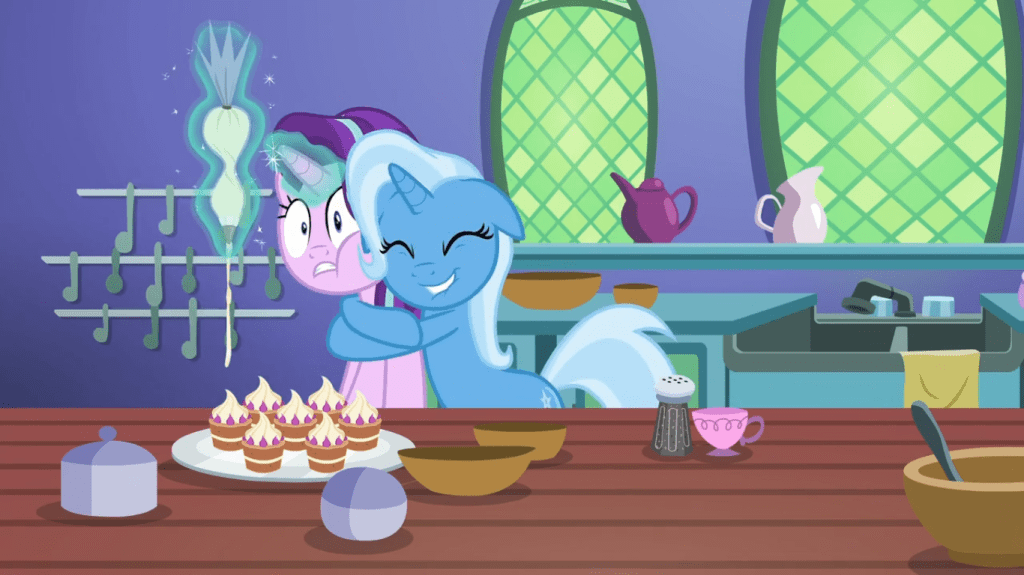
… but the moment Trixie hugs Starlight overly tight and makes her spill frosting, the episode’s conflict becomes clear. It’s a similar style of cold opening to Make New Friends but Keep Discord: we see a friendship established a season or two ago, and since we already know they’re friends, it doesn’t take long to introduce their conflict.

Continue reading

Cookie Fonster’s Journey into Eurovision 1987: An 80’s Fever Dream

Intro Post

< 1986 Review | 1987 Review | 1988 Review >

Introduction

Hosted in Belgium for the first and only time, Eurovision 1987 had quite a lot of drama behind its production. Two broadcasters had agreed to organize Eurovision together in the event Belgium won: the Dutch-speaking BRT (now called VRT), and the French-speaking RTBF. However, when the time came for them to team up, they were as good at cooperation as a nerd and a jock assigned to do a high school chemistry project. When the French-speaking broadcaster chose Brussels as the host city, the Dutch-speaking broadcaster threw their hands up and left RTBF to organize it alone, while BRT chose the Belgian entry. If you want to see two broadcasters successfully collaborating, you’d have to wait until 2023.

This contest had the largest lineup of countries so far: Greece and Italy returned after skipping last year, making for 22 countries total. All countries that had ever participated in Eurovision were present this year, except Monaco, Malta, and Morocco. This is an intimidatingly long contest, almost as big as a Eurovision final in the current era. The winner was the first person to win Eurovision twice: Johnny Logan, representing Ireland. The postcards are themed upon what comes to most people’s minds when they think of Belgium: Belgian comic strips.

Annoyingly, this is another year where due to one particular song (glares intensively at Spain), you can’t find many commentary uploads on YouTube, and most of them are of terrible quality. So, um, I guess I’m watching it with Swedish commentary this time. The video description contains a link to the full unabridged Swedish commentary in good quality, so I’ll use that. I won’t be able to understand the commentary, but I’ve at least picked up on a few words from Scandinavian languages by reading translations of their Eurovision entries.

Continue reading