
< 1972 Review | 1973 Review | 1974 Review >
Introduction
Vicky Leandros’ victory brought Eurovision to Luxembourg for the third of four times. This time, the show took place in the Grand Théâtre de Luxembourg, which has 943 seats in the main theatre and 400 in the studio. That is a tiny audience by modern standards, the kind you might see in a smaller country’s national final. I think this gives the show an intimate feel, compared to those with grandiose arenas such as 1968 in the Royal Albert Hall. This intimate feel is further helped by the orchestra surrounding the performers in a circle, which I think looks just plain awesome. Unfortunately the show has no postcards this year. We only get a picture of each singer taken during a rehearsal with their name on the bottom to introduce each song, and they often have unflattering expressions.
Eurovision 1973 is a year of many firsts. It was the first year to have at least one female conductor (for Sweden and Israel), the first that explicitly let countries sing in any language they wanted, the first where at least one song used a backing track (“Power to All Our Friends” from the UK), and the first year where Israel participated. Austria and Malta from last year skipped this contest, meaning it had a total of 17 participating countries. Because this was Israel’s first time participating and came just a year after the horrific Munich massacre, the contest had extreme security measures in place, especially for the Israeli delegation. According to Swedish conductor Monica Dominique, two men with machine guns guarded both sides of the stage throughout the television broadcast.
The intro to the show is pretty simple: an opening film with little clips of the contestants set to an orchestration of “Après toi”, a glimpse at Vicky and Leo Leandros in the audience, then the presenter Helga Guitton introducing the show in French and English with a pinch of German and a few words in Luxembourgish. I watched the show with German commentary uploaded to YouTube just a few weeks ago, but I made sure to check out the versions of each song with strings created by awuga. The orchestra had major sound issues this year which caused the strings to be mostly inaudible on TV, although when I first watched the year I just thought the orchestra was brassier than usual.
The top three of this year are all quite iconic: Cliff Richard with “Power to All My Friends” at third place, a very famous Spanish song called “Eres tú” at second, and the winner was Luxembourg with “Tu te reconnaîtras”—the second of five times the host country won.
Finland: Tom Tom Tom
Artist: Marion Rung, returning from 1962
Language: English
Key: D♭ major, D major
My ranking: 8th
The show opens up with a showcase of what’ll be different about Eurovision 1973: the new linguistic freedom. It’s no wonder that Finland took advantage of this rule as quickly as possible, since the juries back then had a notorious bias against songs in Finnish. I think in modern Eurovision this bias has been cured by now, but the juries still have a bias against fun songs which is why “Cha Cha Cha” didn’t win 2023. By now I’ve gotten over my salt that it didn’t win, because “Cha Cha Cha” is now one of the defining songs of Eurovision.
Anyway, whether it’s in English or in Finnish, I think this song is cutesy and happy. I think it benefits from coming first, because if it were after a serious song people would’ve thought it was inane in comparison. Unfortunately she is shaking like crazy throughout the performance, as though she’s absolutely terrified to perform but is trying to suppress it. Is it because she’s singing in English and not confident about her language skills? You can sort of hear a Finnish accent, but she makes a solid effort. The opportunity to sing in English worked pretty well for Finland and earned them sixth place.
Belgium: Baby, Baby
Artist: Nicole and Hugo (Nicole van Pamel and Hugo Sigal)
Language: Dutch, plus phrases in English, Spanish, and French
Key: D minor
My ranking: 5th
The last place entry of 1973 is a polarizing one. Some fans absolutely hate it, while to others it’s a total cult classic. Erica quite likes this one and even suggested once I do an 8-bit cover of it. I went with a different song for 1973, but I might go back someday and do this one because it really is a total earworm. The section “baby baby I love you / yo te quiero, oui mon amour” is stupidly catchy and exactly the right way to do a multilingual hook—Malta last year should’ve tried something like this.
Their indigo suits loook unreasonably awesome; they’re both the same style, yet the man and woman both rock it. Their dance routine is fun to watch too. I’m not saying this is the most amazing song ever—it’s kind of silly and inane. But anyone who hates this song should think for a second why, then hopefully reconsider themselves.
Portugal: Tourada
Artist: Fernando Tordo
Language: Portuguese
Key: D minor
My ranking: 4th
About the fanmade string restoration: I love the work awuga put into making these restorations, but I wish they had put an audible cowbell into this song, because we clearly see one at the start and it’s jarring that we don’t hear it. That’s actually the only criticism I can think of for any of these restorations.
My opinion on this song is exactly the same as it was in round 1. It’s a really fun scornful song which gives major Amy Winehouse vibes. Come to think of it, it might not remind me of Amy Winehouse’s music in general, but rather of her song “You Know I’m No Good” which is one of my mom’s favorite songs. I’m not sure if others see the resemblance, but for me it’s because of the bassline, twangy guitar, and slightly swung rhythm. I’m not a huge fan of the slowdown and speed-up gimmick near the end, but there are enough things to like about this song that I can live with it.
The lyrics are an indirect protest against the dictatorship that would still rule Portugal for a few more years, and the instrumental totally suits this theme. Musically this song just beams with sass (helped by the tinges of major key), so I’m still fond of it after all this time. Plus, I’ve mentioned many times on this blog that I’m a total sucker for a good bassline.
Germany: Junger Tag
Artist: Gitte Hænning, who completes the trio of German-speaking Scandinavian singers
Language: German
Key: C major and C minor in alternation, then D♭ major
My ranking: 13th
Since there was no language rule, technically Gitte could’ve sung this song in English, or even Danish if she realy wanted to. But then it wouldn’t have made sense for this song to represent Germany. This song does indeed have versions in both English and Danish, and even a Spanish version.
As you can see from my ranking, I’m not the biggest fan of this song, but I don’t think it’s too bad because 1973 has a noticeable lack of bad songs. The main problem with this one is that there’s too much of a disconnect between the dreary verses and brassy chorus. Also, Gitte’s dress is hideous and has way too many colors. I do somewhat like the chorus, and I also like that you can hear the slightest Danish accent from Gitte, because I think Scandinavian accents in German sound cute.
Norway: It’s Just a Game
Artist: Bendik Singers, another group of two men and two women. I’ve seen some people call them EBBA.
Language: Every single participating country’s language this year, except they forgot about Portuguese, oops. But mostly English and French. Actually wait, this preview video shows the ladies holding up both Spanish and Portuguese flags during the line “caro querido mine”, so it looks like that line representing both languages is canon after all.*
Key: C major
My ranking: 2nd
In round 1 I picked apart this song in immense detail, so don’t expect a review nearly as long this time. It may not be my winner anymore, but this one is still easily a 10/10. It’s just a total work of genius, with the jazzy composition in the 5/4 time signature, the gimmick of the men singing one set of words while the ladies sing another, and the language gimmick done to perfection. You can tell this song was composed by the same mastermind who wrote “Intet er nytt under solen”, because that one is also in quintuple time and sounds just a bit whimsical. That mastermind is none other than Arne Bendiksen. The song was originally written in Norwegian and I commend whoever decided to not just localize it into English for Eurovision, but instead turn it into language soup.
You know what? I’ll paste my tangent about something called “The Family Song” so you can read it again here.
If you’ve ever owned a Casio digital piano, chances are it came with at least one flashy, upbeat, brassy 70’s-sounding song as a demo tune. My family had a digital piano when I was about six years old—I believe it was Casio, but I could be wrong—where I would often play a built-in song of exactly that type. I called it “The Family Song”. My dad absolutely hated that song and kept asking me to turn it off, but for me, it was my jam. I cycled between several other digital pianos after that, including a Casio CTK-720, and when I was 11, I got for Christmas one of two pianos that I own today: a CTK-4000 digital piano which has 570 built-in sounds, 152 built-in songs, but tragically only 61 keys (instead of the full 88). One of the two demo tunes has an extremely similar vibe to what I remember of The Family Song, so much that I think of it as The Family Song too. Again, it’s a song that I find absolutely delightful, whereas my parents think it’s completely tacky.
[…]
Here’s a little footnote. If you’re curious, the other digital piano I own is a Yamaha P-45B with the full 88 keys. Nowhere near as many sounds or built-in songs, but a lot of nifty customizability if you look hard enough, plus some wonderful demo tunes for each sound. I bought it for my current house with my Christmas money from the end of [2022], because life goes full circle.
Maybe “The Family Song” isn’t one particular song, but rather it represents the concept of a bombastic brassy 1970’s style song that no one but me loves this much. So as far as I’m concerned, “It’s Just a Game”, the CTK-4000 demo tune, and whatever that other piano demo song was called, are all The Family Song. Just as I annoyed my dad playing that song as a kid, if I ever have kids, maybe they could find a “family song” to drive me crazy with. Or I could dig up that digital piano and play its Family Song to irritate them.
* I would say that line representing both Spanish and Portuguese kills two birds with one stone, but a few years ago at a doctor’s appointment my doctor mentioned offhand that she hates that idiom, and that statement has stuck with me ever since. I support the alternative phrase “feed two birds with one scone” because birds are our friends. I’m not the type of person who insists we should sanitize all idioms and phrases that may be deemed the slightest bit offensive, I just think analogizing getting two cool things done at once to murdering innocent birds is stupid.
Monaco: Un train qui part
Artist: Marie-France Dufour
Language: French
Key: G major
My ranking: 14th
This is my fourth last place of the year, but it isn’t really that bad as a song. Her voice is kind of annoying and she almost kisses the microphone a few times, but on the plus side it has a nice super-catchy chorus. In a year where I dislike most songs, such as 1965 for instance, this could’ve been my fifth or so. But in a year where I like most songs, instead it’s near the bottom.
Spain: Eres tú
Artist: Mocedades
Language: Spanish
Key: D major, E♭ major
My ranking: 3rd
Ah, and now we have the song that every Spanish speaker knows. Seriously, it’s hard to overstate how famous this song is in Spain and Latin America—in those countries, it’s one of those songs everyone knows and loves. It even became a big hit in the United States, back when Spanish-language music didn’t chart as often. As I said in round 1, the song is simply beautiful from start to finish. I still can’t pinpoint what it is that I like so much about it, so if you were expecting a long analysis I’m sorry to disappoint. It’s just such a heartfelt song with lovely melodies and a great buildup. The German commentator was wowed at the end too, and felt this had a change at winning. It came very close at second place, but it’s such a widely loved song that it didn’t really need to win.
It’s still fucking annoying that some people insist this song plagiarized the Yugoslav entry “Brez besed”. Whenever a song has a similar melody to another song, people never go “huh, an interesting coincidence”, but instead go “those BASTARDS, they PLAGIARIZED someone else’s amazing song and deserve to go to HELL!” Because obviously there’s no such thing as coincidences, am I right? Every melody sounding similar to another song is obviously on purpose. It’s especially annoying when people insist a song plagiarized one from a completely different country. That recently happened when Væb from Iceland, who made the song “Róa”, got accused of plagiarizing the Israeli song “HaTunat HaShana”. You can’t seriously think the average Icelander knows every hit song in Hebrew off the top of their head, can you?
Switzerland: Je vais me marier, Marie
Artist: Patrick Juvet
Language: French
Key: C minor and C major in alternation
My ranking: 12th
This song I have no strong feelings about; it just sort of exists. It has a weird alternation between major and minor key and a stompy beat that slightly bugs me, but it’s not too bad to listen to. I think it was an attempt at a heartfelt song about a man who’s getting married but promises he will keep all his other friendships, but it sounds a little sillier than it’s probably supposed to.
Yugoslavia: Gori vatra (Гори ватра)
Artist: Zdravo Čolić
Language: Serbo-Croatian (Bosnian)
Key: D minor
My ranking: 7th
Yugoslavia this year has brought us not a ballad, but a minor key 70’s pop song heavy in bass and guitars that feels sort of, I don’t know how else to put it, fiery.
I never thought about this song much until I learned a few weeks ago that my commenter Maaria has this, of all songs, as their favorite Eurovision entry of all time. I suspect some people like to proclaim an unusual song as their favorite Eurovision entry ever at least in part because they want more people to care about it. I’m a bit guilty of this sort of thing myself, since I shower “You” by Vasil and “Funny Girl” by Laura Rizzotto with so much love. And I have to admit, with this song it’s sort of working. I got curious enough to check out its studio version and it turns out the song has several musical tropes I like: funky sprawling basslines, and a male voice that sounds rich but not overdone. I don’t think I will ever be half as passionate about this song as Maaria is, but good job, you made me start paying attention to this song.
I also like to make people start caring about obscure entries I absolutely fucking hate, like “If We All Give a Little” or “The Moon Is Rising”. Because part of the fun of Eurovision is bashing on your least favorite songs.
Italy: Chi sarà con te
Artist: Massimo Ranieri, returning from 1971
Language: Italian
Key: C major, D♭ major, D major
My ranking: 15th
After bringing some artistic quality last year, Italy unfortunately has one of few entries this year that I would call forgettable. It’s a middle of the road ballad that is sung well but just impossible to remember how it sounds. It’s nowhere close to the standard of quality you’d see in Sanremo entries.
Luxembourg: Tu te reconnaîtras (the winner)
Artist: Anne-Marie David
Language: French
Key: F♯ major. This time I feel confident labeling it just as that.
My ranking: 1st
My relationship with this song is pretty much the same as with the last winner, “Après toi”. I always thought it was a well-deserved winner, but it wasn’t my favorite at first until I gained more and more appreciation for it. If I had to describe this song in one word, I would say “anthemic”. It’s bold and dramatic and makes you want to sway your head to the beat, and even sing along if you know the words well the words well enough. My commenter Famicom Guy has this as his favorite Eurovision song of all time and credits it for getting him into old Eurovision. “Ding-a-Dong” from 1975 played a similar role for me, except (spoiler alert) I’ve gotten kind of bored of that song.
As with “Après toi”, this song just does everything right, except it has that extra little spice to earn it a 10. What is that spice exactly? Probably the way Anne-Marie sings it. She is a romantic performer who absolutely owns the stage. She puts all her heart into her singing and makes me believe every word she says. I could see her singing this as a marriage proposal to her boyfriend, perhaps. I also feel that the orchestra arrangers went the extra mile arranging this song, because many different instruments get their time to shine here. This song does a dramatic ending in a way that actually works, because the conclusion is dramatized to just the right degree and actually feels earned because the song is just that powerful.
The lyrics are romantic and powerful in a French way, and one thing I particularly like about them comes near the end. In the chorus, she normally sings that her love interest will recognize herself in every moment and joy, but the final chorus has an extra-direct love confession just in case her crush doesn’t get the hint. That confession is in the line “dans cet amour que j’ai pour toi” (in this love I have for you), and it’s such a nice way to lyrically end this song.
This was the song I chose to 8-bit cover for 1973, and I didn’t need to think hard about it at all. When I got to that year, I immediately knew this was the right choice to cover. But I do wonder what song I would’ve chosen to cover if not this one. Probably Norway, though I really do want to cover “Baby, Baby” at some point too.
Sweden: You’re Summer
Artist: The Nova (a duo) and the Dolls (a backing trio)
Language: English
Key: D minor, D major, B major, then the cycle repeats, then D major in the final chorus
My ranking: 6th
Buckle up, because I have a lot of new things to say about this song. And yes, most of them revolve around the elephant in the room: the line “your breasts are like swallows a-nestin”, which was carried over from the song’s Swedish version “Sommar’n som aldrig säger nej”.
But first, let’s discuss the song’s backstory. Every Eurofan knows that ABBA won Eurovision 1974, but you might not have known that they competed to represent Sweden the previous year with their song “Ring Ring” and lost to this song by a band named Malta. ABBA weren’t well-known back then, but most people still expected them to win Melodifestivalen that year, so this song winning came as a big shock, especially to its composers, the married couple Carl-Axel and Monica Dominique. They were proud that their song won Melfest nonetheless, and Monica stepped up to conduct it in Eurovision—right after it was localized to English, since the Swedes were now allowed to do so. The band went by the name “The Nova” for Eurovision, to avoid confusion with the country named Malta.
Many non-English Eurovision entries have their lyrics toned down in some way for their English versions. For example, “Kan” by Duo Datz is a very patriotic song in Hebrew, but the English version just a “let’s be friends” tune with no patriotism to be found. So it’s incredibly funny that the songwriters for this song chose to retain the line about breasts, already infamous in Sweden, for the English localization. Some fans wonder if the line “dina bröst är som svalor som häckar” sounds less dirty in Swedish, but reading this interview with the conductor Monica Dominique makes it clear that it does not. And I mean, this is the same country whose Eurovision host showed her underwear to 400 million or so people, so it’s not like this sort of thing is unusual for the Swedes.
Part of me feels like I should hate this song because of the breast line, but I can’t help myself—I really do rather enjoy this. The song just comes together really well. It plays with key signatures in interesting ways, it’s heavy in harmonies, it has some nice acoustic guitar work, and it overall just keeps me engaged. I particularly enjoy the part where the song modulates from D major to B major, since that’s an intriguing musical twist. That part comes right after the guys sing “you never tell me know”.
Netherlands: De oude muzikant
Artist: Ben Cramer
Language: Dutch
Key: E major, F major
My ranking: 11th
Ah, and here’s the song where the producers turned off the lights for the performance. That’s a pretty nice touch since it draws more attention to Ben and the accordionist.
This song reminds me of “Straatdeuntje” by Bobbejaan Schoepen, because it’s a sort of circus-sounding waltz in Dutch, except it’s not quite as good. It was composed by Pierre Kartner, the same man behind “Ik ben verliefd” from 2010, and the Dutch fans are probably not surprised by this at all. Erica compares this song to “De troubadour” (which she loves even more than I do) because both songs are about an old musician who was once beloved, and says it’s not even half as good as that which I agree with. The song is alright enough and Ben’s dramatic performance entertains me, but it’s nothing too remarkable. Neither good nor bad, so a textbook 5/10.
Ireland: Do I Dream
Artist: Maxi (Irene McCoubrey)
Language: English
Key: A major, B♭ major
My ranking: 16th
When performing this song, Maxi is the total opposite of Anne-Marie David, because she does not feel the lyrics in the slightest and just wants to get this song over with. You can see in her eyes that she is not enjoying this performance at all. Even though English is my first language, I actually follow along with the lyrics of Luxembourg’s song better than with this, because Anne-Marie invites me to pay attention to them. Musically this is an alright enough 1970’s pop song that I’d score a 5/10, but her unenthusiastic performance means I’ll give it a four instead. I actually quite like the chord progression in the chorus, so at least the song has that going for it.
United Kingdom: Power to All Our Friends
Artist: Cliff Richard, returning from 1968 with vengeance
Language: English
Key: E major, F♯ major
My ranking: 9th
And now we have the third place entry of 1973. Cliff Richard got second place by one point last time, and this time third place by six points. He would later go on to say that he “lost Eurovision twice”, because he’s the archetypical sore loser of Eurovision.
I think I agree with Erica that this is a tough song to rank, because it feels more like a 70’s pop song than a Eurovision song. It’s decent enough and clearly was designed to win, but it also feels like one of those standard seventies hit songs that I’ve heard countless times without realizing it. Maybe part of the reason why is because this is the first song in Eurovision history to use a backing track. It didn’t entirely use a backing track, but rather a hybrid of playback and orchestra where the guys on stage are pretending to play guitar and drums. If you want to know the story of how this song came to use a backing track, read this interview with the conductor David Mackay, who was embarrassed that he accidentally played a part in the rise of backing tracks at Eurovision.
The way Cliff Richard moves around on stage… it just feels so “Cliff Richard”. You can tell he’s a professional performer, but he always looks a little awkward and bumbling on stage. Especially in the parts where he waves his arm as if he’s trying to push something. The interview with David Mackay says that Cliff Richard hid in the dressing room during the voting out of fear of not winning again, which is again very “Cliff Richard” of him.
France: Sans toi
Artist: Martine Clémenceau
Language: French
Key: F♯ major
My ranking: 17th (last)
It’s nice that my last place of the year isn’t too terrible, just a forgettable song with somewhat annoying singing. It may be more fun when my last place is a song I can rant about, but it’s not so fun to have to listen to a 1/10 song again. This is a ballad with alright musical ideas especially in the chorus, but her performance makes it hard to appreciate any of that. I can only pay attention to her breathing into the microphone at the start and then shouting too loud once the chorus comes in. I can’t even pay attention to the lyrics here, even though I’m normally pretty good at understanding songs in French.
Israel: Ey Sham (אי שם)
Artist: Ilanit (Hanna Dresder-Tzakh)
Language: Hebrew
Key: G major
My ranking: 10th
And to close Eurovision 1973, we have the first ever entry from Israel. I like how the running order of 1973 starts with something silly and fun, then ends with a showy song from a brand new competitor. Note that in this review, I won’t go into the drama concerning Israel’s participation in recent contests. Just read my reviews of 2024 and 2025 for my thoughts on this topic.
In my round 1 review, I theorized that songs in Hebrew did quite well because the language might be familiar to Jews in Europe, or because it has some sounds in common with French and German, but I think neither of those things are the reason why. Now I just think Israel knew how to send songs that would appeal to Europeans despite the language barrier. It’s just like how “Dinle” from Turkey did really well because the composition and vocal stunts grip the listener, and “Cha Cha Cha” from Finland nearly won the contest because it’s such a gigantic crowd pleaser. Likewise, Israel made sure their first entry was accessible to European ears while still showcasing the Hebrew language.
Israel tends to take a “go big or go home” approach in Eurovision, and their debut is a great example. To this contest they sent Ilanit, one of the country’s most popular and respected singers to this day. The song is an decent enough pop ballad, but Ilanit really elevates it with her heartfelt performance. She comes across as hopeful and romantic and even though I don’t speak a word of Hebrew, I can tell that she truly means what she’s singing about. In my round 1 review, I said: “The lyrics are about a supposed garden of love found somewhere at the end of a rainbow, where she wants to go with her lover.” Thanks past me for explaining the lyrics! I can see why this song left such a strong first impression on the juries and landed fourth place.
To someone binging every Eurovision year in order, this song tells you right away that in the 1970’s, Israel already had a vibrant pop music scene and was more than ready to show it to Europe. I also like how you can see some shots of Nurit Hirsh having the time of her life conducting this song. As she recounted in the Eurovision conductors blog: “Before we went on stage, Ilanit and I simply prayed that we would be alive after this… and that was it! During the performance, I forgot about what could happen to us and I returned to being my normal self, who is always excited to play and to perform in front of an audience, trying to transmit my energy to the other musicians.”
My full ranking
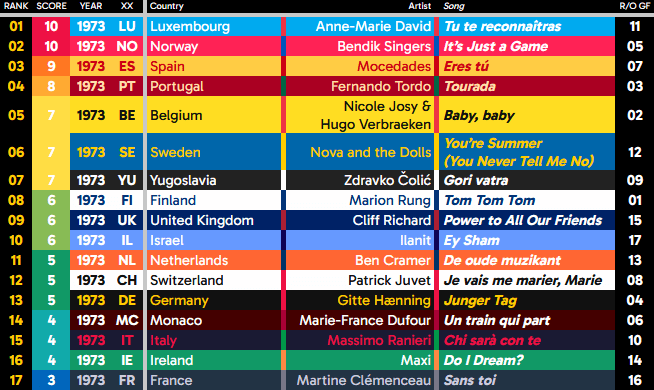
This is an exceptionally strong year, as you can see from my ranking. It’s the first year to have two 10/10’s, and one nine right below. It’s also unusual to have my last place be as high as a 3/10. Only my bottom four are songs I actively find bad or forgettable.
Rest of the show:
The interval act was weird and not good. Yes, I know Charlie Rivel was a very popular clown in Europe, but I never understood or enjoyed this type of humor or the weird noises he made, and I far prefer when interval acts feature cool music and dancing. And plus… I’m not sure how I should tackle this topic, but I feel like I need to mention this: Charlie Rivel was a strong supporter of Hitler in World War II. I won’t get into more detail on this topic, so instead I will invite you to do your own research on him. Suffice to say, this sours the interval act even more for me and casts a dark cloud over this show.
And then comes the jury voting. I feel like the juries were generally harsher this year than in 1972, and also more scattershot in their votes. They also displayed a big bias towards songs in English and French, but that’s not really unusual for the juries. This bias was most apparent in their votes for Finland. I’m lucky I love “Tu te reconnaîtras” as much as I do, because otherwise I would’ve insisted it only won due to francophone bias. I like how the top three ended up so close: 129 points for Luxembourg, 125 for Spain, 123 for the UK.
When the host announced Luxembourg as the winner, we see all the contestants for this year in a little cluster of seats together, which is cool because I love seeing all these contestants gathered in one place, except one seat is empty. If you read David Mackay’s interview, you’ll know it’s because Cliff Richard was hiding in the dressing room. Anne-Marie David walks to the stage and looks absolutely thrilled to win. She exchanges a hug with Helga Guiton, then Vicky Leandros enters the stage to pass flowers and a pair of trophies to our winner. The German commentator said he had hoped “Junger Tag” would get more points, but eh, the song isn’t that great. I do get why he felt that way, because Germany wouldn’t win the contest until 1982.
General thoughts:
As you can tell from my review, I still really love this year. It has an awesome lineup of songs with a good amount of variety, but a clear style at the same time. All the entries sound a little brassy and punchy, and many of them sound quirky in some way. The presentation is charming especially with the orchestra surrounding the singers. And as a nice bonus, I agree with the winner for the second year in a row! The year has just the right mix of silly songs (like Belgium) and heartfelt songs (like Spain or Luxembourg’s winner).
The hosting felt a little low-budget this year, which mostly wasn’t a problem but led to a few jarring things, most notably the orchestral sound issues and the lackluster substitutes for postcards. The interval act I really don’t like for several reasons, but it’s common for media I love to have an unfortunate elephant in the room.
See you next time as I revisit the victory of that random-ass Swedish band no one has ever heard of. What was their name again, Ubbi Dubbi or something?
 Cookie Fonster's stuff
Looking at the other commenters I’m clearly alone in finding this year as middling as most of the early contests, but then I’ve always been a bit of an outlier! And funnily enough I didn’t even mention the interval act in my review, so I guess I (inadvertently) did the right thing there.
LikeLiked by 1 person
I remember reading that the Irish delegation was considering replacing Maxi just days before the contest, so argumentatively unhappy was she with her song’s arrangement. They actually flew in sub Tina Reynolds just in case. (thoughtfully sending her music & lyrics so she could practice on the plane on the way over.) This move seems to have sharpened Maxi’s focus on her performance and she was retained. But to add to her woes she came down with a touch of Luxembourgeois covid-73 (or whatever) in the hours before she was due to sing and was rather below par health-wise too, so, yes, not a happy bunny.
Not unhappy enough to stop her from giving Eurovision another shot a few years later though.
LikeLiked by 1 person
If Maxi was sick on top of all the other drama she had to endure, props to her for still performing at Eurovision at all. And it’s nice that both she and Tina Reynolds got another chance to perform at Eurovision.
LikeLike
Aww, thank you for the shoutout! I totally wasn’t expecting it and I’m glad you appreciate my beloved Gori vatra more because of me. Anyways, 1973 is a year I have a huge soft spot for. The song lineup is far from my favourite, but the highs are so high that they brighten up the whole year.
Marion Rung is a legend, however I am not a fan of either of her Eurovision entries, due to the fact that both of them have some of the most annoying hooks ever conceived. I personally prefer Tipi-tii over Tom tom tom, because that one had some nice flutes and was in Finnish. (Makes sense that Tipi-tii is a classic in Finland today, while Tom tom tom is practically unknown). If you want a good Marion Rung song, I recommend checking out her Intervision winning song from 1980, called ‘Hyvästi yö’.
Norway is a huge grower. When I watched 1973 for the first time, I HATED it. The simultaneous different melodies basically fried my brain and made the song really hard to listen to, however thanks to subsequent listens (and reading your and Fam’s blogs) the song no longer causes that issue. The 5/4 beat and multiple languages gimmick make the song super interesting (however the guy with the glasses somehow butchered the only Finnish word in the song).
I first found out about Gori vatra in a compilation video of Yugoslavia’s entries in Eurovision. I was intrigued by all the fan favourites, like Jedan dan, Hajde da ludujemo and Dzuli, and of course Gori vatra, which I knew I had to check out in full. I never actually did and kind of forgot about it until I actually watched 1973, where the song completely and utterly blew me away.
I can best describe the song as a fusion between a 70s rock song and a dramatic orchestral tune, with a bit of piano ballad sprinkled in. It’s an interesting combination of genres that makes in stand out not only in this year, but also among Eurovision entries in general, as there is no other entry quite like it. The song, like you said, is also EXTREMELY fiery. So fiery in fact, that when I first watched 1973, the moment the song started, my eyesight was covered in flames. (I don’t think I have synesthesia btw). I cannot pinpoint exactly what makes the song so fiery, it has to be something in the instruments and chords (I’m almost completely deaf when it comes to chords, ) The song also has memorable melodies both in the instrumental and vocals, and the chorus is catchy despite having a very unusual melody. Another way the song stands out is the usage of electric guitar (a rare instrument in this era of ESC, and this was the most prominent usage of it at the time).
However, the song would only be half as good without Zdravko’s INCREDIBLE vocals. He has an absolutely amazing voice; rich, filled with emotion and extremely strong. From the moment he started to sing, he instantly captivated me and I could already tell he’s an amazing singer. At just the age of 21, he delivers a perfect performance of a very difficult song. The song requires absolutely perfect control of one’s voice (the elongated high notes in the chorus have to be hit just right to sound good), not to mention the absolutely HUGE big notes after the second and final chorus. He isn’t breathy at any point, even in the quieter parts (despite the song requiring a supehuman lung capacity to sing). In fact, I would say this is my favourite vocal performance in Eurovision history. It ticks every single box. It’s not just the vocal performance that is amazing though, Zdravko is extremely charismatic and knows how to connect with the camera. His expressions help sell the song and make me connect to it even more.
All in all, an immense effort from Yugoslavia, and I am baffled it only came 15th. Usually, there is a reason why an amazing song does poorly, but with Gori vatra, I simply cannot figure it out. The more I think about it, the less sense it makes. Despite the song’s poor result, it became a hit in Yugoslavia and began Zdravko’s career. Zdravko is actually a huge star in all former republics of Yugoslavia, and possibly the most famous Yugoslav singer of all time, no doubt because of his talent (and amazing discography). One last sidenote: Zdravko is the hottest man I have ever seen.
That said, Tu te reconnaîtras is amazing and completely deserved its win. It really is the perfect Eurovision ballad, with a fantastic melody, supported with a gorgeous arrangement featuring piano, horns and strings, and of course Anne-Marie David’s performance bringing the song to life. At just the age of 20, she already had a strong voice and loads of charisma. When I first watched 1973, I actually picked Luxembourg as my winner at first, but changed it to Yugoslavia just two days later, after I noticed I was getting increasingly obsessed with it, however Tu te reconnaîtras is still an easy 10/10 and by far the best Luxembourgish entry ever.
In typical Maaria fashion, I have a fan-favourite last, this time the UK. The song itself is decent (although I’m not a fan of its repetitiveness or the lyrics), but the performance almost completely ruins it for me. I can’t stand Cliff’s idiotic dance moves. (Also, the shot during the first chorus where Cliff is dancing and behind him we see the drum kit guy in the orchestra doing nothing even though the drums are playing has forever been etched into my brain).
Holy shit, I did not intend for the comment to be this long. I guess I just had that much to say, and I didn’t even type out all of my thoughts on the Yugoslav entry (I am typing this at midnight and got writer’s block haha). See you next time in 1974, which is sadly one of my least favourite years of all time.
LikeLiked by 1 person
I just checked out “Hyvästi yö” and it’s a pretty great song—a lot more serious than her Eurovision entries. It’s absolutely the kind that would do well at any song contest, probably even reasonably well at Eurovision even though the juries were insanely biased against songs in Finnish.
I like how you wrote such a huge wall of text about “Gori vatra”. I never thought about how difficult the song must be to sing, but you’re absolutely right that it would take some serious skill. And if your love of an entry is influenced by the singer’s hotness, I don’t blame you. I have a few such cases of that myself.
And I’ve come to realize that I find Cliff Richard unintentionally funny for several reasons. His bumbling but lowkey arrogant attitude when talking about Eurovision, and his weird and clumsy attempts at dance moves.
LikeLike
I love seeing people get really enthusiastic about their favourite song. I’m sorry to say it didn’t leave much of an impression on me, but it just goes to show that every song has its fans. 🙂
And I’ll say it again, Cliff looks like one of those weird waving cat statues, though they are Japanese, not Chinese like I said in my review.
LikeLike
I’m a big fan of 1973, and not just because it has, as you pointed out, my all-time favourite entry (but that’s definitely part of the reason ;). No, it’s just a very memorable year. I’d go as far as to say that every song leaves some kind of impression (and very few leave a negative one).
It even overcomes my clear preference for strings over brass. I think that brass-heavy arrangements usually sound too bombastic, heavy-handed and very outdated, which makes me enjoy the songs less, but a lot of the arrangements work this year.
Now, I can talk about Tu te reconnaîtras a lot, but I’ll save it for my second round of reviews, so instead, I’ll mention my new niche favourite from this year: Monaco. Yeah, the live performance definitely leaves a lot to be desired, but the studio version of that song is actually really good. I only recently discovered this fact and I keep returning to it.
As for Israel, I recently had some discussion about this with an Israeli friend of mine and he said that the big difference were the composers/songwriters. In the past, Israel always brought their biggest composers to do make the songs for Eurovision. As you say, they always tried to make them accessible to the European ear, unlike, say, Turkey, who just did what they wanted.
LikeLiked by 1 person
You’re absolutely right that every song in 1973 leaves an impression of some sort. It’s one of few Eurovision years where every song feels memorable in some way, which is why it’s so easy to review.
I just listened to the studio version of “Un train qui part” and it comes off as a more serious song that way, and I mean it in a good way. Its Eurovision orchestration sounds kinda goofy and probably wasn’t supposed to.
And Israel hiring their biggest songwriters for Eurovision who knew well what they were doing makes a lot of sense. Turkey on the other hand, one could argue is kind of like the Georgia of Eurovision, since they sent whatever kind of weird stuff they wanted and usually didn’t do well (although I’m sure many of their songs actually were intended to score well).
LikeLike