
< 1971 Review | 1972 Review | 1973 Review >
Sorry this post took so long! I got sidetracked by other projects, that’s all. It’s quite exciting to see Romania and Bulgaria return after multi-year breaks to Eurovision 2026—let’s hope they send honest efforts and not flops. But I’m still very much worried about the elephant in the room that is Israel’s participation. I still firmly believe that country should be banned from 2026. It’s pretty clear that the EBU is trying to procrastinate dealing with this issue as long as possible. We’ll see what happens, I suppose. I don’t see any of the countries that said they would boycott the contest if Israel participates backing down from this position, especially not the Netherlands who are a huge financial contributor, because AVROTROS has been more stubborn than any other broadcaster regarding Eurovision ever since the Joost Klein incident, and for very good reason.
Unfortunately I probably won’t go to Vienna for Eurovision 2026, unless maybe I get a high-paying job very soon and get lucky regarding vacation days. Even then, it would be much wiser to save up money for later trips. I need a new job very badly, but even if I do have one I might need to watch next Eurovision from home.
Introduction
After having won Eurovision 1971, the tiny country of Monaco originally wanted to host the next Eurovision contest, but the country had no concert hall or TV studio big enough to host the show. The second and third place countries, Spain and Germany, both declined to host, so the BBC stepped in and offered to stage the event in either Blackpool or Edinburgh. In the end, Edinburgh had the honor of hosting the event, making this the first Eurovision in Scotland, and the only Eurovision hosted in a part of the UK other than England. The show took place in the Usher Hall, which has a modest 2200 seats. You won’t hear much of a Scottish accent from the presenter, Moira Shearer—her accent is total Received Pronunciation (RP), just as much as our good pal Katie Boyle.
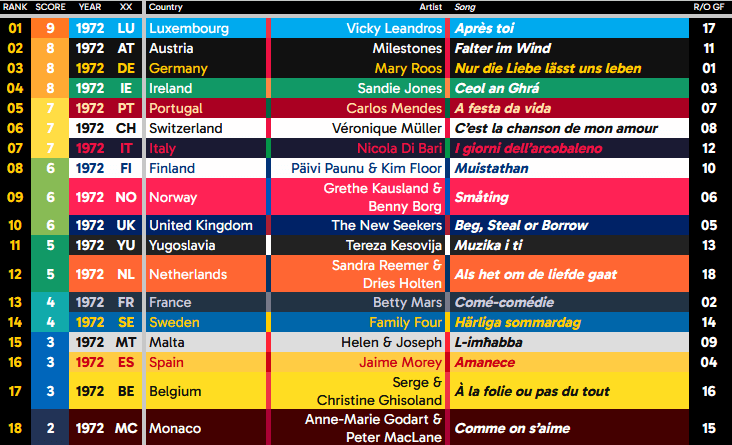
This year had the same 18 participating countries as 1971, and the same 1-5 star voting system as well. The winner was Luxembourg with the iconic song “Après toi”, the UK scored yet another second place, and Germany scored a third place two years in a row although they still had yet to win. In last place came Malta for two years in a row, which led them to skip the next two years.
Last time I watched the contest with German commentary, but this time with British commentary done by Tom Fleming. He begins the show narrating the history of Scotland as though he’s a movie narrator. The orchestra plays an arrangement of “Un banc, un arbre, une rue” in homage to Monaco as the camera pans down to the audience, all dressed in fancy suits but with a little splash of color. Then Moira Shearer enters this year’s glamorous stage and gives the usual efficient British-style introduction to the show in English and French. Sadly the show doesn’t have postcards this year, but it does have cute little photos of each competing artist on the big screen before each song begins.
Germany: Nur die Liebe lässt uns leben
Artist: Mary Ross
Language: German
Key: E major, F major
My ranking: 3rd
As I said in round 1: I wasn’t born before 1996 so none of the before 1996 German spellings appeal to me. That’s why I spelled the fourth word of the title as “lässt”, not “läßt”.
Last year the contest got off to a really bad start with “Musik”. This contest is the total opposite: this is the perfect opener to put the audience in the right mood. I personally think it’s one of my country’s best Eurovision entries. It puts a big smile on my face and gets me nostalgic for when my mom was a kid, and I wasn’t even born then.
Remember when I criticized the previous German entry “Diese Welt” for having a catchy chorus but forgettable verses? This song solves the problem by having verses just as catchy as the chorus. This is peak German-sounding retro pop, or at least close to the peak. Not only does it have a brilliantly catchy melody in the lyrics, it also has a lot of hooks in the instrumental that jump at me. First off is the guitar riff playing broken chords that appears in the opening of the song, then after each chorus. The song is also heavy in brass riffs, which get bigger and bolder as the song progresses. And if that wasn’t enough, we have a whole lot of string riffs in the verses as well. I like when a catchy melody from the singer is complimented by a just as catchy melody in the instrumental, and that’s what the strings do here.
The singer helps sell the entry to me in several ways. She has a fabulous black dress with a cool little checkerboard pattern in the bottom half, and her energy is completely infectious. The song also makes good use of backing singers: they alternate between harmonizing with her and some backing ooo’s.
I’ve had nothing but praise to say about this song, so the fact that there are two entries I like even more proves that Eurovision 1972 is a banger year.
France: Comé-comédie
Artist: Betty Mars
Language: French
Key: F major, F♯ major
My ranking: 13th
We can’t have too many nice outfits in Eurovision. I hate Betty’s dress just as much as I love Mary’s. It looks like it was created with a random outfit generator: it has a pink striped top half, a wedding dress bottom half, and sleeves that would themselves work as wedding dresses.
Anyway, this is France sending their usual French-sounding waltz, though this didn’t get too good of a result: only 11th place. She has a good voice like pretty much every French singer, but the song lacks progression and does nothing to excite me. It’s not too bad to listen to, but I think I agree with Erica calling it dreary.
Ireland: Ceol an Ghrá
Artist: Sandie Jones
Language: Irish, for the first and only time
Key: G major, A♭ major
My ranking: 4th
Hey Ireland, please send songs in Irish more often! I know the Irish are proud of their traditional culture and I wish they’d show it off more in their Eurovision entries instead of sticking to ballads (and later, uncompetitive pop). I can understand whey they don’t send Irish-language songs more, because it’s a rather obscure language and the vast majority of Irish musicians sing in English, but I wish they did because this is such a lovely song.* It’s a waltz that makes me feel like I’m galloping through a fairytale world of Irish folklore. I love the melody and 12/8 meter, as well as Sandie’s expressive voice. I don’t like the bombastic speed-up ending because it sounds out of place, but the rest of the song is lovely and dreamy. This got only 15th place—shame on the juries for not appreciating it.
I looked up the lyricist of the song out of curiosity: his name is Liam MacUistín and he’s not only a songwriter, but also an author and playwright who modernizes Irish folk tales, both in English and Irish.
* I actually have an Irish friend who’s able to speak the language, and she snarked once that Americans don’t think Irish is a real language.
Spain: Amanece
Artist: Jaime Morey
Language: Spanish
Key: F♯ major and D major in alternation, then G major
My ranking: 16th
In round 1 I said this entire song fades into mush for me, and I still feel the same. It feels like an AI-generated 1970’s Eurovision song: you can recognize the style, but there’s no soul behind it or personality. How dare the juries give this more points than Ireland?! I’m curious if people who speak Spanish find it just as generic as I do.
United Kingdom: Beg, Steal or Borrow
Artist: The New Seekers
Language: English
Key: G major
My ranking: 10th
I should mention this was the last Eurovision year where 100% of the music was required to be played live. I know this from this article on a blog about the Eurovision conductors. The band was nervous about playing their instruments live, which makes sense because when you need to amplify even one instrument on stage, the entire setup is a pain in the ass. The conductor David Mackay made the live instruments work with a little coordination, so the next year when he conducted again, he was disappointed to realize he played a part in the rise of backing tracks. But that’s a topic for when I review 1973.
The UK went all out in 1970’s fashion this year, and I love it. All five of their outfits look awesome, even more so as an ensemble. The song itself is a British-sounding rock tune with harmonies and a tinge of country, and it’s quite sugary but a pleasant tune nonetheless. I think second place was too high because there are better songs this year.
Norway: Småting
Artist: Grethe Kausland and Benny Borg
Language: Norwegian
Key: D major, E♭ major
My ranking: 9th
Norway brings us the first of many romantic duets this year, and I find this one rather cute. It probably helps that the song has a similar theme to the previous Norwegian entry: it’s about finding happiness in the small things. A man playing guitar and a woman just singing is a common trope in this era of Eurovision, isn’t it?
When was the last time a Eurovision song had a freeform intro? The start of this song truly brings me back to the grayscale years, and I don’t mind as much as I would if this year were filled with freeform intros. The song is quite nice in the verses with those harmonies, but unfortunately in the chorus, the laid-back beat of the guitarist clashes with the more energetic beat of the orchestra. Still a pleasant little tune overall. It has a freeform ending where the duo sings the title a few more times, and I find that a cool touch.
Portugal: A festa da vida
Artist: Carlos Mendes, returning from 1968 and now with a beard
Language: Portuguese
Key: E minor
My ranking: 5th
I often see this song in personal winner compilations, and even though there are much better songs this year I can understand why. This is a solid little Portuguese-sounding retro pop song with a super catchy melody in the chorus. Both the instrumental and melody have a very Latin sound to them, and I could see some people wanting to dance to this. Forgive me if my review of this isn’t long, there just isn’t much to say about this.
Switzerland: C’est la chanson de mon amour
Artist: Véronique Müller. Only in Switzerland would you get a name with a such odd combination of languages.
Language: French
Key: B♭ minor (verses), B♭ major (chorus)
My ranking: 6th
I’ve totally forgotten how this song sounds, though apparently I rather liked it in round 1. And yeah, I totally agree with my thoughts from last time. It’s such a shame the song has a generic title (it’s the song of my love), because a song as interesting as this deserves a better one. I think it’s because of the generic title that I forgot this song existed for so long.
Normally I don’t like when songs have minor key verses and a major key chorus, but there are occasional songs that pull off this trope well, like this one. I can’t fully explain why; maybe it’s because both the verses and chorus sound interesting? The verses sound mischievous while the chorus gets all romantic and dreamy, but not in a clichéd way. I also like how minimalist the instrumentation is, and her expressive performance on a guitar.
Malta: L-imħabba
Artist: Helen and Joseph (Helen Micallef and Joe Cutajar)
Language: Maltese, plus Italian, Spanish, German, and English words for “kiss”
Key: E♭ major, F major
My ranking: 15th
Now we have Malta’s last entry in Maltese; as with their previous entry, this one got last place. I have to admit, this song made me hit a brick wall for two months writing this post, because I really don’t know what to say about it. It’s a generic cheesy 1970’s pop song that tries to do a language gimmick but doesn’t succeed because the foreign words are barely noticeable (at least to me) except for “kiss” in English a few times. Apparently I was peeved about them staring into each other’s eyes in round 1, but now I just find this song forgettable.
Finland: Muistathan
Artist: Päivi Paunu and Kim Floor
Language: Finnish
Key: B minor
My ranking: 8th
This is a better romantic duet compared to the previous song. It doesn’t spark passion in me, but it has quite a few things to like about it: the singers have solid harmonies in the chorus, the man has a nice deep voice, and the whole thing is extremely Finnish-sounding. The slightly mischievous sound and melodies in an even rhythm are the main reason it sounds so Finnish to me. I’m cool with the freeform parts and the speed-up at the end too, because they give the song a sort of stage play feel.
After this song, you can see the younger jurors from Belgium and Luxembourg seated side by side and having a little chat. Are they doing any strategic voting perhaps? The winner of this year is a well-liked song, so there aren’t really any conspiracy theories about it.
Austria: Falter im Wind
Artist: Milestones
Language: German
Key: A major
My ranking: 2nd
Ah, and now we have my former winner of the year. Relistening to one of my ex-winners feels like reuniting with an ex-friend and remembering what I liked about them.
I haven’t listened to this song in quite a while and I totally forgot how good this was. It’s so different from all those cheesy 70’s pop songs and formulaic ballads. It features two guitarists, one pianist, and one flautist all jamming out and singing together, and all four instruments feel essential to the song. The flute lady can’t sing and play flute at the same time, so her vocals only appear in the chorus. The flute melodies are really funky and make the song so interesting. Oh, and it’s got lovely harmonies too. Plus some interesting percussion in the chorus if that wasn’t enough. Is there anything more I could ask for?
I’m not sure what genre this song falls into—it’s sort of rock-adjacent I suppose. But I do know this is the kind of song you can vibe to while thinking about nature. The lyrics are about nature as well; they describe a butterfly that is exploring nature and tell this animal not to fall into the sun. It might be a metaphor about romance or something, but I prefer to just think of this as a song about nature.
Part of me wants to change my winner back to this, but I won’t do so because I’ve gained so much appreciation for “Après toi” as a composition. Still, sending an unusual song paid off well for Austria and landed them fifth place. Perhaps the Austrians had expected more than that, because they would not return to the contest until 1976.
Italy: I giorni dell’arcobaleno
Artist: Nicola Di Bari
Language: Italian
Key: D major
My ranking: 7th
I think I was too hard on this song in round 1. I’m not known for loving Italian ballads, but this one actually sort of wins me over. I like that it stays minimalist the whole way through, for one. The song comes off as very artsy to me, in a good way. In round 1, I said that this is the kind of song people think is artistic just because it’s in Italian, but I think that was unfair. The lyrics and performance feel thoroughly artistic even if you don’t speak Italian, because he looks expressive and the words sound phonetically pleasing. It’s sort of like “Non ho l’età” eight years back in that sense, because that song also feels artistic to me.
This is on a much higher standard of quality than other Italian entries of the time, because it was the first Sanremo winner to go to Eurovision since 1966, and the last until 1997. So yeah, overall I quite like this song now. It’s just nowhere close to my winner because 1972 has a lot of other great songs.
Yugoslavia: Muzika i ti (Музика и ти)
Artist: Tereza Ana Kesovija, who represented Monaco in 1966
Language: Serbo-Croatian (Croatian)
Key: F major, briefly F♯ major at the end
My ranking: 11th
Monaco and Yugoslavia has to be the strangest combination of countries someone has represented in Eurovision, unless I’m forgetting something even weirder. Helena Paparizou got fourth place in Melodifestivalen 2014, so she got close to representing an odd pair of countries: Greece and Sweden. She’s a Greek who spent most of her childhood in Sweden, so she has a connection to both nations.
For some reason, I have a very distinct memory hearing this song in the Emporia Mall in Malmö, probably while getting some food. I spent a lot of time in that building during Eurovision 2024, because it’s right next to the Malmö Arena and was bustling with fans the entire week. It was confusing as fuck to navigate that place.
This isn’t a song I think about much, but the fact that I recognized it in the wild shows that it’s quite catchy. But otherwise, it’s a generic 1970’s Eurovision entry with the usual bombastic chorus and overdramatic singing. It also has a cheesy key change and drawn-out ending, because of course it does. Not a bad song, but very formulaic.
Sweden: Härliga sommardag
Artist: Family Four, returning from 1971
Language: Swedish, for the last time until 1977
Key: B♭ major, B major
My ranking: 14th
This is similar to Family Four’s last entry but a little better. I still can’t say I’m a big fan of it though: the verses once again sound too dreary, and the chorus is a little too restrained. Sweden had the right idea with a band of two men and two women and there are some good harmonies in there, but we all know they got the formula much better two years later. As with “Vita vidder”, this sounds nothing like an ABBA song except I suppose the two women dominating the vocals.
Monaco: Comme on s’aime
Artist: Anne-Marie Godart and Peter McLane
Language: French, for the first of three songs in a row
Key: G major and G minor in alternation, then B♭ major at the end
My ranking: 18th (last)
Apparently I found this ultra-sugary in round 1, but I can’t remember how this sounds at all. Oh god, this is just as saccharine as it apparently was, and not in a good way.
It’s without a doubt the worst entry of 1972 and has a rather impressive amount of things wrong with it. It alternates between two completely different songs as I already discussed in round 1. The singers spend the most of the song staring at each other and I think I’ve figured out why that’s so annoying. It’s because that makes the singers come across as self-indulgent and making everyone else watch their romance, instead of sharing their romance with the audience like the couples in “Sing, Little Birdie” or “À chacun sa chanson”. Additionally, there was a major missed opportunity for some harmonies, since they just sing an octave apart most of the time which does not count as harmonizing.
This song doesn’t get a 1/10 because it isn’t completely awful. The minor key sections aren’t too bad; their alternation with the ultra-sappy major key parts just annoys me. I kind of wish this song was more awful because ranting about songs I hate is so much fun. In summary, this is a pretty bad song, but not bad enough to be a memorable atrocity like, let’s say, “Quién maneja mi barca”.
Belgium: À la foile ou pas du tout
Artist: Serge and Christine Ghisoland, a married couple as you can tell from their shared last name
Language: French
Key: D major, E♭ major, E major
My ranking: 17th
I want to like this romantic duet because it’s by an actual married couple, and they seem like the type who would be able to sell this song well—it’s about a couple whose style of romance is proudly extravagant. Unfortunately, this song is only slightly better than Monaco’s. It has proper harmonies and sticks to one style, but it’s also very dreary and repetitive, and uses a series of key changes in lieu of musical progression. The singers don’t convince me that much—maybe they aren’t fond of this song either. The part where he sings and she responds with spoken word especially seems unnatural to me.
At the end, this song leaves me thinking “that wasn’t very good”, so it’s the definition of a 3/10.
Luxembourg: Après toi (the winner)
Artist: Vicky Leandros, returning from 1967
Language: French
Key: F major
My ranking: 1st
This song was composed by Vicky Leandros’ father Leo Leandros, who died just a few days ago on October 31, 2025, at an astounding 102 years old. I didn’t even know he was still alive until the day he passed. His daughter is still alive at 76 years old.
In any case, it feels good when the best song of the night wins the show. Let’s see, is there anything interesting I missed about this song when I first reviewed it? Not much, really. I’m not gonna repeat my analysis of the alternate language versions; you can read my original review for that.
This is just such a beautifully composed song, especially in the chorus which just manages to hit me right in the gut. Vicky Leandros nailed her performance on the night: she looks absolutely gorgeous in that black dress, and it’s exactly the perfect style for a song as heartbreaking as this. She truly feels the song as she performs it and convinces the audience effortlessly. To recap, the lyrics are about her love interest ditching her for someone new, and she sings that she will no longer exist in his heart. You can see and hear the heartbreak as she performs it. It’s not quite a 10/10 for me, but the song does absolutely everything right so it’s a very high nine. You know this is a great song when even Erica, the biggest ballad hater I know, has this as her winner.
This song was the natural choice for 1972 to turn into a chiptune cover. I decided to arrange the orchestral version for the sake of saving time, though almost all my covers after that point were instead based on the studio version. I’m pretty happy with how that one turned out.
Netherlands: Als het om de liefde gaat
Artist: Sandra and Andres (Sandra Reemer, Dries Holten)
Language: Dutch
Key: D♭ major and B♭ major in alternation
My ranking: 12th
I’m just a little bit ticked that Sandra and Andres are one letter apart from being anagrams. If only his stage name was Andras instead, that would be a lot more pleasing.
An actual crowd pleaser in the second last spot, and a goofy ditty at the end… that’s exactly the kind of running order the Eurovision producers come up with these days. Except back then it was randomized of course. Anyway, this song is weird and childish-sounding, but also fairly catchy. It’s a little bit like a duet version of “Puppet on a String”, since it has the same sort of oompah beat, except it also has random slow sections for some reason. I’m surprised it landed as high as fourth place when it had to follow Vicky Leandros.
My full ranking
This was a pretty easy year to rank, since there was a clear divide between good, meh, and bad songs. The hardest song to place was Italy because how much I like it depends on my mood, but for its artistic merit I placed it quite high.
Since it’s been a while since my last round 2 review, an update to my winners list is due. I’ll do three changes for now, while I’ll save some others for future posts. I changed my 1996 winner to Norway in this post, but now I’m changing it back to Sweden, Den vilda because it just feels like the right choice. For 2009 I should’ve chosen Moldova, Hora din Moldova this entire time because it’s so impossibly amazing and joyful (sorry Estonia). It has to be in my top 20 if not 10 favorite Eurovision songs of all time. And as for 2025, I’m sorry to say I’m getting tired of “Zjerm” from Albania and my new winner is Sweden, Bara bada bastu. You can see my current ranking of 2025 here; Albania has fallen to my seventh. Don’t get me wrong, Shkodra Elektronike are absolute geniuses. They just have even better songs than “Zjerm”. Anyway, here’s the new list:
- Belgium, 3 (1957, 1976, 2003)
- Bosnia and Herzegovina, 2 (2001, 2006)
- Denmark, 2 (1963, 2000)
- Finland, 4 (1983, 1989, 2010, 2023)
- France, 3 (1977, 1990, 1991)
- Germany, 5 (1956, 1968, 1979, 1982, 1999)
- Greece, 1 (2013)
- Hungary, 2 (2005, 2019)
- Iceland, 1 (1992)
- Ireland, 3 (1970, 1980, 1994)
- Israel, 1 (1987)
- Italy, 1 (1964)
- Latvia, 2 (2002, 2018)
- Lithuania, 1 (2022)
- Luxembourg, 4 (1965, 1972, 1973, 1988)
- Moldova, 1 (2009)
- Monaco, 1 (1960)
- Montenegro, 1 (2015)
- Netherlands, 8 (1959, 1967, 1969, 1971, 1975, 1998, 2014, 2024)
- North Macedonia, 1 (2020)
- Norway, 4 (1966, 1985, 1993, 1995)
- Portugal, 2 (1984, 2017)
- Serbia, 4 (2004, 2008, 2011, 2012)
- Sweden, 4 (1958, 1974, 1996, 2025)
- Switzerland, 2 (1986, 2021)
- Turkey, 2 (1978, 1997)
- Ukraine, 2 (2007, 2016)
- United Kingdom, 3 (1961, 1962, 1981)
- (21 winners)
Rest of the show:
The host with her uncanny RP accent introduces the interval act in English and French, and the commentator Tom Fleming reflects on this year saying it has a high standard of songs. Then comse the interval act, which basically goes “we’re in Scotland so why not do the most Scottish thing possible?” It’s pre-recorded footage of a Scottish bagpipe band and it keeps the audience entertained quite well. I like big crowds of people doing big theatrical performances, that’s what interval acts should be all about! The interval act wasn’t very long though—I assume that because of the streamlined voting system, the show could have gone without one, but the producers felt one was obligatory anyway.
Now for the jury voting, it was weirdly funny whenever a jury member rated a song 1/5. It’s like they’re saying wordlessly “your song fucking sucks” and can’t be a pleasant experience for the contestants. But a lot of the juries’ ratings do make sense here; the voting seems less random here than in 1971. Some of the others felt like strategically voting against the songs with a good chance of winning, especially the 1’s to Luxembourg. At one point during the voting, Andres from the Netherlands smoked a cigarette indoors, which is how you know this was over 50 years ago. I can’t recall seeing anyone smoke a cigarette indoors in the past ten years or so. People my age have been bombarded with statements about how unhealthy tobacco is since childhood, so we were raised to think of it as uncool. My parents are a different story: they struggled for years to quit smoking, but they managed to do it while I was a kid.
Anyway, Luxembourg in the voting stayed consistently in the lead, but by a close enough margin to still feel exciting. It was a completely deserved victory, as were most during the 20th century. Vicky Leandros traded cheek kisses with Véronique Müller from Switzerland, who must have really liked her song, then presumably exchanged congratulations with other entrants. Then a brief orchestral reprise of “Un banc, un arbre, une rue” leads Sévérine to pass the trophy to a man the commentator calls “Mario Panas”, who is in reality Vicky’s aforementioned father. The winner’s reprise happens, we get credits with some glamorous orchestra music, and that’s that.
General thoughts:
Eurovision 1972 is, simply put, a banger year. Maybe not the bangerest of banger years ever, but it has a lot of great songs in a variety of genres. Some songs perfect a typical Eurovision genre like “Après toi”, while others are totally unique like the funky nature tune “Falter im Wind” and the Irish-language “Ceol an Ghrá”. The year also has that glamorous BBC stage design and some fun touches in the production, like the camera projected photos of contestants and the fancy fonts used on stage. There are a few crappy songs this year, but the same holds for pretty much every Eurovision year. In fact, I consider the bad songs part of the fun of Eurovision. That’s something I love about Turin 2022 in particular—it has an insane amount of awesome songs, but the bad songs are an absolute joy to bash on.
See you next time for another absolute banger year for me to pop off about.
 Cookie Fonster's stuff

Hello, and nice to see you making another post again! To me 1972 is a strong year, about as strong as 1971, and I really enjoy a lot of the songs here.
My winner is Finland. In my opinion, Muistathan is our first truly great entry, and also by far the best executed one out of the duets this year. The song tells the story of the singers’ brief romantic encounter, without any cliches. The lyrics in general are really well written in my opinion. It is quite rare for old Finnish entries to have such well-written lyrics, and here they really add to my enjoyment of the song. Päivi and Kim have great chemistry together and they bring the song to life.
Other songs I love this year are Austria (very interesting song + I love love love flutes), Germany (super fun and energetic, with great percussion) and Portugal (love the drama).
I’ve never been a fan of Après toi personally. I can see why people love it, but to me it’s just rather bland, and overly dominated by the chorus. Vicky’s vocals improved a lot between 1967 and 1972, which makes me prefer this over L’amour est bleu (which suffers from the same issues). Fantastic styling though!
Comme on s’aime is a banger and I will unashamedly defend it
See you in 1973, where my favourite entry of all time gets cruelly robbed by the juries.
LikeLiked by 1 person
I somehow forgot to mention that I love the UK this year, first good UK song ever
LikeLiked by 1 person
I’ll have to take your word on Finland’s lyrics—that’s language barriers for you! And that’s also why it’s nice to have commenters from so many other countries. And for me, the thing with Monaco’s entry is, the major and minor key parts aren’t actually too bad individually. The jumps between them just really throw me off.
LikeLike
Nice to see you again!
1972… I recently watched that edition only a week ago. I can probably say that Germany was my favorite, while Luxembourg is a VERY close second.
I also liked the United Kingdom’s, Yugoslavia’s, and Austria’s entries as well. Overall, I’d say it was a solid year. I agree that Belgium and Monaco were bad – and easily my least favorites from the year. Everything else just… exists (in my opinion).
I would also like to add here that in the event that Israel does participate next year in 2026, then sadly I will not be following the contest – but I will still listen to and rank the entries, I will just not watch the shows. I’m not a believer in boycotts – its simply because I can’t find myself enjoying following an event that has become so embroiled in controversy and uncertainty over the last few months. I still do believe that Israel should be excluded from the 2026 contest on the grounds of their proven deliberate manipulation of the televote from last year and the year before. That is all.
LikeLiked by 1 person
So your tastes are pretty similar to mine for this year—it seems a lot of people agree 1972 was a strong year. And as for the 2026 contest… I probably will still watch the semifinals because it’s just so exciting to see who qualifies. But if that country isn’t banned, I will probably only watch the final after the event if I know they didn’t win. The results of the 2025 final left me thinking, “what the actual fuck was that?”
LikeLike
I’m very fond of 1972 as a year. I can’t see myself changing my winner from Austria, but Germany and the UK are great 2nd and 3rd for me.
I really like that the UK broke out of their silly circus-sounding songs and sent something serious like this. It’s probably the first UK entry I’d consider listening to casually.
I also really like Yugoslavia. It’s bombastic, but it’s bombastic in all the right ways.
As for Après toi, I like it, but I don’t love it. I think it’s just missing that spark of greatness for me to go crazy over it.
My least favourite of the year has to be Spain, however. He just screams at me for 3 minutes and then the performance ends. And yeah, both Belgium and Monaco are bad too. But I do like Malta actually.
LikeLiked by 1 person
It seems like we’re on the same page regarding this year over all. And circus music is actually the perfect way to describe most of those cheesy old UK entries.
LikeLike