
< 1968 Review | 1969 Review | 1970 Review >
Introduction
Eurovision 1969 (the year of my mom’s birth) was the most controversial year up to this point, even before the show began. It’s not a controversial year to fans today, unlike Rome 1991 which is still hotly debated among modern fans, but at the time it was very much controversial. There are two big reasons for the controversy: first, that it was hosted in Spain which was at the time a dictatorship ruled by Francisco Franco. Second, the voting sequence had four countries tied for first place, and since there was no tiebreaker rule, the producers decided to make all of them the winner. Many countries were not happy with this decision.
When I did round 1 of my Eurovision blog, I said this was the first Eurovision in a city I’ve been to: Madrid, which is a beautiful city and lots of fun to explore. But now, the oldest Eurovision in a city I’ve been to is Copenhagen 1964. The count of Eurovisions hosted in cities I’ve visited was “anywhere from four to eight” last time, but now that number has increased by eight because I went to Gothenburg (1 contest), Malmö (3), and Copenhagen (3) in 2024, and Basel (1) in 2025. Now the number of Eurovisions where I have visited the host city is anywhere from twelve to sixteen. Sixteen is also the number of competing countries this year, because Austria skipped out. Ostensibly they couldn’t find a representative, but most people believed the real reason was as a protest against Francisco Franco.
Now the contest having four winners is ridiculous for two reasons. First because the EBU should have had a tiebreaker rule, or at least thought of one on the spot. Second because there was one song clearly far better than everything else that should have won outright: “De troubadour” from the Netherlands. The other three winners (Spain, the UK, and France) I remember being likable songs, but not half as good as the Netherlands. There were no nul-pointers this year: Norway landed at the bottom with one point.
The show opens with “Te Deum” on the organ set to a metal sculpture onstage by Amadeo Gabino, then a kickass promotional poster by Salvador Dalí set to an orchestral arrangement of “La la la”. Why did Eurovision have to abolish the orchestral reprises of last year’s winner early on? They were so cool and fun! Then the presenter Laurita Valenzuela comes in to do the show mostly in Spanish. Her diction in Spanish is very clear and quite easy to understand, even with my limited level of Spanish, and she’s a rare presenter who’s more comfortable speaking in French than English. After the intro in Spanish, French, and English, she said “guten Abend” so I thought she was going to give a speech in German, but she just said “good evening” in all the remaining languages.
As with last time, I’ll watch this with Spanish commentary, done by longtime commentator José Luis Uribarri. He last commentated for Spain in 2010 and died two years later.
Yugoslavia: Podrav svijetu
Artist: Ivan & 3M
Language: Serbo-Croatian (Croatian), plus greetings in Spanish, German, French, English, Dutch, Italian, Russian, and Finnish
Key: D♭ major, D major
My ranking: 12th
This is one of those entries that puts in a gimmick to make it memorable, but isn’t anything interesting musically. A gimmick can make a good song even better, but it can’t improve a dull or bad song.
Pretty much the only interesting thing about this song is the language gimmick: half the lyrics are Ivan and his backing singers saying “good morning” in a bunch of languages, the other half is also just about greeting the entire world. I want to score this lower than a 4/10 because it’s so inane, but it’s not unpleasant to listen to, so a four will have to do. I remember this being a strong year, so this won’t be very high in my ranking.
Luxembourg: Catherine
Artist: Romuald Figuier, who represented Monaco in 1964
Language: French
Key: F♯ major, G major
My ranking: 14th
I was quite harsh on this song the first time: I said it was about a man who still has a crush on his childhood friend and called it “creepy as fuck”. I could’ve totally given this song the benefit of the doubt, but the fact that I didn’t proves that I didn’t think much of it. I don’t think much of it now either; it’s just a generic French waltz whose singer looks slightly full of himself. I think 3/10 is the right rating for this: at the end I’m left thinking “that wasn’t very good”.
Spain: Vivo cantando (winner #1)
Artist: Salomé (Maria Rosa Marco Poquet)
Language: Spanish, sung by a Eurovision winner for the last time
Key: F major at the start, F minor in the verse, F major again, then briefly F♯ major, then G major, then A♭ major
My ranking: 5th
I already did a huge analysis of this song’s structure in round 1, so read that again if you wish. I won’t write that analysis all over again, but instead discuss my relationship with this song.
This is one of those Eurovision entries I really enjoy while they’re happening, but never go out of my way to listen to. It’s sort of like “La la la” on steroids: even gloomier verses and an absolutely crazy happy chorus. One cool thing about the song I didn’t mention in round 1 is the funky bassline in the chorus. I’m always a sucker for a good bassline. It’s obvious why this won, because Eurovision is all about leaving a good first impression. I am wowed at the end of this song, but I never am left feeling “wow, I need to listen to this more often”. I think that’s because the song is episodic and meant to be experienced as part of a live show. Compare this to my beloved “De troubadour”, which is one of the most beautiful songs in existence no matter where you hear it.
Monaco: Maman, maman
Artist: Jean-Jacques Bortolaï
Language: French
Key: C minor, D minor at the end
My ranking: 4th
You know what? Underage singer or not, this really is a lovely little song. He sings it very well and it rings with emotion both in lyrics and vocals. As I said last time, “It’s about a boy who had a dream of being a heroic man and making his mother proud, then a bad dream where he saw his mother age, and ultimately decides he wants to remain a kid as his mother protects him. It’s a nice little movie-sounding tune with a heartwarming message.” I don’t mind the little genre switches, because most of the song is pumping and dramatic, and the marchy bits are just a few measures at a time. It also has a really lovely melody.
Unlike with Spain’s song, I am left at the end thinking I should revisit it more often. I’m actually hard-pressed to think of an entry with an under-16 singer that I like more than this. “J’aime la vie” would be a candidate, but that one has somewhat grown off me.
Ireland: The Wages of Love
Artist: Muriel Day and the Lindsays
Language: English
Key: B♭ major, C major
My ranking: 10th
Thanks Ireland for not sending a ballad for once! It’s an upbeat late 60’s pop song, but I want to like it more than I do. She looks and sounds too rehearsed and while her vocals are perfectly solid, I feel like she puts more attention to her dancing than expressing herself vocally. It pretty much goes in one ear and out the other, and the slowdown notes before the final chorus annoy me. Otherwise, I don’t have strong feelings about this song.
Italy: Due grosse lacrime bianche
Artist: Iva Zanicchi
Language: Italian
Key: F major
My ranking: 15th
Ah, here’s the song that I remember starts with a lovely guitar riff but the riff unfortunately disappears and it turns into a generic DAF ballad. And yep, this song is just as bland as I remember it being, and there’s no way I’ll be able to hum this ten minutes after hearing it. I also don’t get why it speeds up near the end only for it to slow down. It feels as if the orchestra players misread “ritardando” as “accelerando” and then realized their mistake a few seconds later.
Funny enough, Vlad has the opposite problem with this song: he hates the guitar riff but likes the rest of the song. I think he just hates country music the same way certain other reviewers hate ballads.
United Kingdom: Boom Bang-a-Bang (winner #2)
Artist: Lulu Kenny-Cairns
Language: English
Key: A major, B♭ major
My ranking: 6th
This, on the other hand, is something you only need to hear once to be able to hum from memory, so as with Spain I can see why this won. “My heart goes boom bang-a-bang, boom bang-a-bang when you are near”, now that’s such a catchy melody! The UK kept doing well with their upbeat pop songs with a catchy hook, so why change what’s working?
Even though it’s another cheesy British romance entry that the singer doesn’t even like, I can’t help but enjoy listening to this, mostly because of the chord progression in the chorus. It’s not a song to keep, but one to enjoy while binging Eurovision. But it was a major European hit at the time, so people my parents’ age are likely to have heard this song a lot.
Netherlands: De troubadour (winner #3)
Artist: Lenny Kuhr
Language: Dutch, sung by a Eurovision winner for the last time
Key: C♯ minor
My ranking: 1st. You shouldn’t be surprised.
I already loved this song when I first reviewed Eurovision 1969, but at this point I love it at least twice as much. Some Eurovision songs I’ve become tired of the more times I heard them, but this song is the exact opposite. The more times I listen to it, the more I realize how insanely beautiful the song is. The triple meter, the acoustic guitar, Lenny Kuhr’s deep passionate voice, and oh my god just everything about it. The song speeds up and slows down in a way that actually works, because it matches the story that the lyrics tell. It’s about a musician who played tunes that touched the hearts of his entire city, and one day he died but the people who heard his songs will never forget him. This, people, THIS is a true winning song. It absolutely should’ve won 1969 outright because it’s just that good, but I consider it the true winner of the year anyway, because the Netherlands hosted next year and Lenny Kuhr passed Dana Rosemary Scallon her trophy.
I’ve always considered this song to be a 10/10, but after getting more exposed to this song through doing an 8-bit cover (which was hard as hell, but so worth it), the song is not just a regular 10/10, but a big fat 100/100. Best entry of the entire 1960’s hands down. Erica loves the song even more than I do—as she puts it, “It’s not messy or boring or vaguely annoying – it’s everything a song should be.” She also said that this is the best song her country has sent to Eurovision. I would say this is the third best Dutch entry in Eurovision history, behind “Europapa” (my third favorite Eurovision song of all time) and “Calm After the Storm” (my second of all time). This is at the very least in my top 20 Eurovision songs of all time, maybe even in my top 10, but I’m not 100% sure.
I don’t want this review to just be gushing about how good this song is, so how about I evaluate the alternate language versions of this? English, German, French, Spanish, and Italian. The English version has a medium-strong Dutch accent, but Lenny Kuhr has the same lovely dramatic voice. You can tell the English version is an adaptation of a song in a different language, and not just because I’m familiar with the Dutch version. I can tell the song is designed specifically to be sung in Dutch. Now for the German version, I find it adorable as fuck when German is spoken with a Dutch accent, and you can hear an accent in that one too, but her pronunciation is also good enough to impress me. The German lyrics fit the rhythm more naturally than the English lyrics do. Some of the German lines are near identical to the Dutch ones, such as “toen werd het stil, het lied was uit” and “nun ist es still, sein Lied ist aus”.
It’s much less common for Dutch people to know French than to know German, so her pronunciation in French is impressively accurate. The French lyrics fit the song reasonably well, because it’s freeform and all, but this is still a very Dutch song. Her Spanish pronunciation is the most thickly accented of all, which makes sense because Spanish and Dutch don’t have so many sounds in common. Is it just me, or does her Spanish sound a little bit Greek? The Italian version is the only one that doesn’t use a translation of the word “troubadour”. Perhaps because it’s four syllables instead of three, but I think Lenny Kuhr could’ve totally added an extra syllable to sing “il trovatore”. Her Italian pronunciation seems pretty solid, but I’m not as qualified to judge it as the other languages.
Bottom line: this song is just so lovely in every way. It feels like something special is happening whenever I listen to this, in any version or any performance.
Sweden: Judy, min vän
Artist: Tommy Körberg
Language: Swedish
Key: A♭ major, A major
My ranking: 7th
Now this, on the other hand, isn’t quite as good as I remember it being. It doesn’t help one bit that “De troubadour” is a tough act to follow. I mean, I still quite like it, and it’s cool that the classical-inspired song is followed by a burst of modernity. Tommy Körberg is an expressive and likable performer, but the song sounds just a little bit like 1970’s cheese now, and it slows down too many times.
I should also note that the host Laurita Valenzuela completely butchered the singer’s last name. She pronounced “Körberg” as if it were a Spanish word and ignored the umlaut on the O. The really tricky letters in his name are the first and last. The K is pronounced similar to English “sh”, and the G at the end is an English “y” sound. I know, it’s a bit unintuitive to have that at the end of the word after a consonant, but let’s face it, Swedish sounds are weird in general. Same for any Germanic language.
Oh yeah, here’s a song I randomly discovered from Melodifestivalen 1969 that is too good not to share: “Du ger mig lust att leva” by Lena Hansson. I have a massive soft spot for bossa nova, so this tune plucks right at my heart. The lyrics I can understand fairly well with my limited knowledge of Swedish, and they’re as romantic as can be. It perfectly captures the feeling of having a new crush.
Belgium: Jennifer Jennings
Artist: Louis Neefs, returning from 1967
Language: Dutch
Key: D major, F major
My ranking: 13th
A glimpse at the lyrics has led me to wonder something: why on earth is the past tense of “komen” (to come) in Dutch “kwam” instead of “kam”, which would match English “came” and German “kam”? Where the hell did that W come from? I’m sure this seems completely normal to Dutch speakers, but I find it strange anyway. As I just got done saying, Germanic languages are weird in general. Just as confusing to me is that “wie” in Dutch means “who”, because in German it means “how” (and a few other things).
Anyway, sorry Louis Neefs, but this is the most meh song of the year. It alternates between a bombastic pop song and a gentle one, but it doesn’t do a very good job at either. It’s not horrible, but it’s very much forgettable, and his shaking on stage distracts me.
Switzerland: Bonjour, bonjour
Artist: Paola del Medico
Language: German, plus a handful of French words thrown in
Key: A♭ major
My ranking: 8th
Ah, here’s Paola del Medico, I remember her from the interval acts of Eurovision 2025! She’s a familiar name to Europeans my mom’s age—I know this because my mom recognized that name when we watched the 2025 grand final. I think the older Paola got, the better her fashion sense became, because my god her dress in 1969 is hideous. What’s with the orange dots and weird transparent sleeves?
As I said in round 1: The chord progression of the verse is jazzy in an eccentric way, and the progression of the chorus is much more normal. I actually enjoy when the verse and choruses’ progressions contrast this much, since it keeps me engaged. I agree with myself, I often love when songs have a weird chord progression in the verses and a normal happy one in the chorus. Unfortunately, I think the verses just sound too weird for me, so I actually prefer the chorus here. Also, the slowdown near the end (plus the gradual speedup) really weighs down the song. It’s the musical form of a traffic jam.
On the plus side, Paola is having a lot of fun performing this song, and it’s a creative composition. I said in round 1 that the eccentric verses don’t fit the romantic topic of the song, but I don’t agree with that anymore. Having a crush always feels dizzying, like you don’t fully know what’s going on in your head or around you, so in a way it makes sense for a song on this topic to sound a bit discordant.
I think this song is pretty good overall, but that annoying slow section means I have to rank it below the other upbeat songs unfortunately.
Norway: Oj, oj, oj, så glad jeg skal bli
Artist: Kirsti Sparboe, returning from 1965 and 1967
Language: Norwegian
Key: E♭ major, E major, F major
My ranking: 16th (last)
Oh hey, I caught the Spanish commentator say something interesting! Norway borrowed some backing singers from Spain this year; two of the backing singers are from the previous winner “La la la”. The backing ladies don’t sing in Norwegian here, but instead provide some la-la-la and a bit of aah-aah-aah.
I was quite positive on this song in round 1, but now I can’t be anymore. I don’t know when I started disliking this song, but I just do now. It’s completely all over the place and sounds like a total mess that I want to forget ever happened. Kirsti’s classic infectious enthusiasm is missing here as well: you can see in her eyes that she’s singing this through gritted teeth, or at least she comes off this way. The song isn’t so horrible to get a 1/10, but it’s crappy enough to be an easy two. This is by far the weakest of the four entries Arne Bendiksen composed (remember, he made “Intet er nytt under solen”) and the weakest of the three Kirsti Sparboe sang. The Norwegians should be grateful this didn’t land with zero points, because their neighbors in Sweden spared one point for them.
Germany: Primaballerina
Artist: Siw Malmkvist, who represented Sweden in 1960
Language: German
Key: A minor, B♭ minor
My ranking: 2nd. Wasn’t expecting to put it so high!
For the second year in a row, we have a Scandinavian lady who boosted her career by singing in German. That was trendy at the time, but now not so much.
This is a textbook example of a German schlager that was all the rage when my mom was a kid, and I know she finds those types of songs cheesy as fuck. But you know what? Cheesy as such songs normally are, I think this one is actually really lovely. Unlike so many other songs this year, this is a lot better than I remember it being. Not half as good as the Netherlands, but good enough to be one rank behind it. Both this and Monaco get an 8/10, but this is a higher 8. It’s much too good for a seven, but doesn’t have quite the “holy shit” factor to reach a nine.
The song is very well-composed and catchy and comes from an era where schlagers were inspired by Russian folk music. You can tel Siw Malmkwist is a professional performer and loves singing these types of songs. I would say this is a German schlager done right, because it’s just that catchy. The slow section and following key change both work well. That’s because the slowdown isn’t an exaggerated halt, but rather just a slightly slower section with no drums. That makes it satisfying when the key changes right after, and the drum and basslines return. If “De troubadour” didn’t exist, I probably would’ve chosen this to 8-bit cover.
I listened to the Spanish version of the song out of curiosity, and holy hell, Siw Malmkvist nailed the pronunciation. It fits the language quite well too. Her German pronunciation is excellent too, I hardly notice any accent. The rolled R’s in “primaballerina” in the title are a bit unconventional, but I view it as a stylistic choice. The song also has a Swedish version, which is Ms. Malmkvist’s native language. And wow, it feels weird to hear a stompy German-style schlager in Swedish. She makes it work though.
France: Un jour, un enfant (winner #4)
Artist: Frida Boccara
Language: French
Key: A♭ major
My ranking: 11th
And now we have the last of the winners: a minimalist classical-sounding chanson. It has something of a cult following among modern fans, so I was hoping I would end up liking it now, but after listening to it no less than three more times, I’m afraid it still doesn’t click with me. Maybe someday in the future I’ll get this song, but today is not that day. It sounds exactly like the kind of dull slow ballad we heard so much of in the grayscale years. She has a good voice, so I suppose I’ll rank it the highest of the fours, but why anyone would have this as their winner over “De troubadour” is beyond me.
Two of the winners sound classical and two sound modern, and the Netherlands pulled off the classical style SO much better. I will forever be on team Lenny Kuhr.
Portugal: Desafolhada portuguesa
Artist: Simone de Oliveira, returning from 1965 to show what she’s made of
Language: Portuguese
Key: C minor, C♯ minor
My ranking: 3rd
In the second last running spot, we have the juries’ least favorite country showing off their culture. At least, their least favorite country at the time.
It was tough to decide whether to give second place to this or Germany, and in the end I went for Germany because it’s unreasonably fun to listen to. But this is an absolutely lovely gem of a song that shouldn’t have scored second last place. This is just beautiful and dramatic in all the best ways. Memorable melodies, a distinctive rhythm, lyrics subtly protesting against Portugal’s dictatorial regime. And don’t forget about her heartfelt voice. The lyrics flow so beautifully, and even someone who doesn’t speak Portuguese like me can see that. The lyrics were written by an actual poet.
Why the hell were the European juries so biased against Portugal? Their bias against Finland is probably because they speak such an exotic language, but Portugal speaks a Romance language similar to the ones the juries idolize so much. If you want to learn about the backstory behind this song and how famous it is in Portugal, you should read this wall of text written by a Portuguese fan. The most famous line of the song, translating to “conceiving a child is an act of pleasure”, is dropped near the beginning, which is an absolute bombshell for Portuguese speakers.
(Also, Simone de Oliveira has good taste because after the show ended, she said the Netherlands should’ve won outright.)
Finland: Kuin silloin ennen
Artist: Jarkko and Laura Antikainen
Language: Finnish
Key: C minor
My ranking: 9th
To close the show, we have the juries’ other least favorite country showing off their culture. This is an unmistakably Finnish-sounding duet in minor key, and I wonder, does this song qualify as jenkka? It reminds me a little bit of a song I discovered not long ago called “Minne tuuli kuljettaa”, which competed in Finland’s national final four years prior (and lost to a DAF ballad). The longtime Finnish conductor Ossi Runne said in this interview that he thought this song could’ve won Eurovision. He called the song a jenkka, and since he’s Finnish I trust him. I’m not sure that song would’ve beaten France Gall in 1965, but I like to imagine it would’ve put up a good fight. “Minne tuuli kuljettaa” is a delightful song, you should listen to it if you haven’t!
This song gives me similar vibes to “Minne tuuli kuljettaa”, but I hesitate to label it as jenkka because some Eurofans incorrectly label foreign genres of music, like those who think every sad song in Portuguese is fado. If you’re familiar with the genre, let me know if it counts at that. This song is fun enough to listen to and has some nice harmonies plus what I think is folk dancing, but the chorus is unfortunately kind of repetitive. I’ve heard better Finnish-sounding songs later in Eurovision.
My full ranking
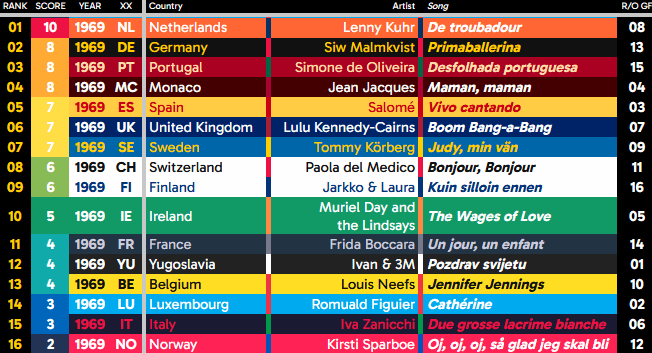
I’d say this was a pretty easy year to rank. My scores were nice and spread out, no big clumps of fours or threes. Lenny Kuhr rests comfortably on top, then come a few good contenders for my second favorite, plus one clear last place. If my winner of 1969 is ever not “De troubadour”, that means I’ve been replaced by an evil doppelganger.
Rest of the show:
I’ll let my past self sum up that absolutely godawful interval act:
It’s some footage of water, fire, air, and earth in Spain, set to a cacophonous mess of random notes. Whoever composed it was probably a pretentious snob who responded to any criticisms by saying it’s bad on purpose, therefore it’s good. It’s the musical equivalent of wine. It does not taste good, so people who say they like wine can claim their taste is more “refined” than others. I’ve ranted about this topic in other posts before—just search “bad on purpose” on my blog. The interval act received zero applause.
Actually, this isn’t even the musical equivalent of wine—it’s worse than that. It’s the musical equivalent of eating dirt. The less said about this act, the better.
Now for the voting, I’m not convinced the juries were watching the same show I was, because the points were scattershot and it took near the end for the Netherlands to be in the lead. Some years the results make sense, but in others they just don’t. At least Lenny Kuhr did technically win in the end, and to me she’s the true winner of the entire year. Oh yeah, the scoreboard is the only one ever in Spanish, and it looks nice and minimalist like last year’s.
Clifford Brown kept an extremely close eye throughout the voting and frequently asked Laurita to go back and fix the votes. Then came the crisis where four countries at the end were tied for the lead. When the last jury (Finland) was about to vote, Spain (song #3), the Netherlands (song #8), and France (song #14), were tied for the lead with 18 points, and the UK had 17. The Finnish votes could’ve easily fixed this situation, but instead they gave one vote to the UK (song #7), after which either the Netherlands or France could still get points. But instead, Finland gave a few points to Sweden (song #9) and Switzerland (song #11), and when we heard “and that completes the voting of the Finnish jury”, the audience went into uproar.
Laurita was confused on what to do about this tie, but then Clifford Brown insisted to make all four songs winners, much to her confusion. Which is just, uh, no. The point of a song contest is that one song wins, so if the songs are scored by points, there needs to be a tiebreaker rule! But the EBU were too stupid to devise a tiebreaker rule, and apparently they didn’t want to extend the show to do a tiebreaker round or do a second round the next day to decide the correct winner, so now we have this bullshit solution. The plus side of four winners is that viewers are four times as likely to have their favorite be the winner, as is the case with me as well as anyone who loves the other three winners.
Massiel comes onto the stage—oh god, what an absolutely fucking HIDEOUS fur coat—and has to pass trophies to all four of the winning singers. Originally the plan was to pass one trophy to the singer and the other three to the songwriters, but instead each of the trophies went to a singer. Salomé looks happy but didn’t have a strong reaction to winning, whereas Lulu bursts with excitement. Lenny Kuhr looks proud of her accomplishment, and Frida looks modest and honored. Then all four of them sing their winning reprises, and you know what, this is a good point to sit back and relax. Two pretty good songs, one absolutely amazing masterwork, and one song I’ve tried to like but can’t. And let’s never speak of Massiel’s fucking atrocious outfit again.
Oh my god, I totally forgot the credits have a new arrangement of “Dansevise” that sounds a little more jazzy. As a lover of “Dansevise”, that puts such a giant smile on my face.
General thoughts:
And just like that, Spain has never gotten to host Eurovision again, unless you count Junior Eurovision 2024. I think they put on a decent enough show and I like the overall surreal art theme, but the surrealism should not have extended to that interval act. Why couldn’t Spain have done something fun like tango dancing for their interval? I like that the show feels like we’re comfortable in the seats of the arena, watching a special orchestral music concert You can see the stage with its art piece and the entrance the artists go through. I just love the stage design of 1969, it feels so intimate.
Now as for the song lineup, the year isn’t as good as I remember it being. It can’t just be because “De troubadour” is that good, because normally when I watch a Eurovision year, the best song doesn’t make everything else seem worse in comparison. Still, like 1968 it’s quite a strong year and put the color TV era of Eurovision to a strong streak.
It’s too bad that so many countries were so unhappy with the four-way tie that they skipped Eurovision 1970. This is what I mean by Eurovision 1969 almost killing the contest. The EBU’s lack of planning ahead meant that the contest lost a lot of countries the next year, and the show needed some adjustments for them to be willing to return. It’s kind of like how Eurovision keeps being on the precipice of disaster now, because the EBU are letting Israel participate during the war in Gaza. I am praying that country gets banned from Eurovision 2026, but that’s beyond the scope of this post. If you don’t know why I want them banned, read this post.
See you next time for a year I had high hopes for that turned out to be a nothingburger.
 Cookie Fonster's stuff
Hi, I suppose as this is my first time commenting here, I should introduce myself. My name is Maaria, I’m from Finland and I was born in 2007, the same year that my country hosted Eurovision. I first watched Eurovision in 2023, and I have gone back and watched all of the old editions since.
The definition of jenkka is that it’s a Finnish folk dance, danced to music in 2/4 or 4/4 time, with about 140 beats per minute, featuring instruments such as the violin and accordion. The dance that Jarkko and Laura do is not jenkka, it just looks like random choreographed movements to me. Video of jenkka danceUnder that definition, Kuin silloin ennen definitely isn’t a jenkka, hovewer there is a variation of jenkka, called Letkajenkka, which is jenkka with non-traditional/modern instruments. I’m not sure if ‘Kuin silloin ennen’ is exactly a letkajenkka, but it does bear a resemblance to ‘Minne tuuli kuljettaa’, the song that you linked (which definitely sounds like a letkajenkka song) or ‘Letkis‘ by Katri Helena (the quintessennial jenkka song).
LikeLiked by 1 person
Hi Maaria and thank you for your comment! It was a very insightful read and lesson on Finnish music. This is one thing I love about making Eurovision reviews: I get commenters explaining things I may have missed, and topics I don’t know much about.
And I actually know the song “Letkis” from a surprising source: the song “Jenka 1” from the video game Cave Story is actually an arrangement of that song.
LikeLike
Thank you for your response! Feel free to ask if you have any questions!
LikeLike
So I looked it up, and the past tense of ‘kwam’ for ‘komen’ is actually the original version – German and English both had a ‘w’ sound in the past tense as well, but both lost it.
And kwam is also part of one of the cheesiest Dutch language jokes I know: What is the past tense of komkommersla (cucumber salad)? Kwamkwammersloeg. (Sla is a verb conjugaton of ‘slaan’ – to hit, and the past tense of that is ‘sloeg’.)
LikeLiked by 1 person
These kinds of cheesy linguistic puns are what I live for!
LikeLike
The only things I have to say about this year is that “De troubador” is also my winner for 1969, and the four-way tie was indeed… something.
LikeLiked by 1 person
Good taste!
LikeLike
1969 is quite a good year. My favorite is the same as yours. De trobadour is a lovely song. My least favorite maybe is Yugoslavia, the song is kind of boring. My biggest disagreement has to be Norway, which is my fifth. Again, I loved to have read your opinions about this controversial year. Take care, my dear.
LikeLike
Anyone who has “De troubadour” as their winner has certified taste!
LikeLike