
< 1964 Review | 1965 Review | 1966 Review >
Introduction
Since Gigliola Cinquetti won 1964 with her smash hit “Non ho l’età”, the next destination for Eurovision was Italy, who hosted the 1965 contest in the concert hall of their broadcaster RAI, located in Naples. After having seen the catastrophically bad hosting of Eurovision 1991, it gives me whiplash to see RAI put on a professional (if not particularly inspired) show with a host who’s fluent in three languages. Renata Mauro did most of the show in Italian, but as with the Danish host last year, she also gave a speech in French and English at the start, and had no trouble using those two languages in the voting. Her French sounds fluent with only a slight Italian accent, and her English is a surprisingly good imitation of Received Pronunciation.
While Eurovision 1991 makes up for the shit production by having an amazing lineup of songs, 1965 has the opposite problem: every song but one is a total piece of crap. Well OK, I’m exaggerating here, but it really is insane how much better the winner—“Poupée de cire, poupée de son” by France Gall—is than everything else. She was a French singer who competed for Luxembourg in Eurovision with a song I absolutely love, then went on to have a stellar career. In second place came the United Kingdom with “I Belong”, and in third came France with a song I hate with a passion, “N’avoue jamais”. I’m warning you now: if you like any song this year other than the winner, you probably won’t like my review of it.
The lineup of countries had two additions from 1964, making for 18 in total: Sweden returned with a controversial entry after skipping last year, and Ireland (who would soon become a 20th century powerhouse) made their debut. Crazy enough, this was the fourth year in a row with four zero-pointers. The good thing about ranking this year is, I already did it a few months back (which was a pretty miserable experience) so my job this time is easier. That’s assuming none of my rankings change.
I watched the contest with British commentary last time and I’ll do the same again, even though the French commentary is archived too. That’s because the video quality on the French-commentated uploads is pretty bad and I tend to enjoy British commentators more, even though I can understand both. Our old friend David Jacobs is back for the second last year, though it doesn’t look like his 1966 commentary has been archived, so for our purposes it’s our last time seeing him.
One more fact: this is the first Eurovision contest broadcast outside the EBU. As I said in round 1, it was also broadcast in Czechoslovakia, East Germany, Hungary, Poland, and the Soviet Union. Viewers in those countries would gradually long for the day they could join the Eurovision family.
Netherlands: Het is genoeg
Artist: Conny Vandenbos
Language: Dutch
Key: C minor
My ranking: 3rd
I’ve never been sure whether I should format the title as ‘t Is genoeg or Het is genoeg. I’ll go with “het” because Erica who is herself Dutch called it that in her review. Anyway, I think my past self hit the nail on the head describing the song:
This is a spicy breakup song whose title means “it is enough”. It’s mostly in minor key, but seeps into major key a few times. The major key parts come off as reflecting on the few good times, and they’re sparse to indicate the good times don’t outweigh the cheating. I appreciate that they tried to differ the instrumentation from other Eurovision songs, but the percussion sounds a little too chaotic. At times, the drums feel like they get in the song’s way instead of adding to it.
I don’t really have much to add to this, except that her performance in Naples sounded slightly flat and she delivered this song much better in the Dutch national final, both in gestures and vocals. The song is alright enough and I like how the message is the opposite of the last Dutch entry: this time, she realized how much of a dickbag her ex was and broke things off. But it isn’t all that great or impressive. Among the two songs I rated 6/10, this has more things wrong with it so it goes into third place. There’s only one song I rated above 6/10, and it should be obvious which it is.
United Kingdom: I Belong
Artist: Kathy Kirby
Language: English
Key: E♭ major
My ranking: 5th
The Brits must have been quite confident this song would win, because David Jacobs said the song needs no introduction and let the host introduce it in Italian. But it didn’t win, and thank god for that because Luxembourg is so much better.
I think this falls short of the last few British entries. It’s an alright pop song about finally finding a good romantic partner and Kathy is a skilled singer, but it’s not as good as she thinks it is. You can see in her face that she thinks the song is hot shit, but it isn’t that great. And worse yet, sources say she slapped France Gall in the face after the young French lady won and insisted the contest was rigged against her. What an asshole. I had originally ranked this above Spain, but I’ve decided to move it lower because she’s too shouty.
I don’t have much to say about this otherwise, so instead, I’ll point out something that bugs me about the production of this year. There’s no variety in backgrounds or camera angles, so most songs have exactly the same look: just a bunch of long shots of the singer’s face, with the Eurovision circle in the background. I think I noticed this problem because of the parody of Eurovision 1965 that NRK produced.
Spain: ¡Qué bueno, qué bueno!
Artist: Conchita Bautista, returning from 1961
Language: Spanish
Key: F major and F minor in alternation
My ranking: 4th
Unfortunately, this doesn’t live up to Conchita’s last entry “Estando contigo”. The vocal warbling is more over-the-top and the instrumental isn’t quite as good or catchy, though it’s still very Spanish-sounding. It feels like a standard old-timey Spanish song and I’m just outside its target audience. I think it has the same problem of excessive bongos as “Het is genoeg”. Conchita Bautista is still an excellent performer, I’ll give her that. And she was rewarded for this with… zero points, apparently. Weird because this is nowhere close to the worst song of the night.
Ireland: Walking the Streets in the Rain
Artist: Butch Moore
Language: English, like all of Ireland’s entries except 1972, which was in Irish
Key: D major
My ranking: 14th
Dammit, I just realized there are no title cards this year. If there were, maybe it wouldn’t be so confusing whether to call this song “Walking the Streets in the Rain” or “I’m Walking the Streets in the Rain”.
Anyway, Ireland debuted exactly as they would continue: with a ballad. It’s got the usual package of grayscale ballad tropes: 6/8 time signature, slow beat, and plinky piano. I like how you can hear a small Irish accent if you listen closely, but otherwise this bores the shit out of me.
Germany: Paradies, wo bist du?
Artist: Ulla Wiesner
Language: German
Key: F major
My ranking: 8th
Originally I had this ranked 14th place, but I listened to the studio version while writing this post and then realized I have to rerank it.
The studio version is actually pretty cool: an old-timey German-sounding song with intriguingly odd chords and a nice guitar, the type my mom’s parents were probably exposed to a lot. Unfortunately, the live vocals are awful, which makes this tricky to rank. She starts off barely audible over the orchestra, then starts shouting, and overall she looks like she doesn’t want to be here. Erica thought that the “da-da-da” part was Ulla forgetting the lyrics, but the studio version proves that isn’t true. Still, someone mistook that section for her forgetting the lyrics, which isn’t a good sign. I can tell the juries didn’t like this either because it got zero points.
I think it’s most convenient to rank all the songs this year based on their live performances, because I can’t be bothered to listen to all 18 of these in studio. But the studio version of this made me warm up to even the live version. Annoyingly, I don’t remember how most of the songs that surrounded it in my ranking sounded like, so I guess I’ll have to rerank this after I’ve listened to all the songs at the end. It’s going above most of the ballads, but I can’t even remember which are ballads and which not. Damn you, Eurovision 1965!
Austria: Sag ihr, ich lass sie grüßen
Artist: Udo Jürgens in an Udo Jürgens sandwich (he performed the previous and next years)
Language: German
Key: B♭ major
My ranking: 2nd
Aside from the wonderful winning entry, this is the song I have the most respect for this year. The main reason why is because the lyrics are fantastically well-written, even better than Udo’s last entry. It helps that I can actually understand the lyrics, so they tug at my heartstrings a tiny bit. He sings that someone who knows his old love interest should send her his greetings, but not tell her how much his heart still hurts. As the song goes on, he says his ex can know everything about how he’s doing, except for the deep dark truth, which is that he still loves her. He emphatically sings as much at the end of the song.
The lyrics flow so well and if you don’t speak German, you’ll just have to trust me that they do. But maybe you don’t need to understand the lyrics to enjoy this song, because Vlad loves this song despite not speaking German. This isn’t getting above a 6/10, because musically it’s still your usual 6/8 ballad, but a bit more decently composed. But second place is a pretty good honor, even in a year as crappy as this.
This is the one entry this year whose camera work isn’t the same as the other years, because Udo is playing piano on stage. This means the camera crew was forced to get creative with it, and that’s what they did.
Norway: Karusell
Artist: Kirsti Sparboe
Language: Norwegian
Key: C major, E♭ major, back to C major
My ranking: 9th
Oh hey there Kirsti Sparboe, the young Norwegian lady with perpetually bad luck. She scored one point in 1965, two in 1967, and one in 1969. She has an infectious happiness when on stage, but unfortunately she’s never been a good singer, which explains why she always scored so bad.
This is another one of those elaborate storytelling tunes you’d hear from a Scandinavian country. It’s about a girl who has to pick between two guys to ride a merry-go-round with, and tries doing it with both at first but in the end settles for one. The instrumental is pleasant and upbeat, and not too sugary for my tastes, but my god, she can’t sing for shit. The worst part is after the instrumental interlude, where she seemed to think there was a key change but there wasn’t one. I’ll give her this, she quickly went back to the correct key without making a fuss.
Belgium: Als het weer lente is
Artist: Lize Marke
Language: Dutch
Key: D major
My ranking: 7th
In my old ranking of 1965, I had this 7th place, highest of the 4/10’s and above the upbeat song from Norway. This must mean that I found it relatively pleasant, for a ballad. Now I think I know why: it’s another one of those ballads with a bossa nova beat, and I love bossa nova beats. This one is too restrained for me to particularly like and I don’t like the freeform sections (we’re still having those in 1965?), but she’s a clearly experienced singer and even does a few gestures that match the lyrics of the song, like snapping her fingers followed by a kiss to the audience.
I almost wanted to move this up to 5th place, above the UK and Portugal, but ultimately I decided to keep it where it is. That’s because even though the song has a nice voice and bossa nova beat, it’s also very unexciting. Even though “I Belong” has a fairly annoying voice, it’s a much more engaging listen than this. I can’t say I’m surprised this got zero points.
Monaco: Va dire à l’amour
Artist: Marjorie Noël
Language: French
Key: B♭ major
My ranking: 13th
It was around this point of writing my blog post that I started to get a headache. I’m not sure whether it was because of subjecting myself to Eurovision 1965, but I’ll choose to believe that played a part, because my head hurt a little last time I ranked this year.
Another dull ballad with nothing remarkable about it, I recall this being particularly forgettable when I ranked 1965 a few months back. As I said last time, her voice stands out for sounding youthful but not too childish, and it has a slight tinge of old kids’ movie sound, but otherwise this makes me want to sleep.
Sweden: Absent Friend
Artist: Ingvar Wixell
Language: English. How dare the Swedes!
Key: E minor
My ranking: 11th
Now we have the weirdest entry of this year, and probably the weirdest song Sweden has ever sent to Eurovision. I find it so strange that the first Swedish entry sung in English isn’t an ordinary accessible song, but a bizarro piece of male opera. The instrumental is a pretty cool mischievous waltz, but his exaggerated opera voice is comically weird. I’m glad I barely understand a word he’s singing, because the lyrics are full of horrible grammar mistakes. “I wish I knew where you are tonight and I wish you’re thinking of me tonight”, now that is total Engrish. I agree with Erica that it’s a hard song to rank, so I’ll just trust my past self’s decision to rank it above Italy and below Finland.
I’m also obligated to mention that because of this song, the EBU enforced a rule that each country must sing in their national language the following year. The Nordics weren’t happy with this decision—as David Jacobs said, even as early as 1965, English-language music sold well in those nations.
France: N’avoue jamais
Artist: Guy Mardel
Language: French
Key: B♭ major
My ranking: 18th (last)
My last place this year is just as obvious as my first place, because I absolutely fucking hate everything about this total piece of crap. I’m actually glad to have reached this song, because it means I can write a nice rant about it.
I really hate the misogynistic lyrics which basically go “never admit to your girlfriend you love her, but wait till she tells you, that’s how you find true love”. David Jacobs points out this topic to those who don’t speak French, bless him. The songwriters think they’re so clever with metaphors about fall having the taste of spring and sowing the seeds of doubt, but in reality it’s just the same kind of shit that these “alpha male” idiots on the Internet like to spew out. Because to those people, the only thing valuable about life is women agreeing to have sex with them, then they wonder why no woman will come near them.
There are many more awful things about the song than just the lyrics. The repeated “jamais” annoys the shit out of me and is hardly even synced with the music. His voice sounds like a teenager while he sings these lyrics that I’m sure he thinks are profound. And I hate the slowdowns when he sings sings “n’a… voue… ja… mais”. This dude seriously needs a slap in the face for subjecting me to this piece of crap. But noooo, the juries just had to give him third place, because he’s singing a ballad in French, which to them automatically makes the song good.
At least this isn’t as bad as “Nur in der Wiener Luft” a few years back because his singing doesn’t hurt my ears, it just annoys the shit out of me. I need some ear bleach after this hideous song… hm, how about “De troubadour”? I think that’ll do the trick.
Portugal: Sol de inverno
Artist: Simone de Oliveria
Language: Portuguese
Key: E♭ major
My ranking: 6th
I apparently rated this a 5/10 when I first ranked 1965, but now I’m dropping it to a four. I guess I didn’t want to be too harsh on this song because Simone is an expressive singer and sang a much better entry four years later, but her voice has too much vibrato and borders on opera which really isn’t my thing. I still think this is the second best of the ballads, because the old-timey kids’ movie sound makes it slightly interesting to me. But only slightly.
Italy: Se piangi, se ridi
Artist: Bobby Solo
Language: Italian
Key: A major
My ranking: 12th
The home team didn’t send anything worth listening to either, unfortunately. It’s a super-dull ballad with a generic 6/8 beat and a voice that borders on opera. I slightly enjoy the guitar part here and the female backing singers with their “ooh” notes, but otherwise this is really boring. I also wish we could see the backing ladies throughout the song, instead of the camera hiding them until the end.
Denmark: For din skyld
Artist: Birgit Brüel
Language: Danish
Key: C major
My ranking: 17th
This is a completely lifeless and boring piece of freeform dirge and I hate it almost as much as I hate France’s song. The lyrics are apparently about a breakup with a man who insists on treating her like a doll, but she does not convey that in her performance at all. She sings completely void of emotion and the instrumental is boring as fuck too and oh god I hate the gradual fadeouts in the camera. Seeing two of her face at 50% transparency is so weird and annoying. Also, I really fucking hate songs that are lyrically about a nasty breakup but musically a boring ballad that drags on and on. How could Denmark possibly send something so awful just two years after “Dansevise”?
Luxembourg: Poupée de cire, poupée de son (the winner)
Artist: France Gall, but it makes more sense to think of it as Serge Gainsbourg’s work
Language: French
Key: F minor
My ranking: 1st
And there we have it, my friends: the first ever Eurovision song that I rate 10/10. I admit, it’s not the strongest 10/10 I’ve given a song, but I’m happy in giving it a ten because the song is a joy to listen to and ridiculously fun to sing along to, hum to myself, or try playing on the piano. I wish grayscale Eurovision had more entries that were as fun as this, instead of so many depressing ballads.
In round 1 I analyzed the story and theme behind this song, so this time I’ll dissect it musically instead. This should be fun, because as a composition it’s nothing short of genius. The song opens with a flute playing a little teaser of the main melody, followed by brass playing one of the main instrumental hooks which goes C B♭ C A♭ C G C. Now here’s something I love about this song: it’s heavy in hooks not just in vocals, but in the instrumental as well.
After the intro, we immediately dive into the chorus with a fabulously catchy melody, a fun and jumpy bassline, and some quirky clicky percussion that we only hear in the studio version, not so much orchestrated. I love the way her melody has a little call and response with the brass lines, and how the bass, strings, and drums all play in the same rhythm her whenever she sings the title. The verses (mes disques sont un miroir) are short and to the point, and provide very nice breathers between the choruses. And after the second chorus we get a fun little interlude where the melody is played on brass and guitar at the same time (but just brass in the orchestra version).
Then after the interlude, the song does something clever: instead of going back to the chorus, it plays the second verse. This adds some tension to the song and keeps the listener engaged as they wait for the chorus. The final chorus has one last clever trope, which is that ending melody repeats a few times with extra lyrics before the song concludes.
Now to further discuss the lyrics. Even though it wasn’t right even back then to have France Gall sing tunes whose true meaning she was unaware of, I can’t deny they’re cleverly written and flow extremely well. Plus, they’re very tame as far as Serge Gainsbourg lyrics go. The verses and chorus all have different lyrics each time, which helps the song tell a little story. The story is that France Gall is at this point an innocent young girl who doesn’t know how the world works or why people love her music, but as she grows older, she will experience romance and live the topics of her songs.
It’s hard for me to overstate how much better this is than every other entry this year combined. Even the live performance with all those off-key notes and melodic slips is far better than any of the other entries this year, though I should say the studio version is far better than the orchestrated version.
I’m far from the only one who loves the song this much. It became a widespread hit all over Europe and elsewhere in the world, and got covered in many different styles and languages. I even threw my hat into the ring by making this into an 8-bit cover; I think it’s the best Eurovision cover I’ve done so far. Erica loves this song just as much as I do, as you can see from her review, whereas Vlad has a different take: he finds the song underwhelming because France Gall can do much better than this, then he lists some of his favorite France Gall songs. That’s a very fair take, because once she became an artist in her own right, her music became truly special and awesome, and full of powerful messages. But I can’t help but find her Eurovision song a joy to listen to as well.
Alright, that was a fun little bright spot. Now back to boring dirge.
Finland: Aurinko laskee länteen
Artist: Viktor Klimenko
Language: Finnish
Key: C minor
My ranking: 10th
Zero pointer number three of four. This is a ballad that starts with a freeform section (not a plus with me) then dives into your usual 6/8 beat. It’s not too bad to listen to as ballads go, and the minor key helps make it more distinct, but aside from his Abraham Lincoln beard it’s not very memorable. I do feel bad for this getting zero points, because it’s an honest effort.
Yugoslavia: Čežnja (Чежња)
Artist: Vice Vukov, returning from 1963
Language: Serbo-Croatian (Croatian)
Key: C minor
My ranking: 16th
Oh god, another ultra-depressing ballad with a 6/8 beat, and it’s less likable than Finland’s ballad. It has a dreary classical-sounding piano to make the song even more depressing. Where are all the fun 60’s pop songs or rock songs? Why did almost every country have to send an old-timey ballad? He doesn’t even have that good of a stage presence; he just looks like some random dude singing some random ballad. In round 1, I said I kept expecting this song to be in Italian, and the same is true this time.
Switzerland: Non, à jamais sans toi
Artist: Yovanna (Ioanna Fassou Kalpaxi)
Language: French
Key: A major, B♭ major
My ranking: 15th
The title of this song confuses me a tad, as someone who studied French in school. I’m used to thinking the word “jamais” means “never”, so my brain parses the title as “no, never without you”. But technically “jamais” means “ever”, whereas “ne jamais” means “never”, although the “ne” is often omitted in casual speech. The phrase “à jamais” therefore means “forever”, so the title means “no, forever without you”.
Anyway, the contest ends with another goddamn 6/8 ballad with plinky piano. Her style of singing doesn’t suit a breakup song that well. Her vocals have a decent amount of power, but she also sounds a bit stiff and rehearsed. Then she gets way too shouty at the end. The song comes off as less of “I’ll be happier without my ex” and more of “this is how loud I can shout”.
My full ranking
Thank god I had already ranked this year a few months back. That means I saved my future self (i.e. my present self) a whole bunch of trouble. I kept my rankings mostly the same as last time, except I moved Germany up six places and Spain up two. Here is my absurdly bottom-heavy ranking:
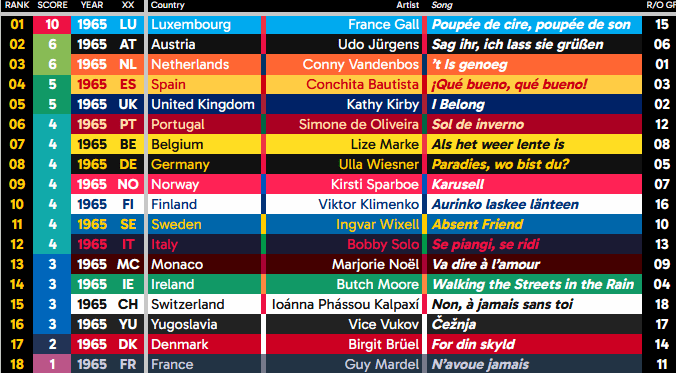
I pretty much don’t give a shit where most of these songs are ranked. Except for my top five and bottom two, these all may as well be interchangeable. The one good thing I can say is, this year doesn’t have many actively horrible songs. You can’t say the same about some years (cough cough 2019). Seriously, 2019 has several songs I dearly adore, but also an abnormal amount of loathsome abominations that make me want to strangle someone.
Rest of the show:
I’m done with the songs, yay! And I have only 30 more minutes of the show to watch. Italy continued the pattern of interval acts themed upon the host country, but they just went with one guy singing opera songs which was a bit boring. There’s not much distinguishing the interval act from competing songs, which is a common problem mostly in recent years.
Now for the voting, the scoreboard uses the same design as 1964, except with the country names in Italian and followed by country codes. The bar graph showing each country’s points is back, which is cool, but I’m not a fan of the ultra-narrow font. As for the results, I can see why Luxembourg wasn’t a runaway winner: France Gall got badly off-key in a few parts, so other songs fought a decent battle against her. But Luxembourg gained most of their points early on, so no one else had a chance to surpass them, and rightly so.
I should also mention I love the Monegasque spokesperson from this and a few others years, because of his goofy old Frenchman voice. I wish we knew what his name was. I also liked hearing the Finnish spokesperson thank Renata Mauro in Italian. I think that’s the first instance of a spokesperson impressing the host with their language skills.
For some reason, the previous winner wasn’t here to give France Gall and Serge and Serge Gainsbourg their trophies, so the interval act singer Mario del Monaco did it as a substitute. The audience didn’t seem particularly excited at France Gall winning, but I am joyed she won. Any other winner would’ve pissed me off.
General thoughts:
Fuck, this was an absolutely godawful year (except the winner). For me, how much I like a Eurovision year is defined mostly by how many entries I love, so the only reason it’s not my least favorite Eurovision year of all time is because the winner is so insanely good. I don’t actually know what my least favorite Eurovision year is. A candidate could be 1988, because it’s a nightmare of ballads and has no entries I truly love. 1992 also comes to mind as a year with nothing I love, but it’s more of a meh year than a bad year.
The presenter was charming, professional, and lingustically skilled, but the rest of this year’s hosting was totally lifeless. No title cards between songs, no creativity in camera shots (except for Udo Jürgens on piano), way too many close-ups of faces. Basically, this contest had a good presenter but was an unimpressive show. Thank god I’m done rewatching this year, because I never want to do it again. Unless I feel like torturing myself. I hope 1966 has a better lineup of songs, I don’t remember the year that well either. Luckily, I already know it has at least one song worth listening to.
See you next time as I gush over Norway’s deep-voiced guitar tune.
 Cookie Fonster's stuff
So I guess it’s a three for three after all of the Italians not doing a great job in hosting!
LikeLiked by 1 person
Yeah, some of the grayscale years (especially those hosted in London or Cannes) had some really lovely details in the hosting that give them life, and none of that was to be found in Naples 1965. I think 2022 was Italy’s best hosting effort, but even then it had a ridiculous amount of mishaps.
LikeLike
Yes, only one winner here…but I DO think you’re being a little tough on Guy Mardel! The song, as often with the French, is (almost) completely tongue-in-cheek. And after all, it WAS written by a woman. And to cheer you up even further on the subject of n’avouing jamais…
N’AVOUE JAMAIS – Bande-annonce
LikeLiked by 1 person
Well, the lyrics of that song being written by a woman is quite a plot twist, I would’ve never expected that! But I never got much of a tongue-in-cheek impression from his performance. And nothing can stop me from finding his voice and the repeated “jamais” annoying, unfortunately.
LikeLiked by 1 person
Yes, well, there’s no getting around all the jamaises, I admit, if you don’t like ’em, you just don’t like ’em. I look forward to your verdict on 1966.
LikeLike