
< 1963 Review | 1964 Review | 1965 Review >
Introduction
As of this writing, Eurovision 1964 is the oldest Eurovision to take place in a city I’ve been to: Copenhagen, the capital of Denmark. The show took place in the Tivoli Concert Hall, known in Danish as Tivolis Koncertsal. It’s hard to visit Malmö without also visiting Copenhagen, especially if you’re playing from abroad, and it’s a real beauty of a city. This couldn’t have been reflected much in the broadcast because it was in black and white, and fans aren’t able to see it today because nobody has been able to find the full video broadcast of Eurovision 1964. The reason why is that Denmark’s DR is one of few host brodacsters in the early years that didn’t save a copy of the show. At some point, DR wiped their video tape of Eurovision 1964 to make way for a different recording. The missing video broadcast is what the contest is best known for today. Well, that and the smash hit from Italy that won by a landslide, “Non ho l’età”.
Sixteen countries competed once again, but the lineup was different from the last three years: Sweden dropped out due to a strike and Portugal made their debut. Italy got first place as I said, the UK got a distant second, and Monaco scored third. Strangely enough, for the third year in a row, four countries got zero points, one of which was the newcomer Portugal. The voting system was changed from each jury awarding 5, 4, 3, 2, and 1 points to just 5, 3, and 1 points, and the headcount of each jury was reduced from 20 back to 10. The scoreboard was redesigned too: now it showed only country names without song titles, and had a horizontal bar graph to the right showing how many points each entry had.
Now back to the video footage problem: the only parts of the show that have surviving footage are the winner’s reprise and a few other snippets from the beginning and end of the show. Some of those snippets came from Denmark’s broadcaster DR, others from Finland’s Yle. This means we have small portions of the commentary from both countries, as well as audio of the French commentary. Over the past few years, fans have been making video reconstructions of the 1964 contest assembled from these snippets, as well as footage of contestants performing their songs in other shows. You can look at these YouTube uploads (1, 2, 3, 4) to see how the reconstruction has evolved over the years. Italy is lucky enough to have the winner’s reprise recorded. Portugal’s song has their national final performance archived, since RTP has preserved every single year of Festival da Canção. Not too surprising because FdC is Portugal’s pride and joy. Most other songs use a later video recording of the artist performing their song, but a few use footage of the artist performing a completely different song, which I don’t like because the lip movements don’t match the song.* For those songs I’d have preferred to just have photos, but I admire fans’ efforts to reconstruct the show regardless.
The show opens with a military march of some sort, which if the reconstruction is to be believed is interspersed with a video montage of Copenhagen. Then comes the presenter, Danish actress and TV presenter Lotte Wæver. She did most of the show in Danish (which I can understand much more of than last time), but graciously gave short speeches in English and French at the start. Fitting the increase in internationality of the hosting, the scoreboard had all the country names in English this time, instead of the local language. The reconstruction has the screen captions feature each country’s name in Danish, but I’m not sure if the show itself did that or not. I’ll watch the latest reconstruction I linked for this blog post. It’ll feel a lot like watching the music videos and national final performances of Eurovision 2020.
* As of this writing, those are the Netherlands, part of Norway, Denmark, Germany, and Spain. 11.5 out of 16 songs have a recording of the artist performing them, which is pretty damn good!
Luxembourg: Dès que le printemps revient
Artist: Hugues Aufray
Language: French
Key: E major, F♯ major
My ranking: 4th. Surprising considering my round 1 review, I know.
If I can get past his voice which sounds like his throat is sore, this is a pretty good start to the contest. I’m pretty sure he was sick on the night, because his voice is nowhere near as gravelly in the studio version. I get slight Johnny Cash vibes from this because of the country instrumentation and trumpets. In particular, the harmonizing trumpet lines remind me of his song “Ring of Fire”.* It’s not something to come back to often, but I do like the guitar work and the way the backing vocalists repeat his lines.
* Oh god, I just realized “Ring of Fire” by Johnny Cash has a fire/desire rhyme. Eurovision has ruined that rhyme for me.
Netherlands: Jij bent mijn leven
Artist: Anneke Grönloh
Language: Dutch
Key: D major, E♭ major in the final chorus
My ranking: 3rd, though this was originally my winner
Oh boy, my relationship with this song is a bit complicated. I used to like it a lot more until Erica pointed out in her review that the lyrics are about a woman who lets her asshole cheater husband walk all over her and thinks that’s okay. I can’t speak Dutch, but it’s close enough to languages I speak that I can get the gist of the lyrics, and they are pretty damn annoying. Shame because I quite like this musically and it’s easily the most upbeat song of the night. It also annoys me that the reconstruction has video footage of her singing a different song; I would’ve preferred photos of her on the night, which we do have.
The song has a freeform section midway through, which is falling out of fashion at this point, but it’s short and provides a nice pause from the bounciness so I don’t mind it.
Norway: Spiral
Artist: Arne Bendiksen, who composed four later Norwegian entries
Language: Norwegian
Key: B♭ major
My ranking: 6th
Ah, here’s Arne Bendiksen: the composer of the Norwegian entries from 1966, 1969, 1971, and 1973. Going by these four songs, his composition style is usually fun and bouncy, but can be serious when he wants it to be. Even “Intet er nytt under solen”, the slowest of his Eurovision compositions, still has a tinge of whimsy.
Arne Bendiksen didn’t compose this song, but whimsical is the right way to describe it. It’s a playful jazzy song about floating around the world on a pink balloon. It’s slightly generic as big band entries go, but it’s decently fun to listen to. And yes, it still reminds me a bit of “Frauen regier’n die Welt” from 2007, because they’re jazzy and both in the same key signature.
Denmark: Sangen om dig
Artist: Bjørn Tidmand
Language: Danish
Key: E major, E minor, back to E major, F major
My ranking: 12th
After Denmark sent the beautiful “Dansevise” last year, this is a disappointing host entry. The first three songs are all reasonably modern, but this song goes back to being stuck in the past. It’s a classical-sounding waltz with a bit of accordion at the start and sounds like what we’d have heard in the first ever Eurovision. It’s not too bad to listen to, but it’s fairly twee and there’s nothing special about it that makes it better than other old-timey waltzes.
Finland: Laiskotellen
Artist: Lasse Mårtenson
Language: Finnish, ending with a phrase in English
Key: A♭ major
My ranking: 8th
One thing I’ve noticed in round 2 of this blog is that this time around, I’m not nearly as bothered by songs being in the lyrical rhythm of the “wrong” language. In round 1 I said this song felt like it was designed to be sung in English instead of Finnish, but I don’t feel that way anymore, at least not as strongly.
Anyway, this year Finland has given us a laid back old-timey movie song in swing rhythm. It’s alright enough to listen to, and he has a good smooth voice, but there’s nothing elevating it to greatness. Still, props to Finland for avoiding zero points this year and instead scoring a respectable nine. That put them in seventh place.
Austria: Warum nur, warum?
Artist: Udo Jürgens, for the first of three years in a row
Language: German
Key: B♭ major, B major at the end
My ranking: 5th
Say hello to Udo Jürgens, a name that everyone in the German-speaking countries is familiar with. I know this because I once showed my mom a compilation of all the Eurovision winners and she was surprised to see Udo Jürgens. He’s famous for expanding German-language music beyond upbeat schlagers and adapting the moody French chanson genre into German, but he has some upbeat pop songs as well. I’m hard-pressed to think of a German-speaking Eurovision artist more famous than Udo Jürgens. He might be the number one most renowned of all. Well OK, Stefan Raab is a big name too, but he’s better known as a TV host than a musician.
If you’re wondering why Udo went to Eurovision three years in a row, it’s not because he won three consecutive national finals. In reality, the broadcaster ORF internally selected him in all three years. They were clearly intent on winning this thing and knew Udo would be the perfect name to do it. And on his third attempt, he won the contest!
All three of Udo Jürgens’ entries are the same type of song: a ballad about the heartbreak of saying goodbye to his love interest. But the story of the breakup differs a little in each one. In this song, his girlfriend abruptly dumped him despite saying he will be hers forever, and now he wonders what the point of existing is when everything will eventually end. Another commonality of his entries is that all three have some of the best-written lyrics in German we’ve ever seen in Eurovision. My favorite part of the lyrics is when he asks why flowers bloom so beautifully when one day they’ll all wither and die. And my favorite part of the music is probably the bridge, since it sounds climactic and gains a tinge of hope. The bridge even has a tinge of pumpy 1960’s pop with those big brass chords, which is an excellent touch that I wish more songs this year had.
Overall, this is a respectable ballad, but not the rare type that knocks my socks off. The same will hold for the next two Austrian entries.
France: Le chant de Mallory
Artist: Rachel Ros
Language: French
Key: E♭ major, E major
My ranking: 10th
And now we have one of the generic ballads in 6/8 time that defines this year. It’s the piano that makes the song repetitive, because I feel like in each one the piano plays the same repeated piano chords. She’s a good singer as is typical for France, but this is fairly boring otherwise. I can’t rate it lower than 4/10 because she has a nice voice, but I won’t rate it higher than that either.
United Kingdom: I Love the Little Things
Artist: Matt Monro
Language: English
Key: A♭ major, A major, B♭ major. For some reason, I barely notice the key changes.
My ranking: 2nd
This is the usual British quality you’d expect from the UK in the early years. “British quality”, now that’s a rare phrase for a Eurovision reviewer, isn’t it? It’s true though, the UK knew what they were doing in early Eurovision. They achieved an excellent second place this year, but with nowhere near as many points as Italy. If only the same can be said about their modern entries…
Easy listening is how I would describe this song. The lyrics are generic “you’re great and I love you” which is a bit annoying. My problem with the lyrics is that he says he loves the little things his girlfriend does, but he never says what those little things are. Not the way she smiles or her cheerful laugh? OK, those are a bit clichéd, but that would still improve the lyrics.
Despite this issue, the song is very pleasant to listen to and he has a soothing voice. I’m tapping my left and right feet in alternation when I listen to this, without even thinking. In round 1 I made an interesting observation I forgot about: I said the fast chord progression when he sings “I love the little things you say” sounds like it would fit in country music. That chord progression is probably my favorite thing about the song, it’s so musically satisfying. The brass riff after he sings “you say” and “you do” is a nice touch too.
This and the Netherlands are about equally pleasant musically, but the lyrics of this annoy me less than the Netherlands’, so this goes in second place and Anneke Grönloh in third.
This song’s reconstruction clip is taken from the British TV show “Mr. and Mrs. Music” and can be found on YouTube. In the reconstruction, Matt’s mouth is perfectly synced to the lyrics, so I was expecting this rendition to sound basically the same as in Eurovision. But instead, this arrangement is totally jazzy and big band style. It sounds even more like a Christmas song than did the last British entry, “Say Wonderful Things”.
Germany: Man gewöhnt sich so schnell an das Schöne
Artist: Nora Nova
Language: German
Key: A minor, B♭ minor
My ranking: 7th
Just after the halfway point, we have the first zero-pointer of the show. They were all in the second half this time, which makes sense because this is the weaker half of the show overall.
It’s a shame we don’t have live footage of Nora Nova singing this, not even from outside of Eurovision, because I bet she was a lively performer. The reconstruction uses the band-aid solution of showing her singing another song, and I still don’t like that.
This starts with a fairly annoying freeform section, as though we’re stuck in 1956. It’s interesting, I didn’t have this pet peeve in round 1 of my Eurovision blog, but now I do. The rest is a decent enough stage play song in minor key, but there are many things I wish were different about it. The chorus where she sings the title has a nice melody, but she repeats it too much without variance and the verses (liebe, liebe, welch schönes Spiel…) are too short. I feel like the orchestral arrangement is too big-bandy when it should be more mischievous and dramatic, like “Ne crois pas” from 1956. And the abrupt switch to full-out big band music at the end throws me off. Despite all these issues, I think zero points for this was way too harsh.
Monaco: Où sont-elles passées ?
Artist: Romuald Figuier
Language: French
Key: A♭ major, B major, C major
My ranking: 11th
I thought this whole year was overloaded with 6/8 ballads with bass, piano, and strings, but nope, it’s only the second half. I kind of like that the song goes into minor key a bit (A♭ major to A♭/G♯ minor) in order to transition to B major, then does a standard key change into C major. But the lyrics have me scratching my head, because I can’t quite decide if it’s about a man wondering why his girlfriends all dumped him (which would be a very selfish topic), or him regretting the crushes he never confessed to (which would be less self-indulgent). He has a pretty good voice, so this won’t be too low on my ranking.
Portugal: Oração
Artist: António Calvário
Language: Portuguese, a language that I still have a crush on
Key: C minor, C major
My ranking: 13th
Ouch, it’s always a bummer when a country debuts in Eurovision only to score zero points. Portugal got crap results for most of the 20th century, but the good thing is, pretty much all of their entries up to 1996 are songs the Portuguese hold in high regard. As I said in the intro, Festival da Canção, which unlike Sanremo originated as a Eurovision national selection, is the country’s pride and joy. Portugal and Italy are the only two countries that have preserved their national finals of 1964.
Unfortunately, I don’t really like Portugal’s debut entry. It’s another 6/8 ballad full of plinky piano and has nothing musically special to elevate it. His voice sounds rich but is ridiculously heavy in vibrato. I will say, it really brings me back to hear Portuguese sung with a rolled R, instead of the guttural R that most speakers use today. Much like the evolution of the Swedish sj-sound, you can track the evolution of the Portuguese R through watching Eurovision.
Italy: Non ho l’età (the winner)
Artist: Gigliola Cinquetti, who won at 16 years old
Language: Italian
Key: F major
My ranking: 1st
When I first watched this song in Eurovision 1964, I didn’t understand what was so special about it, why it got such an enormous applause, and most of all why it was a runaway winner. But over the past two years, the song has gradually grown on me, and now I find it by far the best song of the year. My reaction to watching the song in round 2 was, “holy shit, this is pure musical beauty”. Unlike “Dansevise” from last year, this isn’t playlist material, but if it comes up in the wild then I will happily listen to it.
So what makes this song so good? Let’s start by discussing the lyrics, then the way Ms. Cinquetti brings them to life. The lyrics put a simple but intriguing spin on the usual tale of a woman in love: they’re about a girl who harbors romantic interest in a man older than her, but doesn’t consider herself old enough to truly love him. Hence the title, which means “I’m not old enough”, or more literally, “I don’t have the age”. As such, she patiently waits for the day she’s old enough to pursue the romance she dreams of. Young Gigliola Cinquetti gives exactly the simple and honest performance that such a song demands. She connects to the audience effortlessly in those three minutes, no matter where they come from or which language they speak.
The composition is the absolute definition of simple but effective. It’s a straight to the point ballad in 6/8 time full of memorable melodies that need only one listen to stick in your head, as proven by Erica’s review. It has a lot of musical elements to like about it. The verses have a “bom-bom” bassline at first, then as they build up they gain some nice string chords and a plinky piano. And the chorus has some very nice string riffs that complement her vocals. Another thing I like is that the song speeds up a little when it enters the chorus, then slows down when returning to the verses. I didn’t even notice the tempo changes till I made an 8-bit cover of the song. That’s one thing I love about making 8-bit covers: I discover some new musical details I never noticed.
It took me two years to learn to love this song, but now I’m glad it won by such a huge margin. Everything else this year is either too dull or has a significant flaw. There are some years where one song is very obviously better than everything else and should’ve been a runaway winner but wasn’t (cough cough Alcohol Is Free), so it’s nice that in this year the best song really did win.
Yugoslavia: Život je sklopio krug (Живот је склопио круг)
Artist: Sabahudin Kurt
Language: Serbo-Croatian (Bosnian)
Key: B♭ major
My ranking: 16th (last)
I guess Yugoslavia’s surprisingly lovely ballad two years back was a fluke, because now I’m back to finding their ballads utterly dull and dirgey.
This is definitely the weakest song of the night. It’s a boring ballad with the additional downside of being unfocused musically. Too many tempo changes and weird random sections to be found here. As with last time, my brain keeps telling me that he’s about to sing in French, probably due to this voice. I also agree with my past self that this keeps sounding like the key is about to change but doesn’t do so. This is the third zero-pointer and the most deserved of them.
Switzerland: I miei pensieri
Artist: Anita Traversi, returning from 1960
Language: Italian
Key: F major
My ranking: 15th
I’m glad that we now have proper footage of Anita Traversi performing this song, because reconstructions 2 and 3 that I linked at the start of the post use footage of her from Eurovision 1960 which I find incredibly jarring. I’m supposed to be watching Eurovision 1964, not 1960! Nice glasses by the way, but she probably wasn’t wearing those glasses during Eurovision.
This is the fourth zero-pointer of the year and it’s harsh but not inexplicable. The song is very low-energy and tries to be a heartfelt dreamy ballad, but instead it just sounds aimless to me. The random speed-up into big band music at the end doesn’t make sense either. I’m afraid I don’t like it as much as I did in round 1. Vlad said in his review that it’s hard to remember how the song sounds after multiple listens, and I think he has a point. The song lacks a catchy hook of any sort, which is what Italy did right and Switzerland did wrong.
Oh yeah, after this song there was a stage invasion where some guy held a sign asking to boycott Spain and Portugal because of their dictatorships. Thankfully the host didn’t say anything in response and just proceeded with the show, even as the audience was chattering. Eurovision would manage to stay clear of stage invasions until the Spain incident in 2010.
Belgium: Près de ma rivière
Artist: Not Fud Leclerc this time, believe it or not! Instead it’s Robert Cogoi.
Language: French
Key: E major
My ranking: 14th
This is another attempt at a romantic ballad and it’s got the same generic 6/8 time signature and plinky piano. Basically an old-timey ballad by the numbers. It’s one of the weakest ballads of the night because his voice is rather flat. I would’ve found this better if Fud Leclerc performed it, because he’s a better singer and a much more entertaining performer. I miss Mr. Eclair already.
Crazy enough, the reconstruction for this song contains a few tiny snippets of his performance live on the Copenhagen stage. They’re interspersed amidst what seems to be a music video, which is a tiny bit jarring, but I get it, it’s better to have that than none of his live performance.
Spain: Caracola
Artist: Los TNT, a trio of siblings
Language: Spanish
Key: E♭ major at the start, A♭ major, A major
My ranking: 9th
Hey, good job on Spain for using backing singers! That’s always a good way to make grayscale entries more interesting. Nelly (the N of TNT) did most of the singing, but her brothers Tony and Tim backed her up in the chorus.
This starts as a slow Disney movie sort of song, then it turns into yet another 6/8 plinky piano ballad, except it’s got a pinch of Spanish flair. It’s more interesting in the chorus because of the harmonies, and because Nelly’s voice sounds overwhelmed with emotion in a way that doesn’t annoy me too much. What does annoy me, however, is the ending because it abruptly turns into discordant jazz. Basically, this song has some nice ideas but isn’t too great overall.
My full ranking
1964 wasn’t too hard to rank, and I surprised myself with how high I scored the winner:
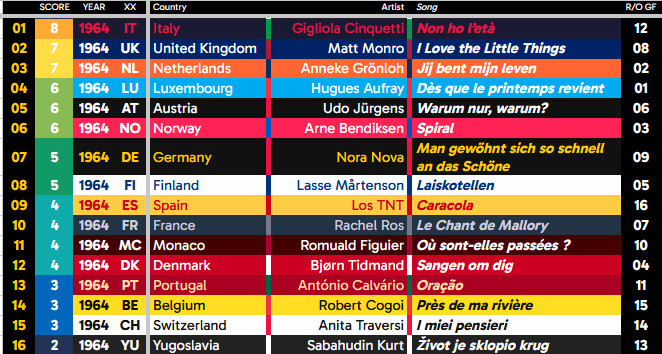
A good range of scores, I would say. The fours and threes were a little tricky to rank because they’re interchangeable ballads, but I managed to do it. Now I need to retcon my winners list real quick because my winner of 1964 is no longer the Netherlands, but Italy, Non ho l’età. As I said earlier, it’s the only entry this year that is not only interesting, but also doesn’t have any significant flaws.
Wait, while we’re here, let me retcon a later winner in advance. I’ve decided to change my favorite of 2018 from Sweden’s “Dance You Off” (probably will be my second) to Latvia, Funny Girl. I just love Laura Rizzotto too much, OK? “Funny Girl” isn’t even her best song (that would be “Symptoms”), but I really love it regardless. Now here’s the updated list:
- Belgium, 3 (1957, 1976, 2003)
- Bosnia and Herzegovina, 2 (2001, 2006)
- Denmark, 2 (1963, 2000)
- Estonia, 1 (2009)
- Finland, 4 (1983, 1989, 2010, 2023)
- France, 3 (1977, 1990, 1991)
- Germany, 5 (1956, 1968, 1979, 1982, 1999)
- Greece, 1 (2013)
- Hungary, 2 (2005, 2019)
- Iceland, 1 (1992)
- Ireland, 3 (1970, 1980, 1994)
- Israel, 1 (1987)
- Italy, 1 (1964)
- Latvia, 2 (2002, 2018)
- Lithuania, 1 (2022)
- Luxembourg, 4 (1965, 1972, 1973, 1988)
- Monaco, 1 (1960)
- Montenegro, 1 (2015)
- Netherlands, 7 (1959, 1967, 1969, 1975, 1998, 2014, 2024)
- North Macedonia, 1 (2020)
- Norway, 5 (1966, 1985, 1993, 1995, 1996)
- Portugal, 3 (1971, 1984, 2017)
- Serbia, 4 (2004, 2008, 2011, 2012)
- Sweden, 2 (1958, 1974)
- Switzerland, 2 (1986, 2021)
- Turkey, 2 (1978, 1997)
- Ukraine, 2 (2007, 2016)
- United Kingdom, 3 (1961, 1962, 1981)
- (21 winners)
Rest of the show:
The interval act was Danish-themed this time: a dance performance from the Royal Danish Ballet set to two songs by the 19th-century composer Hans Christian Lumbye: a slow waltz and a more upbeat song. It was cute and fun, not much has to be said about it.
After the interval act, Lotte Wæver describes the voting system in Danish and the reconstruction has helpful visuals for those who don’t speak Danish. A country can give 5, 3, and 1 points to their top three songs; 6 and 3 points if its jurors voted for only two different songs; and 9 points if they all voted for the same song. Every country gave 5, 3, and 1 points this year, but Belgium next year would give 6 and 3. Then the scrutineer, Miroslav Vilček from Yugoslavia, gave Lotte the go-ahead to vote. The EBU hiring an Eastern European for such an important role? They would never do that today!
Now for the voting sequence, an advantage of using a reconstruction is that we see the scoreboard in full the entire time. It feels a bit like watching a video from The Reorder Board (fantastic channel by the way), except the scoreboard doesn’t automatically sort. It’s easily the funniest voting sequence we’ve seen yet, because the audience burst into laughter whenever a country gave points to its neighbor and their amusement is infectious. Of course, all the neighborly voting couldn’t prevent Italy from winning by a landslide, and they absolutely deserved it. The bar graph makes a one-sided voting sequence more fun to watch than it would normally be. Spain was the last jury to vote, so it sucks that Portugal didn’t get a point from them at the end. That’s not very neighborly of them!
Gigliola Cinquetti walked down the stairs to receive her prize, which was handed to her by a Danish TV executive who didn’t seem to have any languages in common with her. No speech in Italian to the winner, unfortunately. It was set to a bit of Finnish commentary which of course I don’t understand a word of. Then she performs her winning song as per usual, and all is well in the world. The reconstruction has some unofficial credits written in Danish, which is a lovely touch.
General thoughts:
Maybe watching a reconstruction improved my opinion, but this was a much better year than I remember it being. My memory was dominated by the slop of 6/8 ballads, but I forgot all about the more interesting entries like Luxembourg’s fun little country song or Udo Jürgens’ first effort. And now I fully appreciate the winner “Non ho l’età”, so that further improves my stance on 1964. The contest seemed to be a well put together show overall, but it’s hard to say for sure without the video footage. Too bad it was such a poorly preserved show though.
The reconstruction had a few annoying parts where the singers’ voices weren’t synced with the song, but otherwise it was a lot of fun to watch, and a better experience than just watching a photo show. I look forward to seeing how the reconstruction evolves in the future. It’ll probably be a while till the next revision, because the latest version of the reconstruction came out two weeks ago.
See you next time as I gush over “Poupée de cire, poupée de son” and rant about how horrible everything else is.
 Cookie Fonster's stuff
Hello, I created the 1964 video reconstructions that you saw (2-4). I’d like to thank you for using my videos to rank the songs as well as your input on them. Glad I can take some honest criticism to see what you liked and didn’t like about it.
If you have any questions about the latest reconstruction, I’ll gladly answer once I’m notified. I’m planning on making the newest reconstruction my last, since I don’t want to repost the same video over and over again.
My favorite entry was the Spanish entry because I liked the melody and how bombastic the ending was. I’m glad I could fix my reconstruction of the song, since the footage I previously used for Los TNT did not fit the song at all.
LikeLiked by 1 person
Oh wow, didn’t expect you to actually find this post! I’m curious what you plan on changing for the final version of the reconstruction. Did you find any more footage that was missing before?
LikeLike
If I find more footage of either the live event or rehearsals, I’ll upload the part where the footage belongs in a separate video. I’m currently not looking forward into making another full reconstruction.
For the ESC footage I used for Belgium’s entry, I used a rehearsal clip that was archived by VRT, where it only showed a few seconds of him singing. The clip did not actually belong to the actual show. Parts of this rehearsal archive include footage of the Belgian and Swiss conductors, which I also used.
I’m currently planning on making a newer 1956 reconstruction with upgraded visuals based on what I found in Swiss reports about the show. You can also watch my previous attempts at this, but I promise this new version will be better than the others. Stay tuned for that!
LikeLiked by 1 person
That’s the plus side of Eurovision 1956 and 1964 being lost media, I suppose: a real adventure for media archivers! And it’s crazy that we have some of the rehearsal footage of 1964 when we don’t have footage of the actual songs.
LikeLike