
< 1958 Review | 1959 Review | 1960 Review >
Introduction
Since France won Eurovision 1958, they were given the first choice to host the 1959 contest, which they did in the Palais des Festivals et des Congrès in the southern coastal city of Cannes. RTF, a broadcaster that hasn’t existed since 1964, put on the most ambitious Eurovision show to this point, and the first one that truly manages to wow me. It’s also the first to feature an opening film: we see guests entering the Palais, then the camera pans up to show the flags of all 11 participant countries in French alphabetical order, starting with l’Allemagne and ending with la Suisse. The UK came back to the contest after skipping 1958 and hasn’t missed a year since. Monaco made their debut as well, but Luxembourg for whatever reason skipped this year.
The show starts with an orchestra playing the Eurovision theme song “Te Deum”, then through a revolving door enters the fabulous host, Jacqueline Joubert. She’s a very charming presenter with excellent diction, so much better than the last two. There are so many nice touches in France’s hosting, like the glamorous orchestral music that plays when Jacqueline shows us the scoreboard, or her saying “good evening, [country]” in each country’s language when the contestants are introduced. The part where all the contestants are introduced is pretty awesome because they’re each revealed on one of three rotating platforms. This introduction scene was long before my birth, yet it amazes me even 66 years later. The intro of the contest was neither too long nor too short—seven minutes was a perfect length.
As with 1958, the only commentary of this show that’s ever been archived is that of the host nation, this time the French commentary. Luckily I’m pretty good at understanding French, so long as it’s not spoken with too much slang.
France: Oui, oui, oui, oui
Artist: Jean Philippe
Language: French
Key: G major, A♭ major, A major
My ranking: 8th
I don’t really have much to say about the opening entry here. It’s a chanson in 12/8 time with a nice expressive singer, and it’s fine enough but also fairly cheesy. The lyrics are about him riding a boat around the world with his love interest, and I’m thankful it goes minimal on the place name dropping. He mentions Capri, Bengal, and Hawaii in one of the verses and nothing else. He could’ve easily brought up, let’s say Paris, Rome, London, and Amsterdam, and that would’ve annoyed the hell out of me.
Denmark: Uh, jeg ville ønske jeg var dig
Artist: Birthe Wilke, half of the duet from 1957
Language: Danish
Key: F major
My ranking: 7th
And next up, we have the number one twee-est song in Eurovision history. The title means “oh, I wish I could be you”, and she sings that if she was her love interest, then she would love herself more than anything else. Everything about the song is complete and utter diabetes. I’m sort of in two minds about this song. On the one hand, it does an astounding job transcending language barriers. Thanks to how Birthe Wilke performs this song, it’s very obvious she sings about how much she adores her love interest, and I think it’s quite a well-composed and catchy song. But on the other hand, the song and her singing are so over-the-top saccharine that it’s just too much for me.
Erica said in her review that the singer doesn’t quite have the skill to carry off a song as sugary as this, and I think she has a good point. Later on, we get a song that’s just as sugary but in a way I actually enjoy, because the singers carry it off so much more naturally.
Italy: Piove (Ciao, ciao bambina)
Artist: Domenico Modugno, returning from 1958
Language: Italian
Key: D major, E♭ major
My ranking: 9th
Italy has brought back Mr. Volare with another song that the man himself composed, but someone else wrote the lyrics. It’s a dramatic tune about a romantic relationship getting drenched in rain as it collapses. This song starts off with another one of those annoying slow drawn-out verses, then the rest of the song doesn’t interest me enough to make up for it. The vocals and lyrics are both very dramatic in an Italian way, but sorry Mr. Volare, this really isn’t for me.
Monaco: Mon ami Pierrot
Artist: Jacques Pills
Language: French
Key: E minor. I’m quite confident in it this time.
My ranking: 4th
France now has two bench teams in Eurovision! Well, not this year because Luxembourg skipped, but starting next year. Unfortunately, Monaco got last place in their debut with just one point. This song is certainly interesting—a hectic fast tune heavy in percussion. It’s more interesting to listen to than the first three entries, but I struggle to say much about it. Hm, let’s see, what did I say about it in round 1?
This song is an energetic trip through tons of surprising chord progressions, but it’s so short! Only about 2:10 minutes long. I think it lacks direction and doesn’t fully explore its ideas. As creative as its composition is, it’s rather inaccessible and I can see why it got the fewest points.
I agree with this for the most part. I kind of like this song, but it’s definitely missing something—maybe it needed a slow section, or lyrics that fit the instrumental better? The lyrics here are about the singer’s friend Pierrot, who was once a successful artist but now is losing his popularity, which is a weird topic to sing about. That said, when I listen to this, I actually have a pretty good time. I’m not waiting for the song to be over, which for the grayscale years is a good sign.
Netherlands: Een beetje (the winner)
Artist: Teddy Scholten
Language: Dutch. Everything from here on out is in a Germanic language.
Key: E♭ major
My ranking: 1st
Oh thank god, finally a song that’s easy to analyze! Not just that, a song I had fun analyzing last time and have even more to say about in round 2.
After winning the contest two years ago and flopping the next year, the Netherlands had a good idea of what worked in Eurovision and what didn’t. And they managed to win once again this year! This song takes the best elements from “Net als toen”—the ambitious composition, the inclusion of an instrumental break, and the playful lyrics—and adds something new to it. It has the same lyricist as the last Dutch winner (Willy van Hemert) but a different composer: Dick Schallies, who would also compose the next two Dutch entries.
The lyrics tell the story of a woman whose lover asks him if she will remain forever faithful to her, and her answer is “a little bit”, or as they say in Dutch, “een beetje”. What she means by this is open to interpretation, and I mean this in a good way. I like to think she’s very much into the man she’s singing to, but she wants him to slow down and let their relationship blossom naturally. The lyrics use the Dutch language’s obsession with diminutives (particularly those ending with -je) to glorious effect. The word “beetje” is rhymed both with other diminutives ending in -je, and with phrases like “dat weet je” (“you know that”, but the words are in reverse) or “dat vergeet je” (“you forget that”, also in reverse). It is insane how heavy in rhymes this song is, which is good because I love creative rhymes.
It’s also insane how great of a performer Teddy is. She’s full of charisma and absolutely nails her performance on the night. She looks exactly as flirty and mischievous on stage as a song like this would demand. As with Denmark’s entry, it’s easy to tell what the song is about no matter what language you speak. Even if you can’t understand a word of Dutch, it’s quite obvious that this song is about a woman playfully teasing her love interest.
This song has an interesting stucture as well. It has an intro that starts fast to tell us this will be an upbeat song, then slows down to ease us into the freeform verse. The past few blog posts have given me an annoyance with freeform verses, but this song uses them in a way that actually works. This song uses the same trope, but in a way that actually works. The reason why is that the melodies of the verses are long and freeform, and just wouldn’t work well in a 4/4 time signature. Especially the part that goes “ik wou dat je hart … in het interieurtje”. It also sometimes annoys me when a song starts upbeat then dives into a freeform verse, but it works in this song because the intro and verses are both quite brief.
Then we get a three-part chorus: the joyful “een beetje” section, then the more mischievous “met rozengeur” part, and a second “een beetje” section that ends with a descending melody. The song goes to another freeform verse, which is thankfully brief because the verses are the weakest part of the song. After the second verse, the song does something interesting: the chorus melody is played entirely on the instrumental. The brass even twists the chorus melody a little bit: for instance, in the part that matches with “zodra je naar wat amor fluistert, luistert”, the brass plays some jazzy repeated notes. The orchestra then plays its own spin on the “met rozengeur” part, then Teddy resumes singing at “je fluistert mond aan mond”, and sings the final chorus which leads the song to a glorious ending.
At this point, it’s tough to decide whether I prefer this over “Sing, Little Birdie”, because both are awesome songs. I think this one has the edge because while the British entry is a very well-composed song, this is a total composition marvel. I wouldn’t put this on a playlist because I need to be in the right mood to listen to songs this old, but when I do revisit it I have a great time.
Germany: Heute Abend wollen wir tanzen gehen
Artist: Alice and Ellen Kessler, known in German as Die Kessler-Zwillinge (the Kessler twins)
Language: German
Key: A♭ major
My ranking: 10th
Now this, on the other hand, is a super generic 1950’s pop song. Swing rhythm, overly brassy instrumentation, lyrics about trying to meet cute boys at a dance party, it’s got the whole package. It’s not that bad or anything, but it’s very derivative of other 50’s pop songs. The parts where they harmonize are nice enough, but not particularly inspired. The higher melody line is simply copied and moved down a third (while still fitting the scale), and that’s all the harmony we get. I think I’d like this better if they harmonized in the verses as well, instead of alternating or singing the same notes at once. I appreciate the effort put into their dance routine, but their moves are very poorly synchronized and one is clearly more energetic than the other, so it comes off as endearingly bad. I ranked this second last place because there are more things wrong with it than with Italy.
Sweden: Augustin
Artist: Brita Borg
Language: Swedish
Key: D major, E♭ major
My ranking: 6th
I don’t have much to say about the song—it’s an alright enough 1950’s pop tune with some decent rhymes. So instead I’ll talk about something Kriszna noticed and now I can’t unsee. Brita looks like she’s staring right into my soul and about to kill me, and her voice sounds weirdly angry too. She’s kind of the opposite of Teddy Scholten: while the Dutch lady delivers her song effortlessly, Brita is clearly just reciting words someone else wrote. Her diction is very clear and I can pick out enough words to understand she’s singing about her crush on a boy named Augustin, but I don’t feel the topic from the way she sings it. It isn’t as twee as France or Denmark’s songs, so I’ll rank it just above both of them.
Switzerland: Irgendwoher
Artist: Christa Williams
Language: German
Key: D♭ major
My ranking: 11th (last)
Wow, it took over halfway through the show to get our first ballad! And oh god, this is as dull as a 1950’s ballad can possibly get. I can literally speak German and I didn’t even notice that the lyrics are about the depression of a breakup until I read someone else’s review, that’s how boring this is. It’s not the most horrible song ever, but her high-pitched voice is fairly annoying.
I guess I can point out this is another song in German with rolled R’s. Those types of R’s survived longer in Switzerland than in Germany, as you can see (though the singer was actually born in Königsberg, which now belongs to Russia, then moved to Munich). To this day, the Swiss often roll their R’s, especially when speaking Schweizerdeutsch. Aside from this linguistic fact and the unintentional “Dummerchen” pun I noticed in round 1, this makes me want to sleep. The juries clearly felt differently, because this got fourth place with just two fewer points than the awesome British entry. And back in Eurovision 1959, one point was one jury member’s vote, simple as that.
Austria: Der K und K Kalypso aus Wien
Artist: Ferry Graf
Language: German
Key: B♭ major (intro), D major, E♭ major
My ranking: 3rd
This tied for Sweden with second last place, both scoring only four points. Which isn’t fair because this is a misunderstood work of genius. I’m able to understand the lyrics and they really make me laugh. Ferry sings about calypso and insists that it does not come from any of the Latin American countries that normally sing the genre, but rather from Vienna. This is a very nice fusion of calypso and Austrian yodeling music and it sounds surprisingly good. I feel like the song ends before it’s finished exploring all ideas, but it isn’t meant to be taken seriously anyway. I love his bright smile as he enters the stage and his playful joy as he performs this song.
This song isn’t good enough for me to come back to it much, but that’s a good thing in a way, because it means on the occasion I revisit it I get a good hearty chuckle.
United Kingdom: Sing, Little Birdie
Artist: Pearl Carr and Teddy Johnson, a married couple for nearly their entire lives
Language: English
Key: A major, B♭ major, B major
My ranking: 2nd. I agree with the top two this year!
Now we have my second favorite song of the year, and the actual runner-up. I think the Netherlands and UK are by far the two best songs of the year, but the juries didn’t quite think the same. The Netherlands and UK scored 21 and 16 points respectively, but France very closely followed with 15, then somehow Switzerland with 14.
Erica says about this song, “this is how you can be a sappy couple without being fucking annoying about it, and this is how you can be saccharine without making people’s teeth hurt.” I couldn’t agree more with her. The singers have genuine chemistry on stage while singing this duet, and share their enthusiasm with the audience. They got married in 1955 and stayed together until Teddy died in 2018, then Pearl died two years later, and they truly had a beautiful romance.
I’d also like the German twins to take some notes here: if you want your song to have harmonies, do it like Pearl and Teddy! Opposite-sex duets have an advantage, because their differing vocal ranges make it easy to harmonize, but two years later the UK would give us a male/male duet that’s just as wonderful. Pearl and Teddy take turns singing in a few parts, but for the bulk of the song they harmonize and it truly sounds beautiful. Their harmonies are creatively composed too: sometimes they consistently sing about a third apart, other times so close that their melodies intersect. There are even occasional parts where he sings higher notes than she does, which I never noticed till I made an 8-bit cover of this song. This goes to show how cleverly composed of a song this is! By the way, “Sing, Little Birdie” is one of my favorite Eurovision 8-bit covers I’ve ever done.
I think it depends on my mood whether I prefer this or “Een beetje”, but I’m keeping the Netherlands as my winner here. Both are equally great songs though.
Fun fact: Teddy Scholten and her husband Henk recorded a Dutch cover of “Sing, Little Birdie” shortly after Eurovision 1959. I love when Eurovision artists cover one another’s songs.
Belgium: Hou toch van mij
Artist: Bob Benny
Language: Dutch
Key: C major
My ranking: 5th
I mostly agree with my round 1 reviews of 1959, but I didn’t give enough credit to this one. It gets off to a slow start, but then it becomes a nice little love song with a melody that almost sounds a little Spanish. Bob Benny performs it with a sincerity that lets the audience feel for him and hope that his wishes for his love interest to love him back will come true. His singing is dramatic enough that I’d need to be in the right mood to listen to this, but this is a pretty good effort from Belgium. The Dutch-speaking part of Belgium has always been a bit misunderstood in Eurovision.
My full ranking
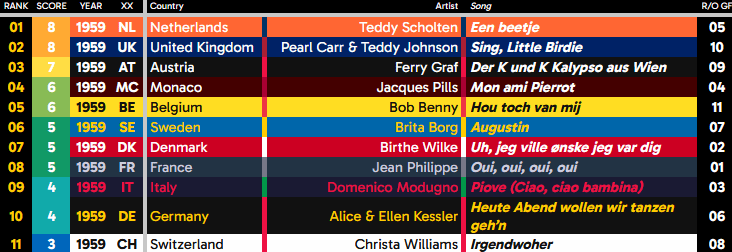
This is a very respectable ranking, especially for a grayscale year. Even my second last place is a song I described as “not that bad”. In most Eurovision years, my last place is a 2/10 or lower, but this year no song is below a 3/10.
Rest of the show:
No interval act this time. Jacqueline Joubert dives straight into the voting and says to the jury spokespersons (who I assume were all watching the show on TV) that they must give their votes in the form of “Song number X, country, Y votes”. This change must have been done to prevent voting mishaps, and in that it succeeded. The scoreboard had a more flowery design than last year: this time it included both the country names (all in French) and song names, written in a fancy serif font. Unlike last year’s scoreboard, this one is hard to read within a 4:3 aspect ratio, so the camera often had to zoom into the scoreboard which was a bit annoying. I prefer getting to see the scoreboard in full.
The voting sequence had a funny moment that made the audience and French commentator laugh. When the German spokesperson awarded France four points, Jacqueline said “la France vous remercie” (France thanks you). As you can see, this host was engaged in the show and wasn’t afraid to put in some whimsy and humor. We then got the first ever instance of audience booing when the Italian jury awarded the Netherlands seven points, knocking France out of the lead. I’m annoyed that the scoreboard was zoomed in at this part, because it means I need to rely on my memory to find out who’s in the lead.
The audience didn’t applaud when the Netherlands was announced as the winner, but luckily for them, all of the top three performed at the end. This was one last innovation France came up with for this show, but that change didn’t stick.
General thoughts:
Overall, 1959 was pretty damn good for a grayscale year. There were no truly crap songs this year and three that I truly enjoy listening to. The Dutch and British entries in particular pushed the contest to lighten up the song lineup in future years. And it’s nice to agree with both the winner and runner-up!
The French were fabulous hosts this year and went the extra mile with their production. The best host nations are those that weren’t asked to innovate the production but did so anyway. France got creative with the stage design and introductions to the contestants, and put some subtle whimsy into the presentation too. Overall the contest has a flowery, distinctly French personality to it. The audience were quite engaged in the show, especially during the voting sequence, but in a subtle formal way, which still proves the producers knew what they were doing.
See you next time as Eurovision comes to the UK for the first time.
 Cookie Fonster's stuff
I’m amazed that on the second round you still have this much to say about your winner! I like the song, but it’s definitely something to be in the mood for, and Sing Little Birdie is better for me, but nice to see.
You’re also surprisingly harsh on the German ladies, their song is just a pleasant, airhead ditty! (She said, quickly checking her own ranking… Ah phew, I had it fourth. :p )
LikeLiked by 1 person
In all fairness, this year had no truly awful songs, so the ones with the most things wrong with them ended up as my bottom two.
LikeLike