
< 2023 Semifinals | 2023 Final | 2024 Semifinals >
With the release of this post, I’ve finished my original goal back when I started this blog post series! But now, I have one more year left to review. Be patient for my 2024 posts, OK?
Introduction
Liverpool, England got to host the final of a special edition of Eurovision, the first to be co-hosted by two countries. The presenters consisted of three women, the same ones who hosted the semifinal, plus one man who joined them for the final. We have British actress and TV host Hannah Waddingham (or as I like to call her, the British Petra Mede), British singer Alesha Dixon, Ukrainian singer Julia Sanina, and for the final, the BBC commentator for Eurovision who’s originally from Ireland: Graham Norton. His presence among the hosts parallels Terry Wogan in 1998, the last time Britain hosted. Terry and Graham both alternated between hosting and commentating, because for the Brits, Eurovision wouldn’t be what it is without a sarcastic Irishman in the commentator booth. While Terry Wogan commentated solo in 1998, Graham Norton alternated with one of the semifinal commentators, Mel Giedroyc. I’ll be watching their commentary for the grand final.
The postcards did something special this year: they showcased three landmarks in Ukraine, the United Kingdom, and the country about to participate that each had something in common, such as universities, opera houses, or botanical gardens. In the third country, we see the contestant performing an activity of their choice, and oh my god they’re so fun to watch. They’re my favorite Eurovision postcards of all time and I’ll discuss further why they’re so great in the general thoughts.
The final results were a battle between two strong competitors: Sweden’s song that was blatantly designed to be popular, and Finland’s song which naturally became an enormous fan favorite. Sweden won the jury vote with 340 points and Finland won the televote with 376 points, but despite Finland’s bigger televote score, Sweden earned their seventh victory. Finland’s fan favorite got second place, and third place was somehow a girl bop from Israel. I won’t even mention which country got last place. It breaks my heart too much.
Ah yes, I remember the opening film and act with its new arrangement of Stefania! The BBC tricked me into thinking every past contest would be as good as this, god dammit. And the early contests with their orchestral reprises of the last winner tricked me into thinking every contest would open with a lovely rearrangement of the past winner.
That was an absolutely perfect flag parade and intro with the hosts—I stayed engaged all the way through. I love the parade alternating between British pop hits and Ukrainian Eurovision entries—an admission that Eurovision is far more influential to the Ukrainian music industry than to the UK’s, but the British music industry is still nothing to scoff at—and I love the 2023 flag parade in general. And the hosts’ opening is perfect too, I love that they tied it in with an announcement that Luxembourg would return next year. Before too long, we get to the first song of the evening, which is…
Austria: Who the Hell Is Edgar?
Artist: Teya and Salena
Language: English, plus an interjection in Italian
Key: B minor
You guys should know who the hell Edgar is! He was mentioned in “White and Black Blues” from 1990, come on, everyone knows this. If you don’t know this, then can you really call yourself a Eurovision fan?
Psst, this the first of three songs this year I 8-bit covered! The other two are “Ai coração” and “Cha Cha Cha”. I don’t know if you guys are into this type of music, but I love making it.
I feel like the staging was a bit restrained for this: it should have gone full out Europapa mode with visuals matching every lyric, to match the sassiness and humor of this song. I’m bringing up “Europapa” partly because I want the song to be remembered for how genius it is and NOT just as “the fan favorite that got disqualified”. I better not rant about its disqualification just yet, I’ll get to do so soon enough.
Musically, this song is a boppy bop of boppiness and I absolutely love it—that’s why I made an 8-bit cover of it. When I listen to it, I feel like I should also be focusing on the lyrics which take the piss out of the music industry, but I can’t tune into the lyrics the way I always do with “Calm After the Storm” or “Ein bisschen Frieden”. Maybe because the lyrics sort of tell two stories at once, one about the girls being possessed by the ghost of Edgar Allan Poe, the other about them trying and failing to make money off their song. Or maybe because the ultra-catchy “Poe, Poe, Poe Poe Poe, Edgar Allan Edgar Allan” steals my attention. The drops of each “Poe, Poe, Poe” chorus always wow me: great synth work and production.
The biggest weakness of this song is that Teya and Salena aren’t the strongest or most consistent vocal performers, especially compared to others this year. It may seem weird that a song written for the Internet crowd flopped in the televote, but between the inconsistent vocals and the message not getting through on stage, I can see why the voters didn’t give it many points. I’m surprised the juries gave this song over 100 points, but I can’t say I’m mad about it, because I do think this is a total bop. Teya and Salena should be proud they wrote this.
Portugal: Ai coração
Artist: Mimicat (Marisa Mena)
Language: Portuguese
Key: F♯ minor
Mel Giedroyc commentated during Austria’s postcard, she seems like a pretty cool commentator. Her sense of humor is a bit different from Graham’s, more focused on puns. Graham came back to the commentator booth a bit before this song and spent most of Portugal’s postcard rambling about what it was like being backstage in Eurovision. He’s truly repeating history by alternating between the stage and commentary booth; Terry Wogan would be so proud of him.
As I said in my initial 2023 review, on the Eurovision stage Mimicat had a strategy of keeping her composure throughout the three minutes of the song, then letting out all her emotions and nervousness during the thank-you message. She worked as a realtor for many years and didn’t have much experience performing on stage, but always had a musician deep inside her.
I still remember the first time I ever heard this time: I instantly fell in love with it. It’s bouncy and upbeat and has a traditionally Latin rhythm plus a clear Portuguese cadence to the lyrics. Eurovision has made me good at identifying languages in music (at least European ones), but even if it wasn’t, the quirky little features of Portuguese stick out to me: all the reduced vowels and the ão sounds and the “sh” sounds at the end of words. It’s kind of like “Dança comigo”, the narrow non-qualifier from 2007, but ten times better. I love the guitars and brass lines and even the hip-hop interlude, a part that some fans aren’t as fond of. Songs like this are what I love about Eurovision.
The tempo changes are awesome and really help give it some Romance-language drama. The only bad part about the tempo changes is, they made this one of the toughest songs I’ve ever 8-bit covered, because I like to transcribe the songs as accurately as possible and it’s so tedious to do so with these slowdowns. The instrumentation is very much not electronic, which also made this a challenge to cover, but it was so worth covering this song.
Mimicat deserved so much better than 23rd place, but you know… that’s the death slot for you. And something has to go into the death slot, I guess. (eye twitches)
The staging is rather low-budget, which I don’t mind at all but unfortunately might explain the song’s low result. I’ll blame the other songs for having more ambitious staging. The way this song is staged reminds me of the two modern years without LEDs: 2010 and 2018 (the latter was in Portugal), but I get the feeling it wasn’t minimalist on purpose, unlike (for example) “Mon amour” from 2024.
Switzerland: Watergun
Artist: Remo Forrer
Language: English
Key: G♯ minor
Now we begin a stretch of songs that I’ve never been a big fan of. This has very professional staging, as is typical of Swiss entries of this era, but I agree with my description of the song as “impersonal” last year. It’s a ballad about not wanting to participate in wars, and it just comes off as too manufactured for me. As with their last entry, this did better in the jury and televote, but Switzerland realized from this and their last effort that they needed to make their song more exciting if they wanted to win. That’s what they did in 2024, and I have so much neighborly pride! Props to Switzerland for making sure their constants can sing since 2019.
Poland: Solo
Artist: Blanka Stajkow, or Bejba as the fans call her
Language: English
Key: B minor
Ah my old arch-nemesis, we meet again! Please pour one out for “Gladiator” by Jann, which should have won the Polish national final but nepotism got in the way. It’s a dark synthy banger which does what Serbia tried to do this year but way better. It would have been such a perfect rebirth for Poland in Eurovision.
I used to absolutely hate this song, not because of the national final drama—I didn’t watch any of those in 2023, though I did hear Gladiator then—but because I found it tacky and obnoxious and it sounded like I’ve heard it a million times before. But guess what you guys, I don’t hate this anymore! I probably would still hold a grudge if this was my country’s entry, because I would absolutely not want to be represented by a song like this, but at this point I can laugh with this song, and the meme of calling her Bejba due to the song’s first lyric has grown on me.
I do still think the song is the musical equivalent of fast food, which I know sounds stuck-up and pretentious, but I don’t necessarily mean it in a bad way. I never go out of my way to listen to it, but I don’t mind hearing it anymore. I can turn off my brain to this and laugh with her sassy lyrics about breaking up and bragging that she’s better off without an asshole controlling her life. It’s a very uncreative composition, derivative of American summer radio hits, but you know what? I don’t mind that anymore. It’s silly and fun and doesn’t demand much of the listener. I’ll go narrower and say this is the musical equivalent of French fries, because I used to hate those things.
I formerly thought the dance break was the only tolerable part of this song, but now I find that part totally out of place. Yep that’s right, I’ve betrayed my past self here. As I said when reviewing 2022, the presence of all those dance breaks in 2023 just proves how much of a success “SloMo” was.
Serbia: Samo mi se spava (Само ми се спава)
Artist: Luke Black (Luka Ivanović)
Language: Serbo-Croatian (Serbian) and English, in rapid alternation
Key: E minor with a tinge of major
Ooh, another fun postcard here—I love the showcase of art galleries. The sculpture of a head in Ukraine brings back memories of “Time”, the Ukrainian host entry from 2017.
Sorry to all the fans of this song, but after not knowing how to feel about this song for the longest time, I’ve decided that I really don’t like this. He mumbles through pretty much all of the song and alternates between languages way too much. It’s an attempt at an edgy synth song, but it really comes off like a far more restrained version of songs like “Hatrið mun sigra”, or like an off-brand Nine Inch Nails. I’m not surprised that this landed near the bottom.
I still don’t like when singers start the song lying down, but it’s less bad when he’s lying on a prop. I get that the staging is supposed to represent him waking up from the isolation of COVID-19 and defeating evil robots from video games, but I only know that from reading about the song. If I didn’t know better I’d assume that it was just because he thinks Transformers are cool, which he probably does.
France: Évidemment
Artist: La Zarra (Fatima-Zahra Hafdi)
Language: French
Key: G♯ minor
I know this song has its diehard fans, but personally I can see why it didn’t land as high as fans hoped—only 16th place. It’s very classy and French, and I like most of the lyrics which are about romantic pain that French way, but I’ve always thought the orchestral instruments and disco beat don’t gel that well together. And plus, I don’t like the part where she sings “ai-je réussi à chanter la grande France ?” (did I succeed in singing (for) the great France?) That part of the lyrics is tacked on for the sake of patriotism and makes it too obvious the song was written specifically for Eurovision.
I really don’t like the staging gimmicks of this song. I can’t imagine it’s pleasant for any singer to sing their song atop a huge tower. To me, it distracts my attention away from the actual song, since instead I focus on her massive dress, which made Graham Norton joke that we finally have a woman taller than Hannah Waddingham. Thankfully, France learned their lesson next year and delivered a performance where the song spoke for itself.
Cyprus: Break a Broken Heart
Artist: Andrew Lambrou
Language: English
Key: E♭ minor
“That’s Andrew Lambrou. He’s been here for over a week and obviously run out of laundry, so bravely performing without a shirt on.” –Graham Norton explaining the guy’s outfit
Apparently Cyprus only has two musical genres now: girlbops and male radio pop. This is extremely derivative of Imagine Dragons’ music in the verses, slightly less derivative in the chorus, but still feels like something I’ve heard a lot before. It’s a fine enough song, I just don’t gain anything new from it that I wouldn’t from turning on a regular radio station. Good vocals and fairly impressive high notes, but otherwise this bores me.
I’d have expected this to do way better in the jury and televote, because to me this is a clear jury bait song. But in reality it got 68 points from the jury and 58 from the televote, nearly an even split.
Spain: Eaea
Artist: Blanca Paloma
Language: Spanish
Key: C not exactly major, not exactly minor—just like (shudder) “Quién maneja mi barca”
I was on the fence on whether I like this song for the longest time. On the one hand, it’s a hypnotic flamenco tune with impressive vocal skills. On the other hand, it’s a chore to listen to in full and doesn’t really go anywhere musically. I’ve tried to fall in love with this song, and I almost did a few times, but it never quite hit that threshold. So I’m sorry (or if you hate this song, pleased) to report that I agree with Erica’s opinion: it really is like a modern-day “¿Quién maneja mi barca?” but not quite as bad. In other words, it’s very difficult to listen to.
The televoters agreed with me since they gave this song only five points, but the juries gave it a more respectable 95. The televote points were four from Portugal and one from the rest of the world—perhaps from Latin Americans? It’s got top-notch camera work with tons of gorgeous shots, I’ll give it that.
Sweden: Tattoo (the winner)
Artist: Loreen, the winner of 2012 and first woman to win Eurovision twice
Language: English
Key: E♭ minor
Before I discuss this all too obvious winner, I should mention that I love the way the postcard throws a surprise. It doesn’t show the obvious skyline of Stockholm or Malmö that you’d expect to see in Sweden’s postcard, or one of the nation’s forests and lakes. Instead it shows the tiny island of Enholmen near Gotland, the medium-sized island that is basically the oddball region of Sweden. It’s a far-off location and I’d say it suits Loreen’s introverted personality well.
Look, I am not denying that this is a good song. It most certainly is—it’s got top tier synth work, expressive sentimental vocals, and a really lovely Middle Eastern strings section in the bridge. And Loreen is a thoroughly kind person, so I hold nothing against her for winning this contest. She even said after the show that she appreciated fans’ enthusiasm for the runner-up, which is such a sweet thing to say. But I am still miffed that this song, which was so clearly designed to become ultra-popular, beat “Cha Cha Cha” which naturally became a fan favorite without trying.
This song was my honest prediction for who would win Eurovision 2023. I say “honest prediction” because I didn’t want it to win—so many other options were way more interesting. But this is one of those songs you just know is going to beat the more interesting alternatives. It’s the last of the three winners that I can’t listen to without thinking about how much better the runner-up is: the others are “Fångad av en stormvind” (1991) and “Rise Like a Phoenix” (2014). All three are good songs for sure, but I am far more passionate about those years’ runners-up: “C’est le dernier qui a parlé qui a raison” (1991), “Calm After the Storm” (2014), and “Cha Cha Cha” (2023). It was just way too obvious that this would win 2023.
I don’t want to spend this whole review being salty, so let’s talk about the song itself. I prefer this over “Euphoria”, Loreen’s previous winner. This one completely outdoes her last entry in synth production and I’m surprised more people don’t think so. It is expertly and professionally crafted and does a lot of cool things with its synths. This kind of EDM with octave pianos, cinematic noise effects, and dancey percussion has always been the first thing to come to mind when I think of Swedish music. It doesn’t excite me the way other entries this year do, but for what it’s worth, I think the aforementioned strings section is gorgeous, the highlight of the song for sure.
At the same time, this was the absolute most unexciting winner possible this year, which made the voting sequence a drag to watch live. I like it better when the winner of Eurovision isn’t How to Write a Eurovision Winner: The Song.
Albania: Duje
Artist: Albina and the rest of the Kelmendi family
Language: Albanian
Key: D minor
If you can forgive that this is exactly the same genre as most of Albania’s last few entries, you’ll realize that this is actually pretty great. It has a waily intro reminiscent of my beloved “Hora din Moldova” and then admittedly takes a bit of time to get going, since the verses are very much “how to write an Albanian entry”. Once the chorus drops, god damn! This is Albanian drama done right, with perfect vocals and great harmonies, and then it leads into an ethnic instrumental interlude much like “My Number One” or “Karma”.
The main way this differs from other Albanian entries is the lyrics: they’re about a family recovering from a conflict and holding together. Personally I can’t imagine a mom, dad, and four siblings preparing to perform in Eurovision without having any petty arguments, so props to them for somehow pulling it off on stage. I don’t speak Albanian so I don’t know how true this is, but I’m told the lyrics could be interpreted as anti-divorce because they encourage a couple to stay married for the sake of their children, which makes the song a bit controversial for some. Musically it’s a banger either way: not as good as “Karma” but still great. The one problem is that the song ends abruptly, ah well.
I find it curious that this got so many points from the rest of the world: twelve in the semifinal and six in the final. Could it be because the other three Albanian-speaking countries (Kosovo, Montenegro, and North Macedonia; co-official in the latter two) weren’t participating this year?
Italy: Due vite
Artist: Marco Mengoni, returning from 2013
Language: Italian
Key: D major
I was very surprised that this got fourth place because I’ve never liked it all that much. Italian male ballads just aren’t my thing and this is the fifth of them since their comeback of 2011, but clearly other fans love them. I agree with Erica’s review once again: it’s more Italian than pizza, but unfortunately I find it very dull. The verses have a piano and drum beat that feels like corporate trailer music, and the chorus is just plain ballady. It’s basically a regular old ballad set apart from others just due to the Italian lyrical rhythm. He can sing, there’s no denying that, but this has never been my cup of tea.
I will give credit where it’s due, this song has a mixed French and Italian version called “La dernière chanson” and it actually works pretty well in French too. And it’s intriguing to see how similar the lyrics are between the two languages.
Estonia: Bridges
Artist: Alika Milova
Language: English
Key: C minor
Ooh, more snow in this postcard! All the snow in postcards brings me back to the earliest postcards of Eurovision, which were back in 1970—back when the contest was in March instead of May.
Estonia brings some class into the competition this year! I think this song qualifying is a significant moment, because it proves that jury bait can appeal to televoters too, which quelled the worries that fans had about televote-only semifinals. Many fans were worried that this song wouldn’t qualify, but it made it through after all. Only tenth place in the semifinal, sure, but it was by quite a big margin.
Alika is a very pretty girl and her dress is a lovely light blue, but I don’t like all the dangly bits in it. Her song is the first of two therapy ballads this year—that’s what I call the style of ballads with lyrics about the singer improving their life. Therapy ballads aren’t my cup of tea and this is no exception. But this is undeniably well composed and sung, so it deserved its top ten result. It landed in eighth place, mostly thanks to the juries. It’s a rare modern Eurovision song not to have percussion, instead using the piano and orchestral instrumentation to make the song sound full. And the ghost piano gimmick is pretty cool too—I love how the piano has “ESTONIA” inscribed on it.
Finland: Cha Cha Cha
Artist: Käärijä (Jere Pöyhönen)
Language: Finnish
Key: E minor
“Now, if you wondered how loud seven thousand people in an arena can be, you’re about to find out.” –Graham Norton
Let’s go, you guys. Let’s FUCKING go. We’re finally at what might be the biggest fan favorite entry of the entire 2020’s. This should have won Eurovision 2023 and you will never convince me otherwise. Like sure, I guess I can see why the juries shafted it a bit, but come on, this got more televote points than Sweden got jury points! Fans loved this more than the juries loved even “Tattoo”, which is really saying something. It lost to Sweden by a fairly narrow margin, 526 points to 583.
This got an absolutely jaw-dropping 376 points from the televote, tied for “Amar pelos dois” as the second highest televote score in history; the highest was “Stefania” getting 439 points. I love how the top three televote results as of this writing are all native-language songs, I think that’s beautiful. Especially because two of them are from countries that the juries did dirty throughout the 20th century: Portugal and Finland. And especially because this is in Finnish, a language unrelated to most others in Europe.
The first time I ever heard this song, which was two and a half months before the show… I would say I was blown away, but in reality, my brain broke. It simply had never occurred to me that this type of music in Finnish existed! Like sure, I knew about hectic rap bangers in English or in Korean (well, really only songs by PSY), but it had never occurred to me that a song this great would exist in Finnish of all languages! It does check out, because Finnish has a consonant-vowel rhythm that reminds me a little bit of those East Asian languages. But still, before I heard this song, I had never thought too hard about what Finnish-language music was like, and assumed that no one outside of Finland really cared about it. In fact, that was largely the case till Käärijä sent this masterpiece to Eurovision. His entry became a worldwide hit and might be the most successful Finnish-language song in the history of the world.
After a few listens where I let myself process that this type of music exists, I became absolutely obsessed with the song and still am. This song is essentially Gangnam Style in Finnish and I’m all for it. In the months after the contest, I started singing the song on runs for fun while holding out my phone with the lyrics, until I gradually memorized all the words by heart. It’s a great song to sing while running because it makes my legs go super fast and I don’t even realize it till it ends. The lyrics are easy to pronounce because Finnish doesn’t do any weird nonsense with pronunciation: what you see is what you get.
In case you don’t know what this song is about: it tells the story of a man who got home from an exhausting work week and now wants to wash away his sorrows with the power of alcohol, which in turn awakens his inner party animal. The composition and staging both tie into the song so brilliantly. The first half is a hectic rap song with a tense driving beat, and the second half turns into a dance party song with a melody and chord progression. The story from the instrumental comes off to me as follows: Käärijä gets home and starts drinking alcohol, he gets wilder and dizzier, and then he breaks out of his shell when the singing section begins. He dances and parties for the rest of the night, but then the stripped-down section (cha cha cha, toinen silmä jo karsastaa […] tänään oon se mies) is a look into his remaining inner doubts, matched both by the composition and lyrics. After the quiet section ends, he throws aside his fears as he cha-cha-chas for the rest of the night. The lyrics are so incredibly goddamn Finnish, it’s unreal. It has that perfect style of taking everything seriously with a pinch of whimsy.
The staging tells a story that matches the music really well. Käärijä starts locked inside a box, breaks a few parts of it as he starts drinking, then climbs up and looks like the king of the world with that gigantic shadow. The start of the second verse introduces those awesome backing dancers tied to ribbons, who dress in pink to complement the lead singer’s bright green. This is a rare case where dressing in pink actually works since it matches a different color. Then when the singing begins, he starts smiling and dancing with the backing crew who take off their ribbons. And finally at the end, he shouts his catchphrase “it’s crazy, it’s party!” which still makes me laugh.
As I mentioned when reviewing “Tattoo”, there are three runners-up in Eurovision history that in my heart are the real winners: “C’est le dernier qui a parlé qui a raison” (1991), “Calm After the Storm” (2014), and “Cha Cha Cha” (2023). Out of the three, “Cha Cha Cha” is actually the one I’m least salty about, because let’s be real here: it was always going to be an enormous fan favorite. By this point, it’s safely become one of the starter kit Eurovision songs, much like “You Are the Only One” or “Dancing Lasha Tumbai” which also didn’t win. I’m not sure which of the other two runners-up I’m more salty about, because I love both of them with all my goddamn heart and they deserve to be starter kit Eurovision songs but sadly aren’t.
And when you think about it, it’s absolutely fucking amazing that a song in Finnish became one of the Eurovision songs. It’s easy to take it for granted given the song is so popular, but it really is crazy when you think about it that this entry made fans cheer louder than anything else this year. I cannot even begin to imagine how proud the Finns must have been that their country sent this song.
Honestly the juries did this song way too dirty—it was only their fourth place! Sure, maybe his vocals aren’t quite as good as Loreen’s, but the only shaky part is the stripped down section at the end and I can happily forgive that. And come on, how did Israel and Italy get more jury points than him??? Sweden I get, since it’s just as much jury bait as this song is televote bait. But you cannot tell me the juries are this repulsed to having fun. The televoters aren’t even this repulsed to jury bait—Sweden was their second place! Though it’s worth noting that no country’s televote gave Sweden twelve points. Finnish televoters even gave Sweden zero points, whereas Swedish televoters gave Finland twelve. You can tell which country wanted to win more badly.
My god, this song is so fucking insanely good. It completely deserves to be such a massive Eurovision icon. I can’t decide if this or “Hard Rock Hallelujah” will remain Finland’s most iconic entry in the long run. Right now I think both are tied.
Czechia: My Sister’s Crown
Artist: Vesna
Language: English, Ukranian, Czech, and Bulgarian
Key: E minor
This is the first time the Czech Republic is competing under the name Czechia, just so you know. It’s also worth noting that Vesna is a band consisting of six women from different Slavic countries who all speak Czech among each other. The members of the group during this song were three Czechs, one Slovak, one Russian, and one Bulgarian who had left but temporarily rejoined for Eurovision.
Finland began of the best part of this grand final: the strong stretch that lasts up to Belgium. This song is a real feast for the ears, especially to a language lover like me. It’s one of those mixed-language songs that actually works because the different parts are designed around different languages, much like “Saudade, saudade” last year. Each language has a distinct role to play in this song: Czech is used in the intro and one line near the end, Ukrainian in the harmonic chorus, Bulgarian in the rapped second verse, and English in everything else.
The song starts with a gripping harmonic intro in Czech, a language we’ve seldom heard in Eurovision: one song that didn’t do well in 2007, and cameos in 2005 (the Ukrainian entry) and 2021. I don’t know much about Czech-language music, but if the white voice songs in Eurovision are anything to go by, Slavic folk music tends to have a blocky even rhythm, and that’s very much reflected in the Czech intro. I like how the stage shows the Czech lyrics during the intro; great way to acknowledge that non-English languages are cool too.
Then comes the meat of the song, the verses with a rhythm clearly designed for English. That’s the kind of English insertion that I actually like, as I’m sure you know. The pre-chorus in English is next, starting with “you can take our hands back”—I consider it a pre-chorus instead of a second verse because the exact same lyrics play before the second chorus.
Then comes that beautiful harmonic chorus in Ukrainian—so irresistible to sing along to! It’s a full love letter to Ukrainians for their perseverance: “My beautiful sister / You are so strong / Brave and the only one / The crown is yours”, plus an English section to end the chorus: “My sister’s crown / Don’t take it down” twice.
I admit, the Bulgarian rap section doesn’t come off all that well on stage; it sounds so much better in the studio version. But I do like this bit of oddball language representation. Must have been a pleasant surprise to the Bulgarians! First time their language has ever been sung outside a Bulgarian entry. Then comes the pre-chorus and second chorus as usual.
The bridge section sadly is a little weak on stage, but screw it, it sounds and looks gorgeous anyway with the ladies forming a circle of hands. Then comes the good type of stripped-down final chorus, which is the percussion disappearing so that the vocals and backing synths can shine. Oh, there’s something I forgot to mention—the instrumental is an awesome mix of ethno-bop and modern accessible pop. Not a full-out ethno-bop, but still has a ton of folksy flourishes to give it life. The chorus ends with Ukrainian and English (which sounds lovely), a line in Czech, and one last line in English.
The song’s lyrics have a clever dual meaning about women standing up for their rights, and Slavic countries (even anti-war Russians) standing together to support Ukraine. For instance, “we are not your dolls” both refers to women not being men’s dolls, and European nations not being Putin’s dolls. You could say the same about nobody having the right to take down their sister’s crown—the sister in question being any woman they care about, or the nation of Ukraine.
They’re not the most professional vocalists on stage and I’m not sure how I feel about their all-pink outfits. I get what the outfits were going for with the unity theme, but I’m a much bigger fan of their colorful outfits in the carpet parade and postcards. At least they’re not dressed in ultra-bright pink. That shade belongs only on Käärijä’s backing dancers, otherwise it’s unacceptable. I get the feeling the staging and outfits were changed a bunch of times till the people in charge of the staging settled upon something these ladies could manage. Still, this song is an absolute treat all around. And despite the holes in the live performance, it landed a respectable tenth place in the end. Surprisingly enough, that’s mostly thanks to the juries.
Australia: Promise
Artist: Voyager
Language: English
Key: G minor
This song is the only Australian entry that deserved the great result that “Sound of Slience” got in 2016. What the juries and televoters saw in “Sound of Slience”, I see in this amazing song. This scored ninth place which is a pretty good result, but you can’t tell me that Israel and Italy deserved to score higher.
Voyager had entered the Australian national final in 2022 with the song “Dreamer” and achieved second place—considering a sadboy ballad won, I imagine that was a divisive victory. Australia couldn’t afford a national final this year, so it’s really smart of them to internally select Voyager. “Dreamer” and “Promise” are similarly styled songs with some of the same musical ideas, very much like some artists’ Eurovision entries in 2020 and 2021, but this song is far superior.
It turns out that this year, we have two rock bands where the frontman is from Hamburg and happens to be the most lovely guy. Personally I think this song gets better the more times you listen to it. It’s full-out prog rock that starts with a simple but catchy synth line and gradually builds into an exciting rock chorus. And then the second verse, I don’t know how to describe all the musical tropes, it’s just plain awesome. Then it has that really sick guitar breakdown in the bridge—a trope reused from “Dreamer”—plus the soaring bridge where the instrumentation strips down with a gorgeous piano and some bitcrushed synths. And finally the final chorus swaps out some of the minor key chords with major key, together with awesome guitar and synth solos, and my mind is blown. It has the perfect blend of rock instrumentation and juicy synths that sounds natural all the way through. Oh, and the clear Australian accent in the singing is a great touch.
I’m baffled that this got first place (149 points) in the semifinal but only got 21 televote points in the grand final. The high result in the semifinal makes sense because it was placed at the end, but the televoters did this SO dirty! I’m guessing the voters were just biased against Australia because it’s far off from all the other countries. Or maybe Finland ate up all the rock votes, but given Slovenia’s worse rock song did better in the televote I’m not convinced. Well OK, to be fair, I forgot to vote for it in the final too.
Graham Norton said this entry could be the sleeper hit of Eurovision 2023, since fans had only recently been giving it this much hype. I think the song landing ninth place proves his point, unless he meant this song would be a global hit like “Snap”, which didn’t seem to happen. He also said at the end of this song that experience means everything: this band has been around since 1999, so they know how to work a crowd. He’s very much right about this. These guys display no hesitation or awkwardness on stage, they rock out all the way through.
This truly feels like the output of Australians and isn’t just another generic pop song. Ninth place for this song was too low, god dammit! I know Eurovision has a few incomprehensible results each year, but 2023 is on another level.
Belgium: Because of You
Artist: Gustaph (Stef Caers)
Language: English
Key: C minor
Now this song, I am more than happy with seventh place! Some fans were opposed to this song due to national final salt, but who cares when it’s this much fun? It’s a 1990’s style club banger with jazzy chords, a positive atmosphere, a singer who’s just the absolute sweetest guy (and loves hats), and a nice message about his husband helping him accept himself for who he is. I can even happily accept his half-pink outfit, because he so obviously finds it cool, so who am I to argue? I’ve always had the feeling that he’s true to himself when performing this song. He just beams with so much positivity. It’s one of a few entries this year that wowed me ever since I first heard it, and it hasn’t stopped wowing me since. I’m so glad I voted for this, both in the semifinal and grand final.
This song is proof that starting from 2018, Dutch-speaking Belgium finally became better at Eurovision than French-speaking Belgium. All the recent VRT entries (2016, 2018, 2020-21, 2023) have been exciting bangers, whereas the last few RTBF entries (2019, 2022, 2024) really haven’t been great. 2024 had a lot of potential, but god dammit, he really couldn’t sing on stage. If Belgium ever gets their second victory, I’m expecting it to be from VRT, just as the last one came from RTBF.
Armenia: Future Lover
Artist: Brunette (Elen Yeremyan)
Language: English, plus Armenian in the final chorus
Key: D minor
Before this song begins, we have the obligatory annual introduction of the Eurovision DVD and oh my god, the BBC did it in the absolute funniest way! Alesha and Julia check in on Graham Norton, who turns out to be busy watching his DVD, and they make it snappy and genuinely funny. And then for viewers on BBC One, he apologized for this skit right after.
Another song that I’ve never been sure how to feel about, I have a clear opinion on it now: it’s good, but not great. It’s a power ballad with a few elements to like about it, such as the theme of Brunette’s wishes for her future lover, which you know is personal to her because she composed it all on her own, or the portion where she sings in a rhythm more typical of rap. The ending in Armenian is a nice touch, I like how the language is featured in the climax instead of the song’s “epilogue” so to speak, which was the case in “Aijā”. I view the ending as foreshadowing their incredible next entry, which is sung entirely in Armenian.
But on the other hand, this is too much of a ballad for me to come back to it much, and again I don’t like that she starts the song lying down. I’m not a fan of the dance break either, but it’s less out of place than that of Poland. On the plus side, she has a great dress made of stitched together elements and delivers a killer performance.
Moldova: Soarele și luna
Artist: Pasha Parfeni, returning from 2012
Language: Romanian
Key: C minor
Fun fact: Eurovision 2023 is the only Eurovision year so far to feature two songs in Romanian, the national language of both Romania and Moldova. If you wondered why these two countries give each other twelve points so often, now you know!
At the time of Eurovision 2023, this was actually Erica’s number one favorite (second was Finland), although since then she’s told me Finland easily surpassed it. Maybe she’s like me in that sense, because “Cha Cha Cha” wasn’t always my landslide winner either. I suspect that the main reason she loves this so much is due to the prominent percussion.
It’s a nice dark ethnic song with awesome folklore staging (love the short guy with the flute!), and I most certainly like it, but I’ve always found it a bit too repetitive to truly adore it. The flute part in particular, I remember watching someone on YouTube contrast it with the flute part of “Shum”, since “Shum” has a flute part that explores all sorts of melodies, while the flute in this is just the same two measures looped, and I have to agree with that criticism. Still, this is Moldovan fun and I’d happily come back to it whenever I feel like.
Ukraine: Heart of Steel
Artist: Tvorchi
Language: English, plus a few lines in Ukrainian
Key: C♯ minor
Ooh, I love the street art theme of this postcard. I’ve always had a fondness for street art, it really helps bring a city to life. And that the guys from Tvorchi paint their own street art, a heart with the Ukrainian flag colors. I wonder if this art is still up today? I mean, it’s only been a year.
Fun fact: Since the introduction of random order in 2013, this is the only year where the running order for two entries was chosen randomly, instead of just one. Normally the host entry and previous winner’s entry are one and the same, but since they’re two different countries this year, Ukraine and the UK both got random slots: 19 and 26 respectively. And both of those countries automatically qualified.
The lyrics are basically “we’re still fighting for our country a year into this war”, predictable for Ukraine, but a little indirect because this is Eurovision. The musical style is totally different from what I expected from the title back then, some kind of rhythm and blues. And yet, somehow this genre actually suits the song! I think it’s down to the visual effects on stage, which really complement the instrumental that sounds like people pushing through a force trying to attack them. And let’s not forget those black outfits with the hearts of steel and sunglasses, they’re the most badass outfits of the year. The portion in Ukrainian is short but actually feels highlighted, much unlike the tiny Czech line in “Omaga”.
Admittedly this isn’t really my kind of genre; it’s more the kind of song I respect than the kind I love. But I can see why it landed a respectable sixth place. These two guys put on a good show and engaged with the audience.
Norway: Queen of Kings
Artist: Alessandra Mele
Language: English, plus the intro in Italian
Key: E minor
Oh hi there Alessandra!!! Honestly I have a bit of a crush on her, or at least maybe a friend crush. From both the Eurovision stage and the postcard, she looks like loads of fun to be around. Just look at her bright smile and bouncy energy as she rides a scooter in the snow. How can you not love her?
Erica is right: this girl is the Queen of the Boppy Bops. It’s just so easy to like this song and anyone who doesn’t like it should be ashamed of themselves! It’s got an awesome 12/8 rhythm and a kickass drum beat that I can’t do anything but bop my head to. Simple as this song may be, I actually like it more the more I listen to it. It’s got some Scandinavian storytelling musical details, especially the violins in the bridge, and god I love that high note. She missed one or two notes in the semifinal, but her singing voice is so rich and expressive that I can happily forgive her. Her stage presence is awesome and so is her outfit. Second most badass ensemble behind the Ukrainian guys.
It may be clichéd to open up the first semifinal with a girlbop, but this was honestly the perfect opener to get the audience in the right mood. I’m so glad she was rewarded with fifth place, even though the juries snubbed her, which I’ve heard was due to missing the high note in her jury rehearsal. Be sure to check out the Italian version, it’s great too. It’s called, uh… “Queen of Kings (Italian Version)”. I’m surprised it isn’t called “Regina del re”, which is in the lyrics.
Germany: Blood & Glitter
Artist: Lord of the Lost
Language: English, but I’ll forgive them
Key: A minor
Hey Europe. We need to talk.
FUCK YOU FOR GIVING THIS SONG LAST PLACE.
That was angry and petty, I know. But this is my country we’re talking about, and it hurts that the first year in forever where we dared to send something other than beige radio pop or weird twee shit, we were fucking PUNISHED FOR IT. And then Germany went back to boring-ass radio pop the very next year and probably will keep doing so. I am still extremely fucking angry that this got last place. How did this get only three points from the jury, the same score that “I Don’t Feel Hate” got in 2021, which was a way worse song in a more competitive year? And how did this get fewer televote points than anyone except the UK and Spain? I am still absolutely fucking baffled and extremely pissed off about this. No matter which reasoning you might throw at me, you will never convince me it makes sense that this wonderful song landed at the bottom.
And plus… Lord of the Lost are a very nice group of people who love this contest and understand what makes a Eurovision entry succeed. They had wanted to compete in Eurovision for many years, but NDR was resistant to letting their music into the national finals until 2023. I actually saw them live at a bar in Malmö during Eurovision 2024 and didn’t stick around for the whole thing because it was very loud and getting late, but I did get to see them cover Eurovision songs live with a good sense of humor then perform their hard metal songs. Chris Harms (the lead singer) is a little bumbling but also passionate when talking about music, and he’s honest about what he wishes Germany did differently in Eurovision, as he’s discussed in several interviews. He all around seems like such a thoroughly nice man. He even said during the 2024 German national final (which had an awfully boring lineup of songs) that his band lost nothing and won everything from Eurovision—I admire his positivity so much. He’s the polar opposite of Eurovision’s sore losers like Cliff Richard, Anggun, or Natalia Barbu. Graham Norton did mention these guys have quite a big fanbase in Germany, so it makes sense that participating ultimately benefitted them.
The low televote score (16 points) I kind of get, because they barely gave Australia any more, and I can assume the rock lovers all flocked towards Finland. It’s still too low, but it’s kind of explicable. (Well OK, it’s actually still ridiculous because this had a good running order spot and came right before a slow song.) But why did the juries save Australia and not save Germany? In the words of Udo Jürgens: warum nur, warum? This is the only German bottom two finish that I think was undeserved, which says a lot about how shit their approach to Eurovision is.
It’s so unreal to have a German entry that actually feels like my country is being represented! And it feels unreal to cheer for this song and feel like these are fitting German entrants—I didn’t realize it, but I am SO used to German entries being those random-ass radio pop songs that do not feel German at all. This song is exactly the kind of industrial hard rock that everyone and their mom associates with Germany. It’s got a pumping beat, theatrical deep vocals, killer 80’s synths and rhythm guitars, and is just everything I want a German entry to be. Well OK, everything aside from the German language, but I’ll forgive them for this.
I still love this, honestly, and I can’t help but bop my head to this. I’m a little biased of course, but tell me you wouldn’t be biased if this was your country. And I actually did vote for this, as a rest of the world voter! This song is a glimpse into an alternate timeline where Germany’s approach to Eurovision is good instead of bad, and let’s hope that timeline someday becomes reality. Bitte Deutschland, bitte? It turns out that having a Eurovision entry that I can feel patriotic about is good, actually! It’s a strange feeling, but a good feeling. The only other entry of ours after Lena that makes me feel patriotic is “You Let Me Walk Alone” from 2018, and even then, that’s mainly because it got such a good result. It did deserve the top five finish, don’t get me wrong.
Lithuania: Stay
Artist: Monika Linkytė, returning from 2015 but now a soloist
Language: English, plus a repeated chant in Lithuanian
Key: G♯ minor
Now, why the hell did THIS finish so much better than Germany? A respectable 11th place, are you nuts? Why must my country be withheld from this great result? I actually somewhat like this song, don’t get me wrong. But coming right after Germany, I can’t help but twitch my eye.
OK, I’ll talk about this song for what it is. It’s another therapy ballad much like Estonia and isn’t that bad musically. It gets off to a slow start in the verses, but the chorus with the harmonized “čiūto tūto” (a phrase from Lithuanian folklore) is actually pretty moving. But I’m not a fan of Monika’s new hairstyle (a short bowl cut) or her orange dress, and she looks overly excited to be back in Eurovision, which breaks the immersion from what should be an emotional song. On the plus side, props to this song for using real live singers for the harmonies, and they do sound good live. I’m not a fan of her long notes near the end though.
Israel: Unicorn
Artist: Noa Kirel
Language: English, plus two lines in Hebrew
Key: F♯ minor
I still don’t get how this landed third place. It got second place with the jury and fifth place with the televote, earning 177 and 185 points respectively. Even though I don’t think this song is all that great: just yet another Israeli dancey song that switches style every 20 seconds.
I mean OK, it has good professional choreography, but as Erica said, it’s really not as good as it thinks it is. I do love watching the dance break at the end, but to me that’s not enough reason to vote for it. To me the vocals are the best thing about this, and otherwise it’s really all over the place. It just feels like too many different musical ideas stitched together, so I never have enough time to get comfortable in each one. I just don’t get why to so many voters, this seemed to be the biggest (or second biggest?) highlight of the show.
Also, I’m still scratching my head about what the hell these lyrics are about. Her singing about how great she is? Her fantasy of being a unicorn? No wait, apparently according to Wikipedia it’s supposed to be patriotic about Israel, but dear god those lyrics are weird and cryptic. Israel’s gonna do the exact same thing next year, of course.
Slovenia: Carpe Diem
Artist: Joker Out
Language: Slovenian
Key: F♯ minor
This song actually used to be my number one of 2023 before the show, but a month before the show Finland surpassed it, and this in my old rankings went down to fourth. Here’s my old pre-show rankings of 2023 with brief thoughts, if you’re curious.*
Honestly I don’t love this song anywhere near as much as I used to. It has its good moments and Bojan has a great voice and stage presence—also, props to him for speaking so many different languages! But it’s a little middle-of-the-road compared to other rock entries, especially Australia and Germany which hype me up more. I still have a nostalgic soft spot for it and I like the rebellious twangy sound… actually, I very much still like this. I’m just not as obsessed with it as I once was. I’ve always liked that Slovenia was so willing to indulge in their language this year, in a genre I wouldn’t have imagined it in.
The best part of this song is the ending: in the era of modern Eurovision where so many songs end like “OK, that’s it”, this song has an absolutely perfect conclusion. The instrumental reaches a climax with snazzy repeated guitar chords (sprejeli, da smo večni samo), then goes into a slow outro with exploratory guitar chords and ends on a lovely major chord. I like that the chord it ends with is A major, which is the same key signature as the song’s F♯ minor. Ending in F♯ major (the chord with the same root note) would be a fairly common trope, but it would also sound unnatural in this song.
* I actually rated Poland as “Fuck no”, but Pastebin apparently doesn’t allow profanity, so I changed it to “Hell no” and the site allowed it. I prefer censoring profanity by replacing it with a different word instead of using asterisks, censor bleeps, or (god forbid) omitting the word.
Croatia: Mama ŠČ!
Artist: Let 3
Language: Serbo-Croatian (Croatian), though in reality it consists mainly of internationalisms
Key: C major
“Now they promised if they win, they’d perform the reprise of their song in the nude. Part of me wants them to win, for them of course, but quite a lot of me hopes that they don’t.” –Mel Giedoryc, who filled in for Graham starting here
This song has great staging that you’d never see anywhere except in Eurovision, and the ŠČ sound really does crack me up, but as a song… I’m sorry, but this is godawful. I know the song is intended to take the piss out of Putin and Lukashenko, and in that it succeeds, but why couldn’t it have also been good musically? I admire these guys for committing so hard to their Balkan sense of humor, I really do. And I’m glad Croatia qualified and then sent their Eurovision magnum opus next year, but this song is just an utterly chaotic mess with too much going on. I guess it’s supposed to be a blend of grunge rock and opera, or something.
I do find it interesting that this song’s lyrics have so many internationalisms, words that exist in many different languages: the words mama, tractor, armageddon, moron, psychopath, and crocodile are all recognizable, and those get down the essence of the song. It’s designed to be easy to understand for speakers of all Slavic languages, kind of like the opposite of “Probka” which I’m told is near incomprehensible even for native Russian speakers.
United Kingdom: I Wrote a Song
Artist: Mae Muller
Language: English
Key: A minor
Musically this song is actually pretty great, one of the best UK entries of the 21st century. Boppy instrumental, humorous sassy lyrics about a woman who discovered her boyfriend cheated on her and was tempted to respond with rage, but instead wrote it as a song. I think I’d like to pretend that live performance never happened, because my god, her vocals were a trainwreck. And her ad-lib singing near the end really didn’t work live. I’m surprised she landed second last place in the end, instead of last place. Which is a shame because the lyrics are so well written and it’s fun to sing along to. I’m curious about the line “my mother would be so proud”; is this a reference to her parents getting separated, which happened when she was six?
I don’t get why the UK keeps sending contestants who can’t sing. Did they learn nothing from Sam Ryder? Maybe they should take some notes from Switzerland; they internally select too and their latest singer won Eurovision!
Who’s my favorite?
Is that even a question? Obviously it’s Finland, Cha Cha Cha. No other entry this year even comes close to hyping me up this much. It is just such a “me” kind of song. Yes, I know it’s a Eurovision fan favorite, but anyone who knows me personally will know that this is the type of song I become obsessed with.
- Belgium, 2 (1976, 2003)
- Bosnia and Herzegovina, 1 (2006)
- Denmark, 3 (1963, 2000, 2001)
- Estonia, 1 (2009)
- Finland, 4 (1968, 1983, 1989, 2023)
- France, 4 (1977, 1990, 1991, 1997)
- Germany, 4 (1956, 1979, 1982, 1999)
- Greece, 1 (2013)
- Hungary, 2 (2005, 2019)
- Iceland, 1 (1992)
- Ireland, 4 (1970, 1980, 1993, 1994)
- Israel, 1 (1987)
- Italy, 1 (1958)
- Latvia, 1 (2002)
- Lithuania, 1 (2022)
- Luxembourg, 4 (1961, 1965, 1972, 1988)
- Montenegro, 1 (2015)
- Netherlands, 8 (1957, 1959, 1964, 1967, 1969, 1975, 1998, 2014)
- Norway, 5 (1960, 1966, 1973, 1985, 1995)
- Portugal, 4 (1971, 1984, 2008, 2017)
- Russia, 1 (2020)
- Serbia, 3 (2004, 2011, 2012)
- Sweden, 3 (1974, 1996, 2018)
- Switzerland, 2 (1986, 2021)
- Turkey, 2 (1978, 2010)
- Ukraine, 2 (2007, 2016)
- United Kingdom, 2 (1962, 1981)
- (22 winners)
As a bonus, here is my ranking of 2023! On the right is my old ranking that I linked to in Slovenia’s review, for comparison.
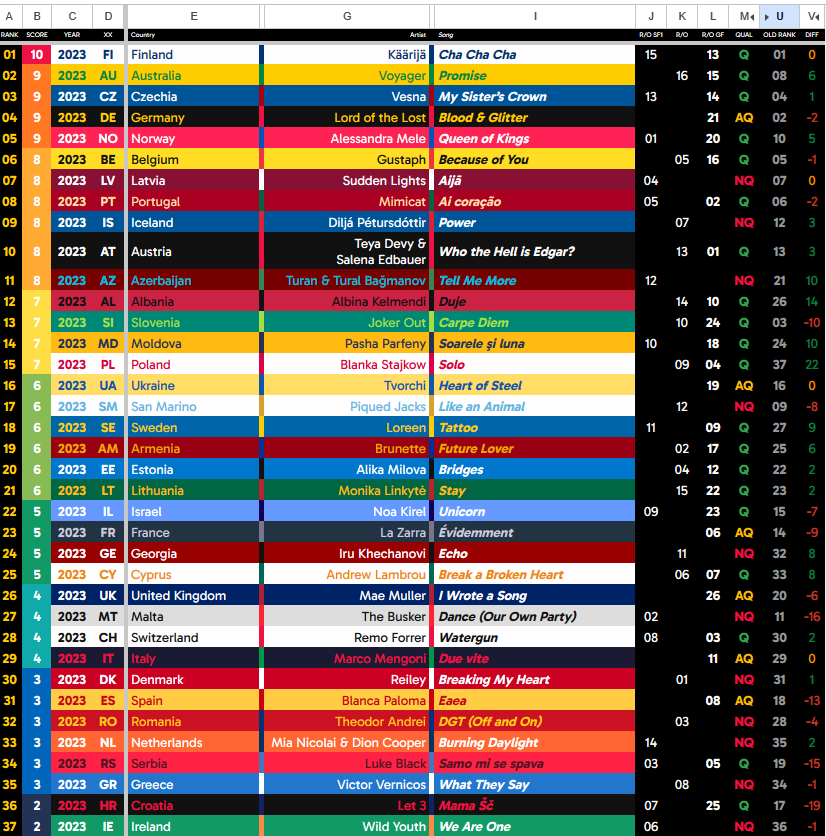
In short: 10 means the song is a masterpiece that always blows me away. 9, I really love it. 8, I love it. 7, I like it. 6, I kind of like it. 5, I don’t like or hate it. 4, I don’t like it very much. 3, I dislike it. 2, I hate it. And a 1 is absolute torture to listen to, even for just ten seconds. Fortunately there are no 1’s this year!
General thoughts:
Show as a whole:
Eurovision 2023 will always hold a special place in my heart. In pretty much every other 21st-century contest I’ve watched, one thought ran through my head throughout: the BBC hosted the show so much better. The British fans deserve to be so proud their country hosted such a fabulous show! It has qualified hosts who are genuinely funny and beam with love for Eurovision, particularly the absolute queen named Hannah Waddingham. The other three are great too, give them all a round of applause. Graham and Hannah have the best banter, it reminds me of Terry and Ulrika from 1998.
They have good banter and humor and overall make the show feel so welcoming. The contest had such an amazing positive atmosphere, both to TV viewers and those who visited Liverpool. I hope the same positive atmosphere can bloom in Basel next year, since Malmö 2024 had so many dark clouds over it.
And the postcards, oh my god, the amazing fucking postcards. Those are the absolute perfect Eurovision postcards. Each postcard showcases three countries at once by pointing out something they have in common, then show us each contestant’s personality and interests. Some contestants look like loads of fun to be around, while others are more of the “yeah… dude…” type. And they all look like they’re having fun in their postcards! These little films tie in perfectly to the slogan “United by Music”, which is such a good Eurovision slogan that I perfectly understand its permanent adoption. They show us that the United Kingdom and Ukraine, two countries from opposing halves of Europe, have a lot more in common than you might think, and they all have something in common with each participating country. The British portions showcase every corner of the country—five in Wales, three each in Scotland and Northern Ireland, and the rest in England—whereas the Ukrainian parts focus mainly on Kyiv and Lviv and avoid the eastern portions due to the war.
Let’s not forget about the visual design: it looks simple, to the point, and attractive. And I’d like to give props to the BBC for bringing back the tradition of Eurovision using a different theme font every year! 2013 to 2022 all used Gotham as their font, which got tiring after a while. That’s just one of many ways Sweden did too good a job hosting in 2013: now all the other countries wanted to copy them. The BBC didn’t copy Sweden’s hosting style, but rather made it into their own distinctly British-Ukrainian show. The font they used is called Penny Lane, and it’s inspired by traditional street signs in Liverpool.
Now as for the song lineup… as you can see from my rankings, it wasn’t nearly as strong as 2021 or 2022, but almost every country had something interesting to offer. There weren’t too many songs of any one genre, it was a perfect celebration of musical diversity. And there was one clear most widely appealing song of all, but the juries snubbed it in favor of Sweden. It is what it is: Finland was always going to become a Eurovision icon either way. And it makes me feel better to remind myself that other non-winners are absolute icons too, like “Fuego”, “Dancing Lasha Tumbai”, or even “Volare” back in 1958.
Interval acts:
The first interval act is Sam Ryder performing his new single “Mountain” set to various backing dancers and percussionists. It’s not as good as “Space Man”, but still rousing and inspiring and British-sounding, and god damn can he sing. Why doesn’t the UK send people who can sing this well every year, seriously?! It also featured Roger Taylor from Queen on the drums.
Then came Graham Norton interviewing 1982 presenter Jan Leeming, which was sweet and fun. I completely forgot this happened, probably because after all the songs in the grand final finish, I’m busy taking in all the hype of what I just watched. I also forgot that the arena contained a special section dedicated to displaced Ukrainians, where Julia Sanina got to spend some time and gave a speech in Ukrainian.
Now the Liverpool Songbook, that is a perfect British interval act. It’s a series of hits by artists from Liverpool, covered by Eurovision artists in styles that suit their voices. This is the type of interval act featuring prior Eurovision contestants I actually like, because it isn’t just a storm of callbacks and lets British music get the spotlight. It’s also sweet that so many Eurovision artists seem to take up any opportunity to perform again. I’m so happy Daði Freyr finally got to sing on stage in this act after missing 2020 and 2021. He looks so happy to be on stage as he covers “Whole Again” by Atomic Kitten. And I love how he has a whole crew of backing dancers with those pixel art outfits. Near the end we got Sonia, who is herself from Liverpool, performing her 1993 Eurovision entry “Better the Devil You Know”—still a 1990’s classic, and a real throwback to hear again. I’m a tinge emotional hearing this, and nostalgic for the time I reviewed Eurovision 1993. Boy was that a fun year—I loved seeing the first few new countries and experiencing RTÉ’s spectacular hosting.
I loved rewatching this entire contest, I never got bored when doing so, not even during the most blatant time filler or the recaps! That’s how you know Britain were amazing hosts. During the third recap I sang along to every song to the best of my ability, and excitedly belted out “nyt lähden tanssimaan niinku cha cha cha”.
The voting:
Ah yes, I remember that voting sequence: it’s basically just “our twelve points go to Sweden” over and over again while Germany stays at the bottom which is so fucking unfair. Every single time a jury didn’t give Sweden 1 to 10 points, I already knew Sweden would be their twelve—no suspense at all. So much more boring than the voting usually is. Here are some spokesperson moments regardless:
- S10 from the Netherlands said she hopes everyone is doing well, especially the girls and the gays. Who is presenting all the votes right now? A girl and a gay! Hannah and Graham shared a laugh.
- If you need any proof that Hannah Waddingham is a champ, after San Marino gave Italy a predictable twelve points, she told the audience not to boo. And they actually listened to her! The BBC couldn’t have picked a better host for this year.
- The Icelandic spokesperson, Einar from Hatari, was the best of them all. He gradually took off his mask bit by bit as Hannah played along and asked him to hurry up. Then he said in a deep muffled voice, Australia. Made me laugh so hard.
- After Norway gave twelve points to Finland, the audience made it very clear who their favorite was. I don’t think I’ve ever seen them this excited about a Eurovision entry. Proof that Sweden wasn’t the right winner this year. They chanted for Finland more and more near the end.
I only realized near the end that the hosts didn’t repeat “X, douze points”, or “X, twelve points”, which proves that this tradition isn’t really needed. But Sweden brought back the pattern next year.
Now for the televote sequence:
- Ugh, I had totally expected the televoters would redeem Germany’s poor jury result. But they fucking didn’t. Why couldn’t we have gotten at least 50 points instead of a measly 15? Is it because of bias against the Big Five? I still don’t understand. It’s really unfair that some way worse songs got so much more points from the televote, like Croatia. And plenty of songs that I thought would only have niche appeal, like Albania.
- Hannah calmed down the audience when they booed the UK getting only 9 televotes. Who needs anti-booing technology when you have Hannah Waddingham?
- Norway’s 216 points is where I really woke up. It’s always the first three-digit score where I think, “shit just got real”. They were fairly low in the jury, I’m told because of her missing notes in the rehearsal. After that came the usual mix of happiness and heartbreak, though my feelings on Germany and Finland overshadow the rest.
- Finland’s 376 points is an iconic moment—Hannah Waddingham’s voice announcing the score was drilled into my head, but it turns out my memory was wrong: Graham announced it instead. Still, Finland got more televotes than Sweden got jury votes! It should’ve been the winner, come on! But as we all know, Sweden got enough televote points to take the prize.
Additional reflection:
It’s so abundantly clear who the audience’s number one favorite was. This is a year where one song got fans excited far beyond the rest, and it’s “Cha Cha Cha”. It’s like “Fairytale” getting by far the most hype in 2009, and everyone’s attention in 2006 being set on “Hard Rock Hallelujah”. It’s just not right that Sweden won instead! “Cha Cha Cha” is a Eurovision icon despite this, but still, it’s just not right. I’m reminded of the audience cheering like crazy for Britain’s Cliff Richard back in 1968, only for Spain to swoop the prize instead. Thankfully, Käärijä wasn’t as much of a sore loser as Cliff Richard. He was a little sore at first, but in a self-aware and honest way.
If you can speak German, I’ll show you this video from Peter Urban where he discusses the results from 2023. To summarize, he said he had an amazing evening on his last year commentating Eurovision and even had to cry a little, until the results happened. He massively disagreed with Sweden winning over Finland and said the result was simply wrong, because “Cha Cha Cha” was so widely appealing to viewers of all ages. He also disagreed with Austria getting so few televote points, and Germany landing last, then suggested a change to the voting where everyone’s first through 26th places get points. He sums up how many of us were feeling about the results of 2023.
Oh, and to think voting results that people don’t agree with were the most controversial part about Eurovision 2023. The next year is a very different story.
See you next time for the first Eurovision year I visited in person, and the most controversial year since 1991. But not just yet—before then, I’d like to make a silly little side post ranking each year’s postcards. (EDIT: here it is)
>> 2024 (Semifinals): The Best and Worst Year Simultaneously
 Cookie Fonster's stuff
I am a bit late on this occasion – have been away to party with my family and partner following an eagerly anticipated visit from my brother – but I’m back with a vengeance, and as usual bursting with thoughts 😉
2023 was really quite wonderful production-wise, it had a lovely atmosphere, actually tolerable interval acts and I really enjoyed all of the hosts and how they interacted with each other. Nothing felt stilted and all the jokes felt natural, contributing to a very relaxed, friendly vibe. I also agree that Voices Of A New Generation was epic, it totally transformed my opinion about Stefania as a song (I REALLY disliked it initially and it didn’t grow on me until I saw this) and it was such a nice way to open the show, the arrangement was weaved into the intro seamlessly and all the different singers really enhanced it. The flag parade has also stuck in my mind, every representative looked so genuinely happy to be there. Weirdly, I have little memory of the postcards – since I intend to start my own Eurovision journey this weekend, I will refresh my memory of them in a year’s time or so haha. So what about the songs?…
At the time of watching the contest live, Norway was my winner, but a year and a half-ish later it has actually aged a bit poorly for me – I think I just loved Alessandra’s voice so much it completely overrode the fact the song itself is a bit middling. I still enjoy it, but it really is just a regular-ass pop tune that might as well have been created by Lady Gaga, I suppose the lyrics could be considered kind of cool but it’s only elevated beyond total mediocrity by Alessandra’s charisma and incredible voice that I still would love to hear in a proper symphonic metal song (even though it’s never going to happen). The Italian version is easier to get immersed in, her gorgeous vocal timbre shines more in the Italian language and the fact I don’t understand the lyrics helps me ignore how middling the song’s composition is.
Nowadays Voyager have edged her out for the top spot in my heart, which I think is the first and only time I’ve ever had Australia in my top 10, let alone my winner! Promise is such an amazing song, the rock elements go all-out hard and the synth elements are used really well to make it more accessible to a wider audience without compromising on quality, and it helps the band has so much personality and perform it with such confidence and joy it’s impossible to not be charmed by them. I have listened to a lot of Voyager’s catalogue and I’ve been pleasantly surprised to find that they have a lot of very complex, very proggy metal music (their newer work is more of a modernised version of classic heavy metal with a lick of prog elements to me), a lot of their oldest work reminded me of Kamelot which are one of my all-time favourite bands. I remember finding the song and performance really good at the time of watching the contest too, but for some reason I didn’t end up clicking with it enough to rank it in my top 10 – that was basically a crime and thankfully I’ve rectified it what also gained me an amazing band to listen to regularly.
Finland has always been and remains my runner-up, which is only because it is quite far removed from my preferred tastes (I am not routinely a fan of songs that combine two radically different genres – this and Lost and Found from 2018 are the only two ESC songs who do this that I really enjoy). I still think it would have been even better if it remained as punchy and edgy as it is in the metal-like first half into the second half, but I understand how the musical change ties in with the theme of the song and I absolutely think it’s the rare example of a song that’s powerful enough to transcend language barriers. I think it’s likely it managed to cannibalize the televotes other rock songs this year would have gotten since despite being in Finnish it has buckets of absolutely irresistible energy and manages to be extremely accessible, yet I can’t be too mad about it. It’s a shame he’s playing a gig nearby in the UK on the same day one of my favourite bands that I’m already booked on to see is, I would have loved to go crazy party irl ☹
Perhaps surprisingly, Moldova is my third. Soarele și luna missed me completely in the lead-up to the show so I heard it for the first time ever while actually watching the contest and was instantly incredibly charmed by it. It’s a different style of ethnobop that isn’t as fast and hectic as a lot of them can be but compromises nothing on the unique cultural experience it delivers, everything from the lyrics to the simple yet intricate staging feels very well thought out and effectively tells the story it wants to tell while also being tons of fun to listen and dance to. I have a distinct memory of taking a toilet break right before this song and breaking into a dance as soon as I walked back into the room, the delightfully bonkers energy just infected me immediately 😂 I don’t mind the slight repetitiveness, I won’t deny it’s there but I don’t find it offensive enough to affect my immense enjoyment of the song in any way. It is classic Moldovan fun, and I can never get enough of Moldovan fun.
I love Germany in 2023 and I was seriously disappointed that it got last place!! Unfortunately, I think I agree with the fact that other songs in similar style this year most likely ate up the votes it would have gotten otherwise since the song tried so hard to be accessible to everyone it ended up being nobody’s favourite, but the dismal points even from juries were rough to see, there’s no world where it deserved to place that low (though I hard disagree with your opinion on Always On the Run, I thought it was a very enjoyable song with excellent vocals and I was happy to see Isaak get a good result, I guess the fact he reminded me of Rag’n’Bone Man influenced my opinion because I love Rag’n’Bone Man). My barrier to having it as my favourite is that the lyrics are kind of cringy, the only metal band I’ve ever seen pull off that kind of love-themed melodrama without being slightly cringy is H.I.M., but I still have it pretty high up, it’s basically a boy bop dressed in metal (and delightfully ridiculous costumes) with how catchy and oddly danceable it is. I wonder if Lord of the Lost have harder songs that may appeal to me even more than this one does, I should listen to their wider catalogue sometime. Their cover of Cha Cha Cha was really fun.
I don’t love Slovenia nearly as much as I loved Latvia, but as far as indie rock offerings go, it’s a perfectly excellent one too. I love its comfy, familiar style and it gets me in a pensive, nostalgic mood recalling all the “good old days”, I don’t understand all of the lyrics but surprisingly quite a lot of the meaning comes across well to a Polish speaker, out of all the Yugoslavian languages Slovenian is probably the easiest to understand for me (well, I understand Mama ŠČ pretty much perfectly in its entirety but I don’t count it as a true example of Croatian since it’s purposefully written to be as understandable as possible). The band are packed with charisma and very easy on the eyes, their enthusiasm really helps sell the song. It’s a shame they were sent with pretty much no staging, it didn’t have to be anything extravagant but something, anything to at least indicate the party that happened in the music video may have helped them connect with wide audiences more and get a better result.
Other songs I quite loved (think of it as honorary mentions) were:
– Czechia – Vesna pulled off genre/language mixing really well and while I find it a bit overwhelming to listen to often due to its very ham-fisted message, I can’t help finding the Russian harmonized chorus incredibly moving;
– Estonia – the best ballad in a year very low on slow songs for me, it’s very well written and composed with a soaring, rousing quality to it that reminds me of Disney songs in a good way;
– Albania – I thought the performance of this classic Albanian drama ethnobop was strangely adorable and the staging was incredibly pretty to look at, though while watching it we were joking that the family looks like a character selection screen in a very classy fighting game;
– Belgium – Gustaph delivered the first fashion bop I’ve ever seen with sufficient style, it’s uncomplicated and fun and utilizes real backing singers super well;
– Spain – I could never listen to this song in my own time, it’s just too much of an aural sensory overload for casual listening and I think Spain would have achieved a way better result with Megara that year, but I still thought the performance of this was very impressive with lots of artistic merit that deserves respect – the fact she created the entirety of the performance on her own is amazing!
Now for the lower end of my heart’s table… I remember enjoying Armenia at the time of watching the show, it seemed classy and beautiful, but re-listening to it recently I actually didn’t like it at all, the weird half-ballad half-rap song structure doesn’t sit right with me and her English pronunciation is really awful, I constantly hear “fart in my face” in the rap bit and the nice harmonized chorus doesn’t help me view the song anymore favourably. Italy’s entry is their usual Italian male ballad borefest, and while I have no issue with ballads as a genre, that particular style of ballad is yet to ever appeal to me. Israel was hilariously bad to me, I suppose Noa had decent vocals but the song was downright dismal imo and I was laughing my ass off at how overly intense she was through the entire performance, especially before and during the dance break. Tattoo is one of my least favourite winners of all time, no matter how hard I try I just cannot engage with this song, it’s very basic Eurodance in composition, I find the lyrics very trite, and the overemoted, pretentiously artsy performance makes me wince with cringe. Loreen is an incredible singer but I don’t like the style she adopted from the point of this song, she took it even further during the interval act in 2024 and that stuff was just creepy. I preferred Euphoria significantly, in many ways Tattoo rehashes many of the same “artsy Eurodance” ideas but the much simpler performance and better lyrics in 2012 appeal to me more and while it’s still not something I like listening to regularly, I can appreciate and have fun with it unlike in 2023. Unsurprisingly though it isn’t my least favourite song this year, it’s Poland. Solo is basically female disco polo in English, and I LOATHE disco polo no matter who fronts it. It’s the absolute definition of banal filler bullshit and I can’t engage with it even as a “fun” song, there’s plenty of better fun and uncomplicated offerings this year that aren’t this offensively vapid.
Anything else I either don’t have strong opinions about or decided to purposefully omit to hopefully prevent WordPress from shadow banning me in your comments section again, though once again this turned out obscenely long, apologies 😆 Onwards to the last year to review from this point of speaking, it’s a shame I didn’t discover your blog sooner so I could be a regular much earlier but I will definitely stick around after all is said and done!
LikeLike
Oh hi there, I’ve been waiting for your comment! But sometimes real life gets in the way and that’s perfectly OK.
I’m typing from my phone and might edit this comment to add more when I get home. For now, know that I continue to be jealous that Slavic speakers understand each others’ languages so well. I already discussed how much I understand Dutch in my 2022 review and the Scandinavian languages are even further removed from English and German. Though thanks in part to my trip to Malmö, I actually know a pretty decent amount of Swedish words now, and to a lesser extent Danish. Not enough to put sentences together—the Scandinavians are insanely good at English anyway. Still, I felt very proud when I saw a sign labeled “sjukhus” and correctly guessed it meant “hospital”.
It sounds like your opinions on Spain are like my opinions on Doomsday Blue, a song I’m looking forward to reviewing because it’s unlike anything else Ireland has ever sent. As for Sweden winning, I always found the song kinda pretentious too, but as I said, it is what it is—Finland was destined to become a starter kit Eurovision song. And luckily, I’m actually really happy with the winner of 2024.
And I am completely unsurprised you hate Solo this much. I don’t know what made me turn around on the song, I really don’t! I just can’t be mad at it anymore.
One more question: do you by any chance have a Discord account? I’d love to have a method of contact with you other than WordPress comments.
LikeLike
Is Solo my most beloathed ESC song of all time? Not really, and tragically I also don’t think it’s Poland’s worst entry – I’d struggle in any good faith call it worse than Time To Party, For Life, The Ride or Light Me Up – but it’s pretty down there. My strong dislike for it isn’t anything to do with the NF drama either, I always disliked Gladiator too (mostly because of Jann’s incredibly irritating voice & accent, the fandom has a tendency to overrate Polish entries that don’t make it to ESC), I just can’t stand that style of vapid club music. I personally favoured Dominik Dudek in the selection that year, Be Good was such a cheerful, energetic indie ditty that sadly got completely lost in the trainwreck of the drama.
All Slavic languages are a family! To varying degrees we’re all partially mutually intelligible with each other, and the horizons are even wider if you learn the Cyrillic alphabet (what I’ve sadly never done, I want to pick up a Cyrillic alphabet based language on Duolingo at some point to finally work on remedying that). I’d personally say Slovak is by far the closest to Polish, but even the more distant Slav languages like Bulgarian/Macedonian still have a lot in common with it and a lot of the same sounds/flow in their speech. It indeed is what it is, I do not like Tattoo but I acknowledge it’s the kind of song destined to win and there’s little anyone can do about it. I wasn’t all that crazy about The Code either, but I enjoy it significantly more for actually being fairly daring and different compared to most winners. I suppose what I think about Eaea is very similar to Doomsday Blue too now that I think about it? Excellent performance package, but the song itself is waaaay too much. I was really shocked to see it do so well, I genuinely didn’t think it would even qualify.
And of course, what gamer doesn’t have Discord :’) My username on it is just kriszna, feel free to add me anytime.
LikeLiked by 1 person
Hi, just saw this comment in spam and approved it! “Be Good” is a surprisingly good uplifting song, reminds me of the Estonian entry “Hope” a little bit. Would certainly be well suited for Eurovision.
I actually do know the Cyrillic alphabet since I read my dad’s Russian textbook as a little kid, but honestly the alphabet was the only part I managed to pick up. My parents have quite a few language learning stories like this from when I was a kid; apparently they also bought a video tape teaching Japanese and I memorized the names of colors, but I only remember midori meaning green.
As for how Doomsday Blue managed to qualify with ease, I actually have a story from my trip to Malmö to tell when I reach that song.
LikeLike
2023 is probably my personal favourite year of the 2020s. I recently went on a big cull of my playlists and 2021 and 2024 ended up having severe cuts made to them, but I didn’t really remove any 2023 songs because they all aged pretty well for me.
The thing I like the most is that the running order feels a little refreshing since Christer Björkman obviously wasn’t involved with it. None of the shows had a ballad in the second slot, for example. The BBC was easily able to take care of the whole productions by themselves, which makes this show feel completely different from the majority of the other shows where the host country was involved very superficially and everything was handled by Swedes. I think this fact alone makes it incredibly enjoyable.
When it comes to the songs in the final, I can’t really point at one and say “this sucks”. While Norway and Israel are about as far from my tastes as possible, I still don’t find them awful. On the other hand, a lot of other songs are really to my taste. Whether it’s because a country has perfected their formula or because they tried something entirely new, many countries have managed to come up with great songs.
Austria has sadly grown off me and became one of the victims of my playlist purges. I just grew tired of it by this point and I can really see why the viewers failed to be engaged by it. Just like with a lot of Austrian internal selections (Austria, like Ireland, is really bad at selecting internally), I get the feeling that Teya and Salena aren’t ready to perform live. They just lack a sort of stage presence to them, an aura that would captivate the viewers. Of course, the minimalistic staging doesn’t help either, it’s just too dark for a playful entry like this.
Speaking of minimalistic staging, let’s talk about how RTP couldn’t afford to give Mimicat a sofa she had in her FdC performance. I think this really let her down because she used it to great effect and it really tied the whole performance together.
When it comes to Solo, I actually prefer it over Gladiator simply because I can’t stand Jann’s voice. It’s for the same reason that I don’t really like Serbia’s song (I’m also a little salty that it qualified over Latvia by just 3 points).
I actually had high hopes for France this year, it was something a little more poppy and less chansony – something closer to modern francophone music. Sadly, those hopes were shattered by the French delegation forcing La Zarra to perform on that pillar when she’s scared of heights. It just needed a performance with more sass and attitude. On the other hand, Spain was the opposite for me: I didn’t like the studio version at all, but the live performance really brought it to live. It’s also one of the best arguments for pre-recorded backing vocals because you can hear Blanca Paloma being her own backing singer, which really adds to the song for me.
Sweden is exactly the kind of beige pop that does really well with the juries and yet I actually like it. It’s the good kind of beige pop and, just like you, I prefer it over Euphoria. Though the panini press they had on stage gave me a lot of anxiety because I kept expecting it to break. I really don’t like props suspended from the ceiling.
Albania and Italy both went for something formulaic, but in a way that I like. Duje is one of those entries that seem entirely unremarkable in the studio version, but get brought to life live. It’s also one of the good revamps because all they did compared to the FiK version was touch up the production a little and adapt it to work well without a live orchestra. I can say basically the same for Italy.
Now, Finland. Well, it’s not my winner and I can’t say I revisit it too often. These days, I listen to Tattoo a lot more often. So I don’t know, I wouldn’t have minded it winning, but a second place is a good result for it too. Still, I can understand why it’s a fan favourite these days.
Now, Czechia, Australia and Belgium are all my kinds of song. Czechia does the multilingual ensemble-style singing right, which is very difficult to pull off wihout making me wince, so huge props to them. Australia is the kind of songs we need more in Eurovision (I’m probably biased) and Belgium is a fun gay bop (Olly, this is how you do it).
I’m surprised you called Armenia a ballad because it definitely isn’t one to my ears. It’s more of a midtempo girlbop in my opinion. Moldova was also good, I think that both Pasha Parfeni entries are really good in their own way.
Germany, well. I wish it could’ve come higher, but it felt like it was trying to compromise between being a metal song and accessible to everyone. And I actually have evidence for this being true, my metal-loving friends thought it was “too soft” when I showed it to them. Meanwhile, my mum still thought it was “too hard”. That’s why it didn’t do too badly in the televoting, but failed to break into the top 10 for most countries – it just failed to connect with its target audience.
Slovenia and Croatia were both good for me. I still regularly listen to Slovenia and Croatia is just a lot of fun, I’m glad it qualified. As for the UK, it’s probably one of my favourites of theirs studio-wise. Sadly, the live performance really flopped, which is a huge shame.
The hosting was really good this year, the hosts were likeable, the stage was big, but didn’t feel empty. It really shows why the BBC are still the masters of international productions and not, say, SVT (who just can’t resist making callbacks to their old shows).
LikeLiked by 1 person
It explains a lot that the BBC didn’t hire a bunch of Swedes to help out with this show—this contest really has its own distinctly British personality and I love it. The BBC works hard to maintain a positive perception worldwide, and it shows because every American knows what the BBC is, when we’re notoriously uninformed about other countries. I think they’re the only broadcaster outside the US that the average American has heard of.
And yes, Austria is a bit bafflingly bad at internally selecting their entrants. Why is Switzerland one of the few internally selecting countries that actually makes sure their contestants can sing? That should be crucial, in my opinion.
Oh, I totally forgot about Mimicat’s sofa in Festival da Canção! That’s what her Eurovision performance was missing, seriously! It looks so empty without the couch.
And you’re so right about Belgium being a gay bop done right. “Dizzy” the next year was just trying way too hard to be pandery—every gay male fan I’ve ever talked to agrees on this.
For Germany, I see what you mean by too soft and too hard, and while you might be on to something, if the song actually scored well like it should have, I wouldn’t have been the least bit surprised!
You’re also right about SVT making too many callbacks to their old shows. Their hosting of 2024 was extremely pandery and fanservicey, not that I mind personally, but I feel like Sweden thinks they are more obsessed with Eurovision than any other country in Europe. Whereas you Ukrainians seem pretty obsessed with it too!
LikeLike
(First of all, great job on those 8-bit covers! The one for “Who the Hell is Edgar” could fit into a video game about trying to become a famous singer)
I felt like 2023 was a very eclectic year; the 100% televote in the semis had something to do with that. This led to a bunch of good songs, though I might need to re-listen to some of them to see if they were really great. Some people think the song quality dropped, but I’m not sure why.
I believed Liverpool would be a great place to host Eurovision, and they proved my point throughout the production! The Liverpool Songbook is an act of genius, and Duncan Laurence singing “You’ll Never Walk Alone” just gives the chills.
My favorite song this year is “My Sister’s Crown” from Vesna! I like how creative it is, along with the message it conveys. RE their vocals: I know during the preparty season everybody was hitting the panic button because their performances weren’t that coordinated. Fortunately, they managed to get their act together and perform well! Probably the best Czechia has ever sent.
Sadly, we’ll have to disagree on “Eaea”, as it is my runner-up! I loved Blanca Paloma’s “Secreto del Agua” from the previous year’s Benidorm fest, so seeing her again, albeit with something more experimental, made me smile. I understand it being an acquired taste, but it’s just so haunting and beautiful for me. I feel like it’s low televote score was undeserved, though it never really catches on to the casual audience the way it would with more pop influences (though “Jako” would prove to subvert that!)
As for Loreen vs. Kaarija, I lean towards “Cha Cha Cha”, because it’s more unique musically and it’s stronger lyrically. Not only with the storytelling, but how it’s written. I respect “Tattoo” for its soundscape and the message it tries to get across (and am more engaged with it than “Euphoria” on certain aspects), though the lyrics don’t really work for me. They can get a bit hackneyed at times.
Anyways, here’s Wonderwall. 🙂
LikeLiked by 1 person
Liverpool really is the ideal Eurovision host city, isn’t it? The exuberant positive atmosphere has never been matched before at all, to my knowledge. And “Secreto de auga” is actually way more accessible and also more musically interesting than “Eaea”, I have to say!
In both “Tattoo” and “Euphoria”, I feel like the lyrics aren’t really the point of the songs—such often is the case for international European hits. And that weighs the songs down a bit, I love when songs have interesting lyrics like “Calm After the Storm” or, for a more obscure pick, “Funny Girl”.
LikeLike
Mel Giedroyc is frickin’ hilarious, and if Graham ever decides to jack it in, she’d be a worthy replacement as far as I’m concerned. Much better than Scot Mills anyway.
I don’t think I’d heard those 8-bit cover of Austria and Portugal yet! They’re both really cool! (Oh, and the husband is still waiting for that cover of Dschinghis Khan 😉 ) Both are great songs anyway, so that helps of course. In fact, I’d say Who the hell is Edgar is as much of a slow burner as No Rules, in that yes, I really liked both from day one, but only weeks later did I realise just how good those songs are, really, if you look past the humour.
I’m never really aware of any national final drama unless it’s all over Reddit, but goddamn that Polish song is awesome! I actually quite like Solo, but this is on another level. (Damn good video too – very dark, but I don’t mind that at all.) You’ve got France way lower than me as well, because I love that song, and I don’t understand most of the lyrics anyway.
I had to laugh at how upset all the diehard Spain fans were at how few televote points they got, but frankly I was surprised it got any at all. As you say, to me this is pretty much exactly like Quien maneja mi barca. But then, Suus got fifth fucking place, so I guess people just like torturing their ears or something. Oh, and I agree with you that Tattoo is better than Euphoria.
I’m not going to say anything about Cha Cha Cha, I’ll leave that for my own review. Same with Germany, because they absolutely did not deserve last place (even if I don’t actually like the song). I am quite surprised at how high you have Czechia though – yes I like the song, but clearly not as much as you do! Australia we do agree on though, and I have a friend who now has their entire back catalog on his Spotify list, so they gained at least one more fan last year.
As for Israel… Maybe it was a premonition of this year, but I maintain that it’s not as good as it thinks it is, even though I do like the song.
LikeLiked by 1 person
I never liked Scott Mills either, the one time I tried watching his commentary, so I got used to ARD semis and BBC finals. The BBC semis are pretty hard to find anyway. But yes, Mel really is a treasure. I love her line “You are our bae, Muller; now slay, Muller”. She seems to love puns as much as I do.
Glad you enjoyed the 8-bit covers! To me, Edgar was a pretty quick burner—didn’t take me long to appreciate how good it is musically. “No Rules” on the other hand, it took until you discussing what you like about it for me to see that it is, in fact, an unironically great song. That song will be one of the bursts of happiness in the shitshow drama of 2024. Oh, how I wish “Europapa” could’ve been one of the bursts of happiness too.
“Gladiator” is freaking awesome, would have been by far the best Polish entry of all time. But TVP had to throw away this opportunity, the bastards. I bet Polish Eurofans are even more pissed at their broadcaster than Germans are at NDR.
And your friend becoming a Voyager fan proves that Australia is another one of the gateway drug entries this year! I’d say the other biggest gateway drugs are Latvia, Germany, and obviously Finland.
LikeLike
We get to the final! Now, this is where the “good stuff” is! (No, seriously. I thought all of the NQs with the exception of Iceland this year were just lame this year and I will stand by this take.) Let’s take a look at my review:
My favorite this year was also Finland, but I didn’t mind Sweden winning too. Cha Cha Cha is my favorite simply because it’s fun, charismatic, and I just couldn’t stop listening to it during post-season. My close 2nd was Norway, and Sweden, Belgium, and Czechia round out my top 5. I also liked Italy, Israel, Poland, Moldova, Australia, and Germany (who did not deserve last place IMO).
My least favorites out of the finalists is Spain and the United Kingdom. Spain because I personally found it really grating and a heavy acquired taste, and the United Kingdom because… well, I just couldn’t really connect with that one.
About the voting… I will definitely say that this year I agree with the televoters’ decisions, as much as I’m going to stay professional and not whine/complain about the results. I honestly didn’t mind several of the “fan-faves” tanking with the televote (as much as they did well with the jury) because I was hoping it would send a message that just because an entry is liked doesn’t automatically mean it will do great in the contest itself.
As for the hosts itself, I personally enjoyed the chemistry between Alesha, Hannah, Julia (as well as Graham in the final). I agree that the BBC did a phenomenal job hosting on behalf of Suspilne this year, and I think it will be a touch act to follow in the years to come (I do not like to remember the murky things that happened this year).
I’m looking forward to reading your posts on 2024!
LikeLiked by 1 person
You have a good point about the fan favorites that flopped with the televote. Eurovision is all about how good of a first impression songs leave, and while fans building up hype helps, it really isn’t everything. That would explain in particular why the televoters didn’t like Austria.
And as for Sweden’s hosting next year, I honestly think they put on a spectacular show and it’s mostly the hardcore fans that have nitpicks about how it could have been better. My mom for one, who is nothing more than a casual viewer, was absolutely blown away by the show SVT put on. But I’ll see soon enough how the hosting compares against 2023!
LikeLike