
< 1962 Review | 1963 Review | 1964 Review >
Note: I’ve decided I will only rewrite my Eurovision reviews up to 2019. For 2020 onwards, I’ll just post ranking images with annotations. The reason why is because my posts for 2020 onwards are already extensively detailed and I don’t feel a need to remake them.
Introduction
After having hosted Eurovision 1959 and 1961 and won 1962, France declined to host 1963 and passed the duties to the United Kingdom, who ended up hosting one of the strangest Eurovision years. Eurovision 1963 took place in the BBC Television Centre in London and had an unusual format in several ways. For one thing, the audience didn’t see the performances live, but rather on a TV screen that showcased special effects. The host, audience, and scoreboard were in the studio TC3, whereas the singers and orchestra were in TC4 which had an elaborate stage full of props. I get that Eurovision has always loved to showcase technology, but not letting the audience see the live performances in person was just ridiculous. At least it was fun for TV viewers though.
The producers put quite a few special effects into the performances, which wowed some viewers but caused others to suspect the performances were all pre-recorded, which it turned out they weren’t. If that wasn’t controversial enough, the voting sequence had an infamous mishap that had to be corrected, which caused many viewers to suspect the winner was illegitimate. I find that a real shame, because the winner (“Dansevise” from Denmark) is by far the best song of the show. The second and third places (Switzerland and Italy) are alright enough, but nowhere near as interesting.
For the second time of four, the BBC hired Katie Boyle to host, who is a dignified and confident presenter as always. She opens the show with a parade of sorts to introduce each country set to comfy orchestral music, and I like how she says something different for every contestant, such as “Austria’s entry tonight will be sung by Carmela Corren” or “The first of our Scandinavian guests: from Norway, Anita Thallaug”. It’s a heartwarming and welcoming introduction and just makes me sad that Eurovision 2024 was such a horrible shitshow. Ah well, we have another Eurovision to look forward to in just a month and everyone is praying it goes better.
The voting system was changed from last year: now each jury had 20 members and they awarded five to one points to each of their top five songs. Even though each country could now award points to five others, we still ended up with four zero-pointers. This time, each song is preceded by a map with a flashing light at the capital of whichever country is up next, which is great because I love maps. The map also has an overlay in a nice bold sans serif font, showing the country name in English, the song name in all caps, and the singer name. What hasn’t changed is the lineup of countries: it’s the same sixteen as last year.
In round 1, I watched this contest with Dutch commentary, and it looks like I tried my hardest to understand it. This time I’ll watch with British commentary, which is linguistically easier for me. The BBC once again hired David Jacobs to commentate, who has a dry sense of wit in a distinctly British way.
United Kingdom: Say Wonderful Things
Artist: Ronnie Carroll, returning from 1962
Language: English
Key: C major
My ranking: 4th
After doing so well with upbeat songs, the UK decided to twist things up and sent something more laid back, and they pulled it off really well! It’s a relaxing waltz that still sounds sweet and British and the female backing singers really elevate it. Seriously, why didn’t more countries in the 1960’s hire backing singers? It was always an option!
This song gets the competition off to a strong start and shows off the kind of inventive staging we’ll see through the rest of the show. It features a man surrounded by three charming ladies to portray a little romantic story. I happily relistened to it a few times as I expanded this review, which is a good sign.
Karina says this sounds like Christmas music and now that she says it, she is totally right. My dad absolutely hates Christmas music, but I don’t mind it too much myself. I wouldn’t go out of my way to listen to that kind of music, but it gives me a nice feeling of childhood nostalgia. For several years in a row as a teenager (2013 to 2019), I didn’t visit extended family for Christmas but rather went on a trip somewhere warm with immediate family (usually Florida), and because my dad can’t stand Christmas music we never heard that during those trips. As such, I can’t help but associate Christmas music with being a kid.
Netherlands: Een speeldoos
Artist: Annie Palmen
Language: Dutch
Key: B major
My ranking: 12th
Thank you David Jacobs for mentioning info about the composers—saves me some trouble from researching on my own! David Jacobs claimed this song had the same composer as “Een beetje”, but going by further research it was instead composed entirely by Pieter Goemans, who wrote the lyrics to “Wat een dag” two years back. This didn’t do anywhere near as well as either song, having scored zero points. This song has a tinge of the playfulness we see in old Dutch entries, but it’s too much of a restrained ballad and there were more exciting songs to be found here. It’s not too bad to listen to, but it fades out of my brain the moment it ends.
Also, for a song titled “a music box”, I feel like the titular instrument should appear more often, instead of just in the intro, a short interlude, and the ending.
Germany: Marcel
Artist: Heidi Brühl
Language: German
Key: E♭ major
My ranking: 2nd
Oh hell yes, now THIS is how you leave a good impression on viewers. It’s the most upbeat song of the evening and I’m surprised it only got ninth place with five points. This song was so long before I was born that I don’t feel like I can be patriotic about it, but at the same time… I just know if I was watching in 1963, I would’ve been like, “oh my god, Germany NEEDS to win this year!” and rooted for lovely Heidi. At least until Denmark came along, because their song is way better.
Most songs don’t evoke much of a color when I listen to them, but for some reason, to me this song is extremely red. Like the color of freshly picked strawberries, perhaps. Maybe because it’s lively and so obviously romantic? As for what the song itself is like, I’ll let my past self do the talking:
A lively, spunky tune that sounds right out of a Broadway musical, this is addressed at a man named Marcel who the singer wishes would slow down and treat her more kindly. While stage play style songs haven’t been my favorite in these contests, this one owns up to the style so completely that I can’t help but love it. This song knows exactly what it wants to be and doesn’t downplay it at all. It just feels so alive. With her energetic tone, snazzy presumably red dress, and showy gestures, you can tell the singer was also a famed television actor.
The one problem with the song is that it has an abrupt ending. Apparently I didn’t mind abrupt endings when I first reviewed this year, but now I hate them. The song still really makes me smile though.
Austria: Vielleicht geschieht ein Wunder
Artist: Carmela Corrin, originally from Israel
Language: German, English, then back to German
Key: E major, E minor, then F minor
My ranking: 15th
Hey, David Jacobs pronounced the title really well! He even got the “ch” sound in the first word right, which is the number one toughest sound in German for foreigners.
Unfortunately, this song brings us back to overly slow and old-timey ballads with too many drawn-out notes, and I’m annoyed that half the song was changed to janky English. I always forget that a handful of grayscale entries had a portion changed to English or French, probably because the EBU stopped allowing that after 1965. She’s singing about the hope that a miracle will happen and she finds love, but the song is certainly no miracle as far as I’m concerned.
Norway: Solhverv
Artist: Anita Thallaug
Language: Norwegian
Key: C♯ minor, but it gradually transitions into C♯/D♭ major
My ranking: 14th
Anita has such an attractive face, so I wish her stylist had given her a hairstyle that complements it rather than an unflattering old-timey housewife haircut. Ah well, I can still look at her face to distract myself from how boring of a ballad this is. It tries to be a little cinematic sounding and a little ballady, but instead it just sounds aimless. It doesn’t help that I don’t like most ballads to begin with. Seriously Norway, why did you send three forgettable ballads in a row? I don’t know if Norway really thought ballads were the right way to do well in Eurovision, or if those just happened to win their national final the first few years. This song landed them with zero points, so they’ll move away from ballads the next few years, thank goodness.
Italy: Uno per tutte
Artist: Emilio Pericoli
Language: Italian
Key: A♭ major, A major
My ranking: 7th
Now here’s another song with clever staging that tells those who don’t speak Italian what the song is about. He sings about four different women he’s loved over the years and each time he name-drops one, he flips a board to reveal a picture of her. He then says that he’s still attracted to all four and will choose the first one to say yes. It’s nothing too groundbreaking, but it has a catchy melody and I like the way it alternates between swing and straight sections.
Finland: Muistojeni laulu
Artist: Laila Halme
Language: Finnish
Key: A major, B♭ major
My ranking: 10th
Ouch, it must have hurt that Finland was the second zero-pointer this year. Their latest attempt at transcending language barriers has Laila sing “la la la” for significant parts of the song, which represents the melody she sings to herself to remember her old lover. It’s an OK enough old-timey ballad with some decent melodies, but there’s nothing really memorable about it so I won’t rank it highly. Still, zero points was needlessly harsh.
Denmark: Dansevise (the winner)
Artist: Grethe and Jørgen Ingmann
Language: Danish
Key: A minor
My ranking: 1st. Not even a question this time.
And there we have it: the oldest ever Eurovision song that I love enough to keep on a playlist, and the oldest I love enough to score 9/10. A 7/10 is good but not good enough to go on a playlist, 8/10 is really good and might be playlist material, and 9 and 10 are always playlist material. The score 10/10 is reserved for the most mind-blowing songs in Eurovision history, like “Dancing Lasha Tumbai” or “Calm After the Storm”. Don’t expect me to rate songs 10 often, except from 2019 onwards.
So what is this song like, and what makes it so great? It’s a moody song in triple meter about a romance that ended years ago which the singer hopes to revive, and the lyrics have lots of metaphors about nature. The song excels at being moody without being boring or overly depressing. In fact, it’s the opposite of the latter two things, because it’s lots of fun to listen to, and listening to it fills me with joy that such a wonderful song exists. It’s performed by a married couple, but it’s set apart from other such songs because only Grethe sings, and her husband contributes to the song using the guitar.
Something that makes this song special is that it contains hooks not just in the vocals, but in the instruments as well. For one, the bass playing the notes E A E A is one of the defining features of the song. Those four notes begin the song and repeat throughout the verses, both as E A E A and raised up as G C G C. The bass hook is complimented with a little hook on the guitar: “et solstrejf i en vandpyt” (guitar: A F♯) “et lille kindkys af en vind” (guitar: E A) Then in the next pair of lines, the guitar hook is twisted up as “E A” is replaced with “D C E”. The other parts of the verse have Grethe’s singing accompanied by some lovely guitar chords.
The chorus does something cool musically: the vocals, guitar, and strings all harmonize with each other, much like a group of three or more singers would. The effect of harmonies is probably more obvious in my 8-bit cover of the song, which is one of my favorite Eurovision covers I’ve ever done. Even though this is song has only one singer, it achieves a similar effect to a vocal duet because of the way her voice interacts with the instruments.
Making an 8-bit cover of the song made me realize it has quite an unusual structure. The first verse leads to a chorus as is usual of songs like this, but the second verse jumps straight into a moving bridge section (kom igen, kom igen…), then a sort of variant of the chorus (kom, lad os danse). After an interlude to cool down the tension. Then comes one last verse and chorus, and the song concludes on a moody but sweet note. The ending uses the trope of a minor key song turning into major key, and it fits the song well without sounding clichéd. That’s because the ending represents hope that the relationship Grethe sings about will regain the vibrant joy it once had.
I should also give shoutouts to the German version of this song, called “Der Sommer ging vorüber”. Since I can actually understand the lyrics of that one, I can confirm they’re beautiful lyrics, better-written than most of the actual Eurovision songs in German. It’s also heavy in rhymes (like the original Danish version), sometimes even within the same line, which delights me and is tough to pull off in a Germanic language. The English version called “I Loved You” unfortunately isn’t half as good and has weird stilted lyrics.
If that wasn’t enough languages, our old friend Corry Brokken covered this in Dutch and it fits her voice really well. She sings crisp and clear as ever and I can decipher most of the lyrics easily thanks to my German knowledge.
If I was watching this show live in 1963, as soon as this song ended I would’ve wanted this to win, and forgotten the German entry ever existed. But I would’ve feared one of the more boring ballads would’ve won instead. I’ll discuss more about the song’s victory in the “rest of the show” section; for now, just know I am extremely glad this song ended up taking the prize. It really should’ve been a runaway winner, instead of a winner by just two points (42, the runner-up got 40) with a voting mishap attached. Still, it’s pretty awesome that Denmark overcame the juries’ bias towards songs in English, French, and Italian and sent an entry that Eurovision fans love to this day. Denmark pulled all the stops in the early years to make their language sound melodic and disprove the stereotype that it sounds drunk. And it earned them a victory as early as 1963! Oh, if only Finland was quite as lucky…
So if I love this song so much, why did I give it just a 9/10 instead of a 10/10? Well you see, I’m simply not always in the mood for a song as lowkey and old-timey as this. There are other entries from 1960’s Eurovision that I’m pretty much always in the mood for, particularly “Poupée de cire, poupée de son” and “De troubadour”. Still, this is an absolutely wonderful song and believe me, I didn’t expect my review to get this huge.
Yugoslavia: Brodovi (Бродови)
Artist: Vice Vukov
Language: Serbo-Croatian (Croatian)
Key: A minor
My ranking: 16th (last)
After sending a surprisingly likable ballad last year, this time Yugoslavia sent a song that tries to be ultra-depressing but doesn’t even succeed in that, and is instead just slow and boring. Oh god, and it has a spoken word intro, which never goes well with me. I don’t like this one at all. The inclusion of ship masts in the staging is nice because it matches with the song’s title, but it doesn’t mean the song is any good.
Switzerland: T’en va pas
Artist: Esther Ofarim, another Israeli
Language: French
Key: D♭ major
My ranking: 6th
And now we have the runner-up of Eurovision 1963, which almost won the contest until the Norwegian jury corrected their votes at the end. You can imagine how much uproar this caused back then. Even to this day, the final result of 1963 has a small dark cloud over it: some viewers still believe the victory of “Dansevise” was illegitimate.
Erica revealed an interesting line from the Dutch commentator: apparently he compared it to the song “Ne me quitte pas” by Jacques Brel. I had never heard of that song before I read her blog, but now it’s the number one saddest song that I have ever heard. As someone who normally hates depressing songs, I mean this in a good way, because “Ne me quitte pas” is an absolute work of art. It’s so utterly hopeless and heartbreaking that I can’t help but love it.
This song, on the other hand… I can kind of see the Jacques Brel comparison, but it isn’t even half as good. It’s a fine enough French chanson in 6/8 time, but I find it crazy that so many viewers back then thought this was the legitimate winner. What’s so brilliant about “Ne me quitte pas” is, even though Jacques is pleading for his lover not to leave him, you can hear in his voice that he knows the pleading is futile and she will never come back. Meanwhile, Esther Ofarim has an air of “I love you so much that I could never imagine life without you”, which is nowhere near as interesting.
I’ll give it this: this is a little better than other French chansons of the era because the instrumentation has some pretty good string lines, and because the melodies are quite memorable. But my god, I am so glad “Dansevise” beat it in the end.
France: Elle était si jolie
Artist: Alain Barrière
Language: French
Key: C minor, C♯ minor
My ranking: 5th
Another song that did something creative with staging, this did something that must have amazed the audience back in 1963: a woman portraying the singer’s love interest fades in and out of the screen, and while the woman dances he turns his head towards her. It fits the lyrics of the song, which are about a man who found a woman so beautiful, he could not bring himself to feel comfortable loving her.
It’s another old-timey French ballad, but I find it to be pretty decent musically. It has a sort of bossa nova bassline and a subtle, sensitive vocal delivery, which makes sense because Alain himself composed this song. I like the descending scales on the xylophone when the key change begins. It’s not the kind of song I would come back to, but when I watch this I’m not waiting for it to be over.
Spain: Algo prodigioso
Artist: José Guardiola
Language: Spanish
Key: G minor
My ranking: 11th
This time, Spain has given us a sort of romantic ballad with dramatic lyrics about his love for his wife. That’s who “algo prodigioso” (something marvelous) refers to, and in typical Spanish fashion José describes his wife through elaborate metaphors. The song isn’t too bad musically and he thankfully doesn’t get shouty, but it’s also just a little bit boring. The most interesting part is probably the military march trumpets in the background, I suppose.
Sweden: En gång i Stockholm
Artist: Monica Zetterlund
Language: Swedish
Key: G major
My ranking: 3rd
An ultra-slow ballad and I’ve ranked it third??? No, it’s not because everything below is utterly horrible. Let me explain.
The reason I actually like this song is simple: it’s exactly like winter in musical form and I love winter. When I listen to this song, I picture vast expanses of snow in midnight. It paints a vivid picture of winter in my mind, kind of how Germany’s song fills my brain with the color red. Plus, it has a subtle lick of jazziness to make the song more interesting, which makes sense because Monica Zetterlund was a jazz singer. The lyrics are quite sweet as well: they describe the woman going on a boat ride through Stockholm and feeling a romance with her love so intense it feels like summer.
The camera spends most of the time zoomed in on Monica Zetterlund’s face, where you can see she’s having fun performing it in her own subtle way. I feel so betrayed at the end of the song, where the camera zooms out to reveal she’s wearing a horrific tablecloth dress.
This is the last of the zero-pointers this year, and easily the most undeserved. It’s weird that although Denmark won the contest this year, the other three Nordic countries all got zero points. I get that this was too experimental (or seemed too boring) to appeal to most of Europe, but you’d think at least their neighbors would give them some points.
Belgium: Waarom?
Artist: Jacques Raymond
Language: Dutch
Key: C major, D♭ major
My ranking: 13th
I don’t get why Eurovision in this era was so slow to catch up with actual 1960’s music. This has a freeform intro, and the rest is a ballad in 6/8 time with a plinky piano and slow basslines and the other generic tropes. I had described it last time as “kind of tedious to listen to” and agree with that, but this time I don’t keep expecting him to sing in French. It tries to get interesting at the conclusion with a bombastic brassy ending, but it doesn’t feel earned at all. Overall this isn’t awful, it’s just meh.
Monaco: L’amour s’en va
Artist: Françoise Hardy
Language: French
Key: D major
My ranking: 8th
“The singing composer is a quite remarkable young lady who at eighteen has crammed more success into a few years than do many people in a lifetime. From fame as a singer-composer, she’s now to appear in a starring role in a movie written by François Sagan.” —David Jacobs introducing the artist. Suffice to say, Françoise Hardy is a pretty big deal. She’s the first woman to perform a self-composed entry in Eurovision, props to her!
Right as I complain about this year not sounding 1960’s enough, I get a song that actually does sound like a 60’s pop hit, or maybe even one from a later decade. Unfortunately, Karina pointed out how utterly detached and bored Françoise looks in her performance, and now I can’t un-notice that. If I don’t look at her irritatingly bored expression, I get a nice enough slow French pop song that’s moody but in major key, which is quite unusual. There are plenty of sad songs in major key of course, but most of them are full-out depressing, not moody like this one.
This isn’t my favorite song and won’t be too high in my rankings, but I respect it for sounding melancholy but not depressing. Vlad is familiar with Françoise Hardy’s music and likes this song enough to rank it third. He said that being shy and reserved is Hardy’s usual performance style, so I suppose I can’t hold that against her.
Luxembourg: À force de prier
Artist: Nana Mouskouri, the Greek lady with the lovely glasses
Language: French
Key: B major, C major
My ranking: 9th
To close the contest, we have the second of two legendary francophone musicians in a row. Nana Mouskouri has made music in an insane amount of different languages, but her Eurovision entry is in the safe choice of French. It’s a fairly sweet song pleading for her crush to love her back in an interesting way: she sings that if she prays enough, her crush will have to return her feelings. It’s a ballad but a little different from others because it’s focused so much on buildup and tempo changes. The time signature gradually transitions from 4/4 to 12/8 by having the narrowest level of beats evolve from duplets (is that the right word?) to triplets. The transition is complete shortly before the key changes, and by this point the song has turned into a sort of pleading march.
Nana Mouskouri performs with authenticity and I easily believe what she’s singing, but the song doesn’t click with me that much otherwise. Aside from the gradual time signature change, I guess the composition just isn’t interesting enough. It’s a respectable effort though.
My full ranking
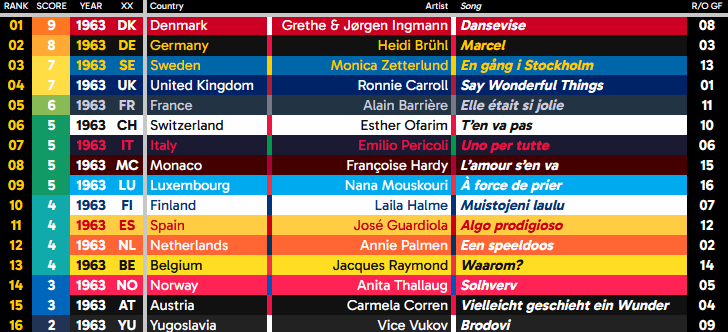
Now that’s a wide range of scores: highest is a nine and lowest is a two. You can see that this is a better lineup of songs than 1961 and 1962, mostly because of the winner (which is also my winner). This was a pretty easy year to rank because even in the fives and fours, most of the songs were at slightly different standards of quality.
Rest of the show:
Have I said yet that they don’t make interval acts like they used to? Because let me tell you, they do not make interval acts like they used to! Between the songs and the voting, we have one of my favorite interval acts in Eurovision history. It’s two circus performers from Sweden performing crazy stunts on a bicycle and unicycle set to playful orchestral music, and it is absolutely delightful. I still remember what it was like watching this interval act for the first time. While writing my original review of 1963, I was making salad I believe, and I put my laptop on the table hoping I could put the rest of the show in the background so that I could technically say I watched the whole show. But instead, I was absolutely transfixed by the circus performers and couldn’t stop staring. In that moment, I realized why interval acts exist: to keep the audience entertained so they don’t change the channel! Nowadays most interval acts have an air of “now’s the time to go to the bathroom” and it just isn’t the same.
After the interval act, Katie Boyle explained the voting system clearly and concisely. This time the voting was done in the same order the songs performed in instead of reverse order, and I think that’s the smartest way to do it. The voting sequence could not be more different from last year’s: it was a properly exciting race between Denmark’s awesome song and Switzerland’s mediocre song. At least, until Norway gave their votes, when it became total chaos.
The Norwegian spokesperson Roald Øyen listed his votes with incorrect song numbers, and the sharp-eyed Katie Boyle noticed this and asked Roald to repeat his votes. Roald seemed to realize at this point that he messed up, so he asked to do it at the end of the voting instead. Note that at this point, Switzerland was in the lead by two points: “T’en va pas” had 17 and “Dansevise” had 15. As Katie progressed through the rest of the voting, more and more countries threatened to take Switzerland’s lead, especially the UK and Italy. When Luxembourg (the final jury) voted, it seemed that Switzerland would be the winner with 42 points, two over Denmark.
Then came Norway’s new results, which were different from their original votes. They voted for the same five countries, but the scores were swapped except the UK which still got five. Now here’s the crazy part: the change in results took away two points from Switzerland and added two to Denmark, meaning that Denmark was now the winner. After the show, a conspiracy theory arose that Norway had intentionally changed their votes to give Denmark some neighborly support. As a certified hater of conspiracy theories, I think this is total bullshit. But… this makes me wonder just how many voting results in Eurovision history are incorrect and were never fixed. Sometimes I wonder if any of the past Eurovision winners only won because of an undetected voting mishap, especially the ones that were close races. I imagine that in such scenarios, the EBU would keep the true results a secret because retconning a winner would cause bad publicity. My viewpoint is, even if voting mishaps caused an incorrect winner, what’s done is done and there’s no use in trying to change the past.
And if all this wasn’t enough, there was one last vote that had to be corrected: Monaco had accidentally given one vote to two songs. It turned out Luxembourg lost one point, which was thankfully inconsequential and didn’t even affect their placement.
At the end, a BBC television executive passed the prizes to the performers, and wanted to give the composers a prize but they weren’t there. He sounded a little awkward while giving his speech, as if he didn’t expect this outcome either. His accent sounds even more posh than Katie Boyle’s, which I thought wasn’t even possible.
So yeah, in the end the right song won, but the way it happened was incredibly strange. If I was watching the contest live, the end of the show would’ve left me laughing in perplexment, because I wouldn’t have known how else to react. Better than how I would’ve reacted if the winner was changed last minute from Denmark to Switzerland, which would’ve been a fit of anger.
General thoughts:
If you don’t like slow songs, 1963 is absolutely not the Eurovision year for you. Only one song out of sixteen (“Marcel”) is properly upbeat, and even that one seems a bit divisive. But the winner is so good that it brightens up the whole year for me. Even though 1965 has an even better winner, the entire rest of the year is a bag of shit so I won’t be nearly as kind. And even if you hate the lineup of songs, you have to admit the BBC put on a fabulous show. The visual design is simple and effective, the host is as professional as ever, and even the credits are a lovely watch because they feature pictures of the host, singers, and interval performers. Huge props to Katie Boyle for staying calm and collected throughout the voting mishaps and handling them all on her own. The plus side of the voting mishaps are that Katie got to show us how awesome she is.
Unlike the last two years, the scoreboard fits comfortably into the 4-by-3 aspect ratio typical of the time. We get a zoom out to the full scoreboard at the start and end of each country voting, which is quite helpful. The scoreboard is easy to read even with poor video quality, because the country names and song titles are written in a bold sans serif font, and the numbers look thin and elegant thanks to the power of Nixie tubes. For more information on how the scoreboard worked, read this article from a sadly deleted blog.
After the show ended, the Swiss broadcaster SRG SSR was furious that their victory was stolen and filed a complaint to the EBU, who confirmed a month later that the Norwegian jury hadn’t finished counting their votes the first time and didn’t intentionally change their votes. But the theory about neighborly voting persists to this day. Unfortunately, as a result of these mishaps, the EBU switched to a worse voting system the next year.
See you next time as Italy wins with one of the biggest margins in history.
 Cookie Fonster's stuff
Dansevise is actually growing on me. In my own review I marked it as ‘not great but there wasn’t anything better’, but now I do actually rather like the combination of the triple beat and the unusual melody. I still don’t think it’ll ever end up on my playlist, but I would happily listen to it if it randomly popped up somewhere.
LikeLiked by 1 person
I can understand where you’re coming from here: it’s exactly the kind of song that you quietly start to appreciate more the more you listen to it.
LikeLike