
< 1959 Review | 1960 Review | 1961 Review >
Introduction
This is where the grayscale years start getting repetitive, but since I’m still unemployed and have way too much free time, I’ll prod on. Though it’s possible that if I get a new job soon, I’ll pause round 2 of my Eurovision blog.
Although the Netherlands won Eurovision 1959, their broadcaster NTS declined to host 1960, probably because they were short on money. So instead, the runner-up nation the United Kingdom had the honor of hosting. The BBC hosted Eurovision for the first of nine times, in London for the first of four times, and presented by Catherine “Katie” Boyle for the first of four times. She holds the record of presenting the most Eurovision contests, followed by Petra Mede three times and Jacqueline Joubert twice. Katie Boyle speaks in perfect Received Pronunciation, an accent that comes off as laughably posh today, but back then was seen as prestigious and educated.
Luxembourg returned to Eurovision this year after skipping 1959, and Norway made their debut, so this contest has a total of 13 participating countries.
To open the show, Katie Boyle introduces every contestant by saying “good evening, (country)” in English and each country’s national language, then “welcome, (contestant)”. The introduction isn’t quite as glamorous as what France did last year, but I like watching each contestant introduced one by one anyway. It’s a shame Eurovision didn’t start doing that consistently until 2013.
This contest has two countries’ commentary archived: the Norwegian commentary by Erik Diesen, and the British commentary by David Jacobs. Last time I watched the NRK commentary because that was the only archive I was aware of; this time I’ll watch the BBC commentary. David Jacobs is a confident, entertaining commentator whose commentating style is extremely British, and I mean that in a good way. He said the stage is “a blaze of blue, red, and gold”, which sounds absolutely lovely and makes me wish we could’ve seen this contest in color.
United Kingdom: Looking High, High, High
Artist: Bryan Johnson, brother of last year’s Teddy Johnson
Language: English
Key: C major, D♭ major
My ranking: 2nd
To start this contest off, we have a song that proves the UK were the kings of grayscale Eurovision. They didn’t win until the last grayscale year, but they consistently did quite well and this song is no exception, having scored second place. This has basically everything I like about a grayscale entry: it’s upbeat, it tells a fun little story, it has an insane amount of rhymes, and most crucially, it’s not overly twee. Lots of songs from 1960’s Eurovision leave a decent first impression but don’t have much staying power due to their tweeness, and thankfully this song avoids that.
The lyrics are about a man who searches the entire world for his love interest and found her right back at home, then she confesses that she loved him the most all along. It’s a simple, easy to understand story, which is good because I love when songs tell stories. Doubly so when the stories are heavy in rhymes.
Bryan Johnson isn’t quite as much of a natural on stage as the couple from last year, and he’s not as good at whistling as his brother, but he’s a great performer in his own right and provides us a fun time on stage. I love when the host nation puts their best foot forward and sends a song that tells us they wouldn’t mind hosting again next year. Not enough host entries are like that these days!
Sweden: Alla andra får varann
Artist: Siw Malmkvist
Language: Swedish
Key: G major
My ranking: 3rd
I find it curious that all the title cards this year omit diacritics from song titles. The title card lists this song as “ALLA ANDRA FAR VARANN”. I presume the producers of this show knew that French in all-caps is sometimes written without diacritics (though I personally don’t like that and think the diacritics should always be retained in uppercase), so they assumed the same should be done for other languages. This doesn’t work for Swedish, because the Swedes consider Å, Ä, and Ö to be entirely separate letters from A and O. Luckily this is the only song where a diacritic is wrongly omitted in capitalization; the only other titles with diacritics this year are in French.
David Jacobs said this “is a very sad song, although it’s got a very gay tune” (gay as in happy), which suggests that he both had a translation handy and heard the song in advance. It’s about a woman who never got the courage to propose to her boyfriend and has to watch all her friends get married while they never achieve that.
Anyway, let’s talk about this as a song! I get the impression that Swedish music was much more cheerful and cutesy pre-ABBA, and this song is a perfect example. Siw Malmkvist is a charismatic performer and comes across as hopeful with a tinge of loneliness when performing this song. It’s not the most groundbreaking song ever, but I do enjoy listening to it. I also like the way the song plays with its title: most times the title is sung, it means “everyone else has each other”, but the last line is different. She ends the song with “du och jag som alla andra får varann”, which means “you and I, like everyone else, will have each other”. The title is still sung as usual, but it’s gramatically used in a different way and I love that.
In round 1 I said that the lyrics of this song could describe a long-distance relationship, but I no longer feel this way. I think I said that only because of a translation that starts with, “only, only you and I have to be apart every day, while all the others have each other”. The rest of the song doesn’t give me this impression.
I still think the instrumental break lasts a bit too long (and Siw herself looks impatient to resume singing), but I was wrong to say it suggests that Siw Malmkvist wasn’t interested in singing. In fact, she absolutely adores being on stage. I know this because she shows up at Melodifestivalen again and again, no matter how old she gets. She even appeared at the opening act in Melfest 2025 at 88 years old. She’s also famous in the German-speaking countries, as proven when she returned to Eurovision with a song in German nine years later.
Overall, the song isn’t good enough that I’d want to regularly come back to it, but it’s likable enough for me to give it third place.
Luxembourg: So laang we’s du do bast
Artist: Camillo Felgen, an actual Luxembourger
Language: Luxembourgish, for the first of three times
Key: E♭ major, E major
My ranking: 13th (last)
I assume that Luxembourg decided this year it would be more authentic if they sang in Luxembourgish, but they got last place so they went back to French starting next year.
Just to clear this up, Luxembourgish is not some kind of hybrid of French and German like some people think. It has slightly more French loanwords than standard German does, but the bulk of the language is very much Germanic. It’s mutually intelligible with standard German, and some people even consider it to be a German dialect, so for me listening to Luxembourgish is probably the best approximation I have for what it feels like when (for example) a Swede hears Norwegian.
Anyway, the song itself is an ultra-boring ballad full of drawn-out syllables that makes me want to sleep, so I ranked it last place.
Denmark: Det var en yndig tid
Artist: Katy Bødtger
Language: Danish
Key: E♭ major
My ranking: 6th
In the old days Denmark put in so much effort to make their language sound lovely and melodious, and to make their songs transcend language barriers. With the singer’s old-timey dress and umbrella, it’s not hard to guess she’s singing about the nostalgia of the old days. While Denmark’s results were mixed at first, only three years after this they’d score a well-deserved victory. Some countries didn’t have such good luck with their language, like Finland who got so many undeserved bad results.
This is another slow freeform ballad, but I actually find this one really cute, because it sounds exactly like something from the opening of a kids’ movie. The language helps it sound cutesy as well. But what interests me most are the lyrics, which are tacky but charming in their own way. Katy sings about how lovely and peaceful the world was before there were cars and before the world wars. It’s basically the 1960 equivalent of a song about how great the world was before computers. I find lyrics about how great the world was in the past to be tacky, but there’s something charming about this one regardless. I take the song as a young lady being fascinated with her grandparents’ childhood and having a rosy image of what it was like for them.
Belgium: Mon amour pour toi
Artist: Fud Leclerc, for the third time
Language: French
Key: F major
My ranking: 11th
Another overly slow drawn-out ballad, this doesn’t have any cuteness to save it like Denmark did. It has some fairly interesting chords but otherwise it’s a total dirge. If I manage to stop cracking up at Fud Leclerc’s name and facial expressions, this makes me want to sleep almost as much as Luxembourg.
Norway: Voi Voi
Artist: Nora Brockstedt
Language: Norwegian
Key: C minor and C major, in alternation
My ranking: 4th
I can see why I picked this song as my winner when I first reviewed 1960, since it’s quite immediate in impact. It stands out on a first watch-through thanks to Nora’s enthusiastic performance in a winter outfit, and the lovely mountain artwork in the background. However, the song has grown off me enough that I’ve moved it down to fourth place. The main reason is because it doesn’t build up or progress much, but rather keeps the same tone throughout, which doesn’t serve well for what’s supposed to be a storytelling song. But it’s cutesy enough to be one of the better songs of the night.
Austria: Du hast mich so fasziniert
Artist: Harry Winter
Language: German
Key: B♭ major
My ranking: 12th
I’m not sure why I saw any good in this song last time, or why it caused me to go on a mini-tirade about popular music being better in the old days. This is a super-boring ballad that makes me want to sleep, and has the added disadvantage of repeating the title way too much. But it doesn’t have quite as many annoying drawn-out syllables as Luxembourg so I’ve put it second last.
Monaco: Ce soir-là
Artist: François Deguelt
Language: French
Key: E minor, F minor
My ranking: 1st
Now this, on the other hand, is easily the best song of the year. I didn’t think much of this song when I first reviewed 1960 and didn’t even consider it for my winner. But a few months later when Erica chose this as her winner, I decided to give this song another chance, and it grew on me more and more until it became one of my favorite ever grayscale entries. Karina gave a great analysis of the song’s lyrics and performance, so instead of repeating her words, I’ll take time to analyze it musically.
This song is cleverly composed in quite a few ways. It has an orchestral intro that’s not too long or too short, just the right length to tell us this will be a moody song. Then the song introduces its musical gimmick, which is the pauses in the instrumental where François Deguelt lets his voice take control. Those pauses help give the song a push and pull. And from here on out, the song has an awesome instrumental buildup but doesn’t lose sight of where it began, because it keeps the bossa nova bassline and bongo drum beat throughout. I have a huge soft spot for bossa nova, so any song with even a trace of the genre has a chance of winning me over.
Another cool musical detail is, I love the series of brass chords that transition the song from E minor to F minor (after he sings “la douceur de ce soir-là). Such transitions are my favorite way to do a key change, because they make the key change so much more musically interesting—another great example is “Without Your Love” from 2006. Once the key has changed, the instrumental pauses and his vocals slow down, which fits naturally into the song.
One last thing that interests me about the song is the chorus. In the first two choruses (“dans tes bras…” and “et pourtant…”), the song seeps into the key a fourth above the base key (A minor before the key change, B♭ minor after the key change), which signifies that the chorus is a sort of B section, then smoothly transitions into the original key. But then the final chorus (mon amour, je t’attendrai…) stays entirely in F minor, which is a great way to signify the song has hit its climax. The song has an ultra-dramatic brassy ending, and I don’t mind that at all because it feels properly earned after the buildup.
I totally understand why this didn’t win, because the top two (France and the UK) are immediate in impact whereas this is a gradual grower, at least for me. But I’m very pleased that this achieved third place, because it totally deserved to do well. Hopefully this review proves that I don’t automatically hate all ballads.
Switzerland: Cielo e terra
Artist: Anita Traversi
Language: Italian
Key: D major, debatably also F major
My ranking: 8th
I’m obligated to mention that the conductor of this song (Cédric Dumont) has almost the same first name as me, except his is spelled with an accent. Well, technically he doesn’t, because Cedric is legally my middle name.
I’m surprised this got 8th place with only five points, because it seems like exactly the kind of sappy ballad in 6/8 time that the juries would love. Not me though—she sings it well and I don’t dislike the song, but it’s too sappy for me and I don’t like the freeform intro. I’d better get used to hearing these types of ballads for the rest of the 1960’s though.
Netherlands: Wat een geluk
Artist: Rudi Carrell
Language: Dutch
Key: A♭ major, A major
My ranking: 9th
Ah, here’s Rudi Carrell, who was a famous entertainer in the Netherlands and Germany, and a childhood nostalgia icon for people my parents’ age. The instrumental is wonderfully upbeat and I love the horseshoe behind him that represents good luck, but his vocals are absolutely godawful—no enegry or expressiveness, and he’s always on the verge of being off key. It’s pretty obvious that this was at the beginning of his career, but still, his vocals at the time were crap. As such, I’ll rank this below the ballads that don’t have anything wrong with them, but above the ballads that do have something wrong with them.
Germany: Bonne nuit ma chérie
Artist: Wyn Hoop
Language: German, except the repeated title in French
Key: C minor
My ranking: 7th
This is a minor key male ballad with a bossa nova bassline, so it would make a great alternative to “Ce soir-là” if it weren’t for a few issues. I think the transition between the bombastic intro and the freeform verses is way too abrupt, and the freeform parts themselves I don’t like. That said, the bulk of the song is pretty good and proves that melancholy ballads can work in Germanic languages just as much as in Romance languages.
Italy: Romantica
Artist: Renato Rascel
Language: Italian
Key: A minor, B♭ minor
My ranking: 10th
Apparently I rather liked this when I reviewed 1960, but now I can’t say I’m much of a fan of this. It tries to be a moody minor key ballad like Monaco and Germany, but it’s too low-energy and freeform to click with me, thus it’s worse than both. Also, the key change comes out of nowhere and doesn’t add much to the song.
France: Tom Pillibi (the winner)
Artist: Jacqueline Boyer, at the time the youngest winner at 18 years old
Language: French
Key: D major, E♭ major, E major
My ranking: 5th
I already gave a pretty good analysis of this back in round 1, but to recap: this is a happy, cutesy storytelling tune about a girl who gets close with a man she has the hots for named Tom Pillibi. This man has all the riches in the world but has just one tiny fault: he made all that shit up, but she loves the guy anyway. It makes sense that this won, because it’s very impactful and memorable especially for those who speak French, and because it got lucky at the end. Jacqueline puts on a convincing performance, very much like she’s an actress in a stage play.
With all that said, I feel this song doesn’t have much staying power after one listen. I was wowed the first time I heard it but never felt an urge to come back since then, and even now I still don’t. It’s one of those Eurovision songs that makes a great single listen but is just too twee to have much staying power, which is common in the grayscale 60’s years. That said, since Eurovision is all about leaving a good first impression, this did deserve to win.
My full ranking
And so, here’s my rankings of 1960. I had ranked this year a few months back and didn’t change much of my rankings, except for moving Sweden up two spots:
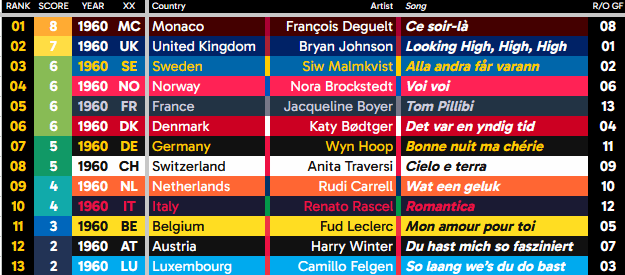
This ranking has a clear divide between upbeat songs and ballads, except for Monaco’s ballad on the top, and the Netherlands’ flubbed vocals in the bottom half.
Rest of the show:
Once again there’s no interval act: Katie Boyle just gets on with the voting. The scoreboard has roughly the same layout as that of 1959, but it looks sleeker and less cluttered, and the country names are in English. I quite like how the font is compressed as needed so that no country or song takes up more than one line.
There’s a lot of charm in the voting system where each country spreads 10 points across different songs, so it’s a shame this system was abolished two years later. I like how excited the audience would get when a country awards another a particularly high score, like Germany’s 7 points to Monaco. The voting ended up an exciting race between the UK and France, though it was clear France was the winner by the time the last jury (the UK) voted, because repeat after me: you cannot vote for your own country. The audience was excited by the race and did not seem to mind that France beat their home country.
It’s also worth noting that this was the first year where the previous winner passed on the award. Teddy Scholten came to the stage in a summer dress and passed the reward to a delighted Jacqueline Boyer, then gave a short congratulatory speech in fluent French.
General thoughts:
There was a bit of clumsiness in the voting sequence where we could hear little bits of other commentators, but otherwise the BBC hosted a charming and professional show. I like what they did with the song title cards: there was a physical board with some kind of photo frame listing the country name, song title, and artist, and the camera focused on the board before each song began.
This year has exactly the type of song lineup we see in most of 1960’s Eurovision: most of the songs are either too twee or too dreary. But there’s usually at least one true gem in the 60’s contests, and this year it was the moody ballad from Monaco. That said, I wish the 1960’s contests didn’t take so long to actually start sounding like the sixties. I suppose for most of the decade, the participant countries had an overly specific idea of what would win the contest.
See you next time as I try not to lose my mind at all the slow dreary ballads.
 Cookie Fonster's stuff