
< 1957 Review | 1958 Review | 1959 Review >
Introduction
The third Eurovision Song Contest was originally going to be hosted in the United Kingdom, but since the BBC apparently failed to reach an agreement with artistic unions, the EBU had to find another broadcaster to host, and after other broaddcasters declined to host, the Netherlands’ NTS was given the hosting duties. As a nice coincidence, the Netherlands happened to be the winner of the last contest, so in all following years, the EBU gave the most recent winner the first choice of hosting. It’s good that the pattern of the previous winner hosting was established so early, because it gives countries an incentive to send competitive entries. The Netherlands chose to host the show in AVRO Studios in Hilversum. In the old days, it was common for the contest to be hosted in the headquarters of broadcasters.
The United Kingdom dropped out of Eurovision this year, while Sweden made its debut, meaning that Eurovision 1958 has ten entries just like last year. Out of these, the Italian entry became an enormous international hit that even charted in the United States and Canada, but for some reason it only scored third place behind Switzerland and the oft-forgotten winning entry from France.
One more odd fact about this contest: this is the only Eurovision year where the host doesn’t appear at the beginning. Instead, we see a camera shot of the scoreboard set to an orchestral opening act, while the commentators introduced the show. This is the first year of the contest where any country’s commentary has been archived, specifically the Dutch commentary. In fact, Eurovision 1958 has never been archived without commentary as far as I know. The Dutch commentator has very good diction and I find him relatively easy to understand, even though I can’t speak Dutch.
Update: A few weeks after this post, the French commentary of this contest has been archived! However, it starts in the midst of Italy’s entry.
After only a minute and a half, the opening entry begins! The orchestra was very much put front and center in this contest—they even have orchestral transitions between each of the competing entries, a detail I absolutely love.
Italy: Nel blu, dipinto di blu (AKA Volare)
Artist: Domenico Modugno
Language: Italian
Key: B♭ major
My ranking: 2nd
I think the intro of this show might have been too quick, because several of the broadcasters ran into technical difficulties broadcasting the first entry, which meant Domenico got to perform his song twice.
Anyway, here is that song! I don’t particularly love this song and it’s never inspired passion in me, but I can objectively see that it’s very well-composed and easy to hum along to, which is why I have it ranked second. I don’t like the verses of this because they’re way too slow and freeform, but I like the chorus well enough, I suppose. What’s clever about this song is, if I sing the word “volare” in my head, all the parts that follow come to my mind naturally without even thinking about it, which proves that it’s a very sticky song.
Since this song is so overwhelmingly famous, more than almost any other Eurovision song in history, I find it weird as hell that it didn’t win the contest. I’m not going to theorize why it didn’t win, because I frankly have no clue. Instead, I’ll say that this song not winning Eurovision 1958 was probably for the greater good, because it reminds us that music tastes are subjective, and a Eurovision song can be successful and beloved without winning the contest. It also proves that the juries have had incomprehensible taste since the beginning.
OK, I may just be saying this because I’m not really passionate about “Volare”. You’d never catch me dead saying “C’est le dernier qui a parlé qui a raison” losing the tiebreaker was for the greater good, for example. I just relistened to that song, and holy fuck, it’s so goddamn amazing in every way. It’ll get a very long re-review when I reach 1991.
Netherlands: Heel de wereld
Artist: Corry Brokken, returning from 1956 and 1957
Language: Dutch
Key: A♭ major, A major
My ranking: 9th
No, just no. This is exactly how you don’t do a returning winner entry, or a host entry for that matter. It feels a little derivative of “Net als toen”, except worse in every way. It’s slow and has way too many drawn out notes, she sings about nothing more than how happy she is, and overall this makes me want to sleep. Oh, and it has so many annoying tempo changes. Unlike the last song, or the Netherlands’ subsequent entry for that matter, this is a great example of a song that didn’t stand the test of time. At least this song doesn’t actively annoy me, so it’s not my last place.
On a sillier note, this song (title means “the whole world”) encompasses a larger area than “Tutta l’Italia” from Eurovision 2025, but not as large an area as “Tout l’univers” from 2021.
France: Dors, mon amour (the winner)
Artist: André Claveau
Language: French
Key: A major
My ranking: 7th
France’s first Eurovision win still leaves me scratching my head. It’s a fairly sweet song, but it’s the same freeform chanson with too many tempo changes that we’ve heard many times already. My best guess for why this won is because the juries have always preferred music that sticks to a true and tested formula. Still, that doesn’t change how weird it is that “Volare” didn’t win.
Luxembourg: Un grand amour
Artist: Solange Berry, a Belgian this time
Language: French
Key: D♭ major, D major
My ranking: 8th
Oh boo, another generic slow chanson with too many tempo changes. When I first reviewed 1958, I said this was older-timey than what comes to mind when I think “old-timey”, and I still agree with that. Even the juries didn’t like this—they gave it just one point, so it tied with the Netherlands for last place. In the grayscale years, they sometimes would reward one generic French chanson and give almost no points to another generic French chanson. Once the contest started being broadcast in color, the same would hold true for power ballads.
Sweden: Lilla stjärna
Artist: Alice Babs
Language: Swedish, which is making an amazing comeback in Basel 2025!
Key: B♭ major
My ranking: 1st
First place, you say? Yep, that’s right: I’m changing my winner of 1958 back to Sweden! I had retconned it to Italy in my 1997 review, but after thinking about it, I’ve decided that this is a far more likable song than “Volare”.
Karina already gave a really good analysis of this when she reviewed 1958. Since she had never seen most of the 20th century contests before, she said that the song has an effect of “holy shit, this is Sweden”.* I never thought of it that way, but now I completely agree. The moment Alice Babs enters the stage in her Swedish traditional dress, I’m slammed in the face with “this is actually Sweden”. And the same goes when the song itself begins—it really does sound like a musical number based on Swedish children’s books. Sweden clearly intended to make a splash with their debut, and in that they totally succeeded. They landed fourth place with ten points, not bad for a debut!
The song is extremely slow so I don’t come back to it too often, but there are a lot of little things to do like about this. The song doesn’t slam viewers in the face with a new unfamiliar language, but rather eases them into it in a clever way: by having Alice sing “la-la-la” in call and response with the orchestra. Then when the lyrics begin, the listener has settled in and is ready to experience the Swedish language for the first time in Eurovision history.
Alice Babs has expressive dreamy style of singing, and the melodies here sound almost like a fairytale. Don’t forget about the rhymes in these lyrics: as I said in round 1, Swedish has a ridiculous amount of vowel sounds, so it’s very satisfying when two words in Swedish have a perfect rhyme. I gotta admit, I’ve had a soft spot for the Swedish language for over a year now. I’ve gradually gotten better at understanding it over the past two years, especially when it’s sung slowly like in this song. But you don’t need to understand the lyrics for the song to hit you in the heart. I also have to admire this song for not having any tempo changes or freeform sections, except for the slowdown at the end.
Before I move on to the next song, I’d like to do some language nerding. For the countries that have been in Eurovision since the grayscale years, their songs in the contest can show you how their languages have evolved. An example is the sj-sound in Swedish: through the course of the 20th century, the most common pronunciation of “sj” has evolved from /ʂ/ (close to English “sh”) to something more like /x/ or /xʷ/ (a notoriously hard sound for foreigners to get right), although some regions still have the conservative pronunciation. In Sweden’s first few Eurovision entries, the sj-sound is generally pronounced like an English “sh”. The title of this song is a good example: she pronounces the “stj” as a clear “sh”. For me, that helps the song stand out as old-timey.
* Russia’s debut entry in 1994 has a very similar effect for me, but that’s a topic for another time.
Denmark: Jeg rev et blad ud af min dagbog
Artist: Raquel Rastenni
Language: Danish
Key: C major
My ranking: 4th
At the halfway point of the songs, between Sweden and Denmark’s entries, we get a fun little orchestral interlude that was presumably put in so that viewers at home could take a bathroom break. The Dutch commentator introduces this song afterwards, and I still love his little remark that he hopes he pronounced this song’s title right. I’m quite confident that’s what he said. I had Google Translate read out the title, and he seemed to get it about right!
I like how in their first few years, Denmark had a clear strategy for how to make Danish-language songs appealing. They generally had the language sung slow and clear—perhaps to help Swedes and Norwegians understand it—and they’d use the performance or props to give viewers who don’t understand Danish an idea what the song is about. In this case, the singer starts by tearing a page out of her diary, then sings about this topic on stage. The lyrics are about her having fully moved on from a bad breakup and encouraging her ex to do the same. The song does quite a good job telling a story on stage, since she comes off as vaguely sassy in that 1950’s way. I just wish it didn’t have those annoyingly slow freeform verses—those weigh down the song so much for me.
Belgium: Ma petite chatte
Artist: Fud Leclerc, returning from 1956
Language: French
Key: E♭ major
My ranking: 6th
This is a run-of-the mill 1950’s jazzy pop song that goes in one ear and out the other—there’s really nothing special about it at all. Yes, I know the lyrics are full of sexual innuendo, but even though I can speak French, I’m just unable to pay attention to the lyrics because this is so unremarkable. It would get a 5/10 from me, but his emotionless singing drops it down to a 4.
Germany: Für zwei Groschen Musik
Artist: Margot Hielscher again
Language: German, plus a few English names of countries, if that counts
Key: F major, A♭ major
My ranking: 3rd
Margot is back with a song that’s even more playful than her last one. It’s perhaps the most gimmicky entry in 1950’s Eurovision. She wears a crown and had banner labeled “Miss Jukebox” around her dress, and she sings about the joy and versatility of music which you can experience for the cost of just twenty cents. Each time she pulls out a music disc, she sings about a different musical genre, and the orchestra responds by playing an example of it. The gimmicks are done to the right degree to make the song engaging but not incoherent.
Unfortunately, I do have one problem with this song. It bothers me that this song starts upbeat, but loses all its energy when she sings freeform over a piano part. I think I’m getting sick of songs having so many slow freeform sections. Thankfully, after the intro, the entire rest of the song is upbeat. Unlike Belgium, this is a 50’s jazzy song done right. That’s because Margot Hielscher is full of joy and energy when performing, and the instrumental itself is more joyful as well. It’s not a song to regularly revisit, but one to have fun with while it’s happening.
Fun fact: the lyrics of this song were written by Ralph Maria Siegel, the father of frequent Eurovision composer Ralph Siegel.
Austria: Die ganze Welt braucht Liebe
Artist: Liane Augustin
Language: German. This is another rare one with rolled R’s.
Key: B♭ major
My ranking: 10th (last)
I was originally going to rank the Netherlands last place, but I’ve decided to swap rankings with Austria. The instrumental of this is actually a little better than “Heel de wereld”, because it’s a little more upbeat in that 1950’s jazzy way. Unfortunately, she spends most of the song singing off sync with the music, like her vocals are constantly lagging behind the instrumental, and it drives me absolutely insane. I don’t know whether she sang that way on purpose or by accident, but I’m inclined to say it was on purpose, because the studio version also has her off sync but a little less so. She probably thought that singing the song off-sync would make it more interesting, and she was so wrong.
This is the only song this year that actively annoys me, so into my last place it goes. What frustrates me is, if she had just sung this normally, this would’ve been around the middle of my ranking.
Switzerland: Giorgio
Artist: Lys Assia, for her fourth and last time
Language: German and Italian, or as I like to call it, Itallemand
Key: C major
My ranking: 5th
This is Lys Assia’s final time competing in Eurovision, where she got second place three points behind France, but it’ll be nowhere near the last time we see her in the show. If you’ve binged every Eurovision year, you already know this. I think this is Lys Assia’s best entry because it’s the most upbeat, but I’m not too big a fan of any of hers.
I don’t know if it’s because most songs this year have been slow, but this song is so frantic that it almost makes me feel as if I have to pee. The spoken word parts are kind of annoying, but otherwise this isn’t too bad to listen to, since it’s upbeat and has catchy melodies.
My full ranking
I ranked 1958 a few months back for fun, but this blog post made me change my rankings a little bit:
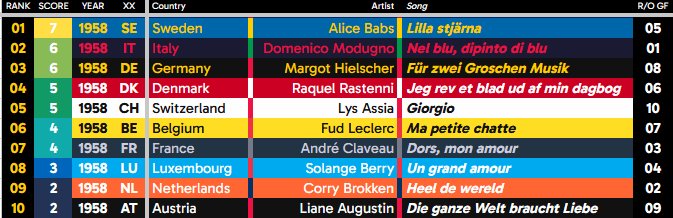
I swapped my top two and bottom two places, and Italy, Denmark, and Belgium all had their scores decreased by one. As you can see, this was a really weak year for me: the highest any song got was 7/10. And since I changed my winner back to Sweden, here’s my new winner list:
- Belgium, 3 (1957, 1976, 2003)
- Bosnia and Herzegovina, 2 (2001, 2006)
- Denmark, 2 (1963, 2000)
- Estonia, 1 (2009)
- Finland, 4 (1983, 1989, 2010, 2023)
- France, 3 (1977, 1990, 1991)
- Germany, 5 (1956, 1968, 1979, 1982, 1999)
- Greece, 1 (2013)
- Hungary, 2 (2005, 2019)
- Iceland, 1 (1992)
- Ireland, 3 (1970, 1980, 1994)
- Israel, 1 (1987)
- Latvia, 1 (2002)
- Lithuania, 1 (2022)
- Luxembourg, 4 (1965, 1972, 1973, 1988)
- Monaco, 1 (1960)
- Montenegro, 1 (2015)
- Netherlands, 8 (1959, 1964, 1967, 1969, 1975, 1998, 2014, 2024)
- North Macedonia, 1 (2020)
- Norway, 5 (1966, 1985, 1993, 1995, 1996)
- Portugal, 3 (1971, 1984, 2017)
- Serbia, 4 (2004, 2008, 2011, 2012)
- Sweden, 3 (1958, 1974, 2018)
- Switzerland, 2 (1986, 2021)
- Turkey, 2 (1978, 1997)
- Ukraine, 2 (2007, 2016)
- United Kingdom, 3 (1961, 1962, 1981)
- (20 winners)
Rest of the show:
After Lys Assia performed her song, the presenter of the contest appeared for the first time and announced in Dutch, English, and French that Domenico Modugno will perform “Volare” again. She didn’t seem all that comfortable speaking English or French and was very clearly reading the translations from a script. Listening to “Volare” again, it’s decent enough song, but I just don’t like those slow freeform verses. I think round 2 of my Eurovision blog has given me a new pet peeve.
Then after “Volare” round 2, we get a fun little interval act, which we didn’t have in 1957. It’s another orchestral number that’s heavy in percussion and I rather enjoyed it. The music pretty much tells viewers “don’t go yet, the voting will start soon enough!” so it does exactly what an interval act should do.
Then comes the voting sequence, where the host seemed to make an effort to speak as little as possible. She doesn’t say “now we’re going to start the voting” in any language, she just goes right ahead and calls the Swiss jury. I quite like the design of the scoreboard, because it neatly fits everything into a 4:3 aspect ratio and is easy to read. The all-lowercase font gives the scoreboard some personality while keeping it minimalist. I should also mention that from this year onwards, countries were only allowed to give their votes in English or French. That made the voting sequence noticeably less clumsy than last year. It had a few technical difficulties, but they weren’t quite as bad this time. Annoyingly, Sweden has its final score listed as 14 points instead of 10, because the scoreboard operators confused Sweden and Switzerland, so it looked as if Italy had awarded their four points to both la Suisse and la Suède.
Corry Brokken only received a short speech in Dutch after she won the contest; André Claveau was given a much longer speech in French with a thick Dutch accent. The guy who handed the prize even used the word “dirigent” to mean “conductor”, even thought the correct French word is “chef d’orchestre”. Then came the winner’s reprise, and that’s that.
General thoughts:
I find the presentation of this year quite charming, since it makes an effort to be as language-neutral as possible. The title cards for each song have the country’s name each written in their own language (Austria as “oesterreich” instead of “österreich”), plus the song title and singer name, which is nice and minimalist. Unfortunately this means the host barely appears at all and doesn’t engage at all with the audience like the last two presenters did.
Now in terms of songs, Eurovision 1958 is very underwhelming and samey. The year has too many slow songs with tempo changes and freeform sections. The winner I’m not a fan of, the most famous song has never sparked passion in me, and even my winner I like but don’t love. Luckily, I already know 1959 will be a more interesting year.
See you next time as the UK comes back and brings some life into early Eurovision.
 Cookie Fonster's stuff