
< Intro Post | 1956 Review | 1957 Review >
Introduction
OK, so… I just got fired from my job shortly before my one-year anniversary. And while I apply for new ones, I need to find something to do during the cracks in the day. Since I’m done with all the 2025 national final reviews I wanted to write, I’ll do what my heart wants and restart my Eurovision blog post series! And do other projects when I need a break from this, like my large number site. The main change in round 2 of my Eurovision blog is: this time I will rank all the songs per year. I wasn’t up for the task of ranking all the songs in round 1, because I was getting to know most of these songs for the first time, but now I’m ready to rank.
In case you aren’t aware of how Eurovision came to be: shortly after they were founded in 1950, the European Broadcasting Union wanted to make a collaborative telvision program between multiple countries. All the European countries speak different languages, but the one language they all can understand is music. The EBU took inspiration from Italy’s annual Sanremo Music Festival, which began in 1951 and was first broadcast on television in 1955, and adapted its format into a competition between multiple countries. Italy sent the winner and runner-up of the Sanremo Festival to Eurovision this year.
Now to recap the basic facts about this contest: seven countries participated—the Netherlands, Switzerland, Belgium, Germany, France, Luxembourg, and Italy—and each of them sent not one, but two songs. Some countries sent the same artist singing two songs, others sent two different singers. Switzerland was given the duty of hosting in their Italian-speaking city Lugano, and most people believe that was because they’re closest to the center of the competing nations. In the early years, the show was hosted in the host city’s language, so the contest was presented entirely in Italian by the TV host Lohengrin Filipello. Luckily, his diction in Italian is very clear and easy to understand for those familiar with at least one Romance language, as is the case for me with French.
Switzerland sent Lys Assia to sing two songs, one in German and one in French, and her francophone song “Refrain” won the contest. Some people suspect that the only reason Switzerland won was because back then there was no rule against voting for your own country, and Switzerland had the extra boost of Luxembourg hiring Swiss citizens as their jurors. But this is nothing more than a theory, because the voting results of 1956 are lost to the sands of time. Plus, the huge applause at the end of “Refrain” is evidence against this theory. Also lost to time is the video footage of that year (except for Lys Assia’s winner reprise), and apparently even one of the interval acts. Luckily, we have audio footage of all 14 competing songs, which I’ll start reviewing right now!
Netherlands #1: De vogels van Holland
Artist: Jetty Paerl
Language: Dutch
Key: C major
My ranking: 4th
Note about key signatures: as someone with perfect pitch, Eurovision 1956 is slightly annoying because the songs are all a little bit between keys. I’m going to round the keys down for the sake of this blog post. For example, if a song sounds like it’s between C major and D♭ major, I’ll list it as C major.
Anyway, here is the song that started it all! As you can tell by my ranking, I’ve always been quite fond of this one. It’s a playful orchestral waltz where, despite the lack of video footage, you can hear the singer smile throughout. As is common in the first few years of Eurovision, this song is full of tempo changes. I didn’t even notice how tempo change-heavy these old songs are till I decided to embark on a project of making an 8-bit cover of one entry from each year. I’ll talk more about this topic when I reach Italy’s first entry.
When I first reviewed 1956 two years back, I said it bends my mind that Dutch is so similar to German but isn’t the same language. But now that I’ve reviewed songs in every national language of Europe, it doesn’t feel that weird to me anymore. There are groups of European languages that are way closer to each other than Dutch and German. A well-known example is Danish, Norwegian, and Swedish, which are all to some extent mutually intelligible. But you might not know that speakers of Slavic languages can understand at least a little bit of most Slavic languages—at least, according to my fellow Eurovision bloggers from Poland and Ukraine. I’m jealous of them, frankly.
As someone who can speak German, I can understand little bits and pieces of Dutch sometimes, especially when it’s in a song. In fact, I wonder if this song was written so that people from other countries can understand at least a little bit of it. The title is easily decipherable to people from four of the participating countries: the Netherlands and part of Belgium already speak Dutch, and the German-speaking countries of Germany and Switzerland will interpret the title as “Die Vögel von Holland” (the birds of Holland). I think there was also an attempt at making others understand the song when she sings about French, Chinese, and Japanese birds, but I don’t notice the place name dropping when I listen to this song. Probably because the nationality names are sung fairly quickly and not emphasized.
Normally dropping place names is a Eurovision pet peeve of mine, but I don’t mind it in this song because it fits with the song’s message, which is: the birds in the Netherlands are better and more musical than anywhere else in the world. I love how the very first Eurovision song proves that the contest has been weird and whimsical since it began. My favorite Eurovision song of all time is “Dancing Lasha Tumbai”, so it’s no surprise I tend to like whimsical entries, as long as they don’t forget to be good songs. And thankfully, I do think this is a good song. Most of the grayscale entries, I pretty much never come back to, but I occasionally revisit this one to remind myself where the contest began.
Switzerland #1: Das alte Karussell
Artist: Lys Assia
Language: German, but unusually with rolled R’s
Key: B major, C major. Annoyingly, my brain parses both parts as C major, because the first half is between B and C major, and the second is between C and D♭ major.
My ranking: 7th
Songs like this, which go on well beyond three minutes, make me understand and even agree with the length rule that Eurovision would soon introduce. I personally wish the length limit was three and a half minutes instead of just three, because it would give songs more breathing room and extend the grand final by no more than 13 minutes. And the voting time window doesn’t need to be this long, hint hint. But I’m glad Eurovision has a length limit, because it means I never think “when is this song going to end already?” Except when hearing really old entries, like this one.
This song isn’t too bad actually; it’s a nice enough orchestral waltz with a bit more of a “flashy” 1950’s sound, if that makes sense. I used the same word to describe her other song “Refrain” back in round 1. Perhaps that’s due to the backing choir singing “ooh-ooh”, or the muted trumpets, or the occasional fast sections. I like the composition and cozy feel of this well enough. But my god, it really takes its sweet time with all these drawn-out slow sections. One song the next year has an even worse problem with dilly-dallying, and that’s when the EBU realized a length rule was necessary.
Overall, it feels a little weird to review this song because it would break a rule by the standards of Eurovision 1958 onwards. Suffice to say, songs like this are a good example of early installment weirdness.
Belgium #1: Messieurs les noyés de la Seine
Artist: Fud Leclerc, who has a hilarious name and makes hilariously weird facial expressions
Language: French
Key: G minor
My ranking: 6th
Several of my readers have pointed out that they’d never heard of the word “twee” before they read my blog, which is funny because it’s I actually picked up from Erica Dakin’s Eurovision blog, and because she’s a Dutchie living in the UK, she uses a lot of British slang in her blog, and one such word is “twee”. Whereas I’m American and thus it’s fairly weird for me to use this word. It means “sugary and childish” in case you didn’t know.
But wait, how can a song whose title means “the drowned men of the Seine river” be twee? Well you see, I brought up this word because this song is the polar opposite of twee: the music is grim and depressing, and the lyrics even more so. I don’t know of an antonym for “twee”, so I’ll just call songs like this “anti-twee”. Thankfully this song is anti-twee in a good way; I don’t think it’s too over-the-top depressing, and it has a very interesting piano to tie the song together.
Erica said in her 1956 review that this sounds like something Jacques Brel would sing, and I can see the comparison. Fud Leclerc isn’t quite as good at singing sad songs as Jacques Brel is; Fud just kind of has the same vaguely quirky personality every time he sings. But he delivers this song decently enough and this is a respectable first effort from Belgium. Unfortunately, for the first two decades of the contest, they were pretty damn bad at Eurovision, but they did send a few underrated gems.
Germany #1: Im Wartesaal zum großen Glück
Artist: Walter Andreas Schwarz
Language: German. You won’t find as many rants about German-language music not existing in round 2, thanks to Eurovision 2025! I really hope they do well this year.
Key: C minor in the verses, C major in the chorus
My ranking: 13th
And now we have my country’s first ever contribution to Eurovision. Note that I don’t actually live in Germany and never have, but it’s my mom’s home country so I call it mine when watching Eurovision.
This is one of those entries that I think some people overrate because they’re told the lyrics have an interesting story. I’ve been told the lyrics are a metaphor about Germans having difficulty coming to terms with their country’s war crimes in World War II, which back then was only a decade ago. Unfortunately, this song is quite a slog to listen to, mostly because half of the song is spoken word. But I get a sense of intrigue listening to this anyway—I’m not sure if it’s because of the piano parts, or because I’m willing to forgive songs from the first Eurovision for seeming weird by today’s standards.
Fun fact: this is the first ever Eurovision entry that the singer composed and wrote themselves. Those entries were rare in the old days of Eurovision—in fact, this is the only entry this year that the singer played any part in composing.
Another fun fact: this is the first song in Eurovision with minor key verses and a major key chorus, which I apparently didn’t notice in round 1. This trope is normally a pet peeve of mine, but I think Walter used it in a way that works.
France #1: Le temps perdu
Artist: Maté Aldéry
Language: French
Key: E♭ major
My ranking: 14th (last)
This is quite possibly the least popular entry of 1956. Erica and my other two fellow Eurovision bloggers (1, 2) don’t like this at all, and I concur with them. It wouldn’t be so bad to listen to if it weren’t for that insufferable soprano voice. For some reason, I didn’t complain about her shrill voice when I first reviewed this year.
Luxembourg #1: Ne crois pas
Artist: Michèle Arnaud
Language: French
Key: B♭ minor
My ranking: 5th
Out of the seven founding countries of Eurovision, Luxembourg is the odd one out because they usually didn’t select local artists, but rather selected artists from all over Europe, and occasionally other parts of the world, usually to sing in French even if their French skills were horrendous. They’re also notable for sitting out Eurovision for three decades straight: after attending almost every contest up to 1993, they didn’t return again until 2024.
In contrast to the last entry, this is the song that most often begins those “my favorite of every Eurovision year” compilations that are so common on YouTube. In fact, this is the oldest Eurovision entry that I would call a fan favorite. It makes sense that this song appeals so much to modern ears. It’s upbeat, it’s short and to the point, and it has an interesting story to tell. After a quick intro, Michèle treats us to some rhythmic singing about how the listener should not expect their youth to last forever, and they’ll grow old before they know it. The title works really well as a hook and I love how the lyrics even pull out a French idiom: “à la Saint-Glinglin”, which is roughly equivalent to “when pigs fly”. The song also stands out for having no slow sections and tempo changes whatsoever. That’s another reason modern fans like this song so much.
This isn’t quite my winner of the year, because I find it a little too short and underdeveloped—there are other fast songs this year that explore more musical territory. But this song is a lot of fun regardless.
Also, can I take some time to discuss the awesome running order of this year? I love how the contest starts with a relaxed, playful song, then the songs gradually get slower and sadder, until Luxembourg begins the first stretch of fast songs. The running order has a distinct push and pull that we won’t see much of again for the next 50-some years, because from 1957 to 2012 the running order was randomized. I also love how the producers made the songs flow into each other with the additional constraint of cycling between each country twice.
Italy #1: Aprite le finestre
Artist: Franca Raimondi
Language: Italian
Key: D major
My ranking: 2nd
Ah, now we have another one of the fan favorites of 1956. This is the song I chose to 8-bit cover for this year; the main reason I chose it was because it has a minimal amount of tempo changes. I like to transcribe songs accurately when making covers, and tempo changes make this very difficult, especially in software where I have to type out the tempos in hexadecimal. Last time I reviewed 1956, this was one of two contenders I originally had in mind for my favorite, so it makes sense I ranked this second.
Before I analyze this song, I’d like to do some language nerding. Covering this song made me realize something I never noticed about songs in Italian: when a word ends with a vowel and the next word starts with a vowel, these two syllables are blended into one. For example, when Franca sings “Aprite le finestre al nuovo sole”, the syllables are spaced out as “a-pri-te-le-fi-ne-streal-nuo-vo-so-le”. I then realized the same is true for songs in Spanish, Portuguese, or even Greek, and also for all of those languages when spoken. This is quite unusual to me, since in English and German, it’s common to separate vowels in word boundaries using a glottal stop, or in British English a linking R. But the Italians like to blend vowels together, which makes songwriting in Italian quite different from Germanic languages.
Unlike the last song, this does change tempo a little bit, mostly just in the intro and outro. The bulk of the song is a super-happy orchestral tune about springtime that’s a real joy to listen to. One thing I particularly like is that the song doesn’t end slow: rather, it slows down near the end, then regains its speed to give the song a happy conclusion.
This was the winner of Sanremo 1956; the other Italian entry this year was its second place. I bet it got a pretty good result in Eurovision, because you can see from other reviewers that it has quite an immediate impact. But in Karina’s case, the song took a little while to grow on her, then she loved it so much she picked it as her winner of the year. Either way, the fact that fans in the 21st century show so much appreciation for this song proves it’s doing something right.
Netherlands #2: Voorgoed voorbij
Artist: Corry Brokken
Language: Dutch
Key: F major
My ranking: 12th
Sandwiched between two of the most popular entries of the year, this largely forgotten song is notable only for having a future Eurovision winner. Corry Brokken would have another go at Eurovision in 1957, and would then win the contest.
All three of Corry Brokken’s entries are rather old-timey, even for 1956. I’m afraid her first one isn’t really wowing me. I had described the song as cheerful in round 1, but now I think it sounds a little flat. The song is clearly about a breakup—to me, the title obviously means “over for good”. “Voorgoed” resembles “for good” in English,* and “voorbij” resembles “vorbei” in German. The problem is, this song can’t decide which type of breakup song it wants to be: the “fuck yes, a weight has just been lifted off my back” type, or the “why did you have to leave me?” type. It ends up somewhere in between, like an “um, I just broke up with you I guess” type of breakup song.
I don’t dislike this song too much, mostly because Corry Brokken is a consistently strong vocalist. She has a distinctive air of self-assurance whenever she sings. Still, it’s meh enough to be my third last place of the year.
* The German speakers don’t use the phrase “für gut” to mean “forever”, that sounds very silly to me. It sounds like a phrase an English or (more likely) Dutch speaker would invent when trying to speak German.
Switzerland #2: Refrain (the winner)
Artist: Lys Assia, again
Language: French
Key: C major
My ranking: 8th
I’ve never been sure what to make of this song’s victory, but now I have a clear opinion: I think this shouldn’t have won 1956. I guess I’ve always accepted it as a fact of life that this won, but this song doesn’t really do much for me. I had described it as flashy by 1950’s standards in round 1, but now I think it’s only mildly flashy if anything. It’s really just a generic old-timey French chanson with too many drawn-out slow sections, so I suppose it fits the formula of the time. There’s a good melody in there somewhere, and Lys Assia is a very good singer, but the song is just so slow and drawn out. I think this song winning proves that from the very beginning, the winners of Eurovision have been a case of ordinary prevails. I wish we knew how many points this song got and what its closest competitors were. Then I might not be so baffled that this won. I’m just as baffled that this got such a huge applause at the end: maybe she just had a really convincing stage presence?
I’ll give Lys Assia this: she always seemed to enjoy herself when dragged into later Eurovision years, which was done an exorbitant amount of times until she died in 2018. I think she was genuinely honored all those years to be the first ever winner of the contest.
Belgium #2: Le plus beau jour de ma vie
Artist: Mony Marc
Language: French
Key: A♭ major, B♭ major
My ranking: 11th
I’m surprised Belgium didn’t select one song in French and the other in Dutch this year. Apparently the reason why was because the Dutch-speaking Belgian broadcaster, then known as NIR, was busy with something called the Venice International Song Festival, so they let the French-speaking broadcaster, then known as INR, select both entries. From then on, Flanders and Wallonia would alternate between selecting the Belgian entry each contest the country participated.
Oh, the song? This is basically a rehash of “Refrain” but with a slightly worse singer. It’s another generic French chanson that’s not outright bad or anything, but it does nothing to excite me. Karina in her blog has a good point when she says that despite the song’s title, Mony doesn’t really convince us that this is the most beautiful day of her life. Her singing sounds too rehearsed to match its intended mood. I guess this also has a slightly worse melody than “Refrain”?
Germany #2: So geht das jede Nacht
Artist: Freddy Quinn
Language: German
Key: F major
My ranking: 1st
I chose this as my winner of 1956 two years ago, and I’m still confident this is the right choice. It’s a twelve bar blues song, reminiscent of the famous rock and roll song “Rock Around the Clock”, but not so much that it feels like a knockoff. It’s one of the the shortest song of the competition, briefer than even “Ne crois pas”, but it makes very good use of the 2 minutes and 18 seconds.
I already discussed what’s good about the song in round 1, but what I didn’t talk about last time was the lyrics, which tell a fun little story. Freddy Quinn sings about his girlfriend going out with a different man every night while leaving him deserted. In the first two verses he sings about all the guys his girlfriend goes out with each day of the week, then in the final verse he sings that he’s going to go out with a different woman each night in return. There’s a fun little difference between the first two choruses and the final one: in the first two he sings “das hätt’ ich nie, nie, nie von dir gedacht” (I would have never, never expected that from you), then in the last one he swaps the words and sings “das hätt’st du nie, nie, nie von mir gedacht” (you would have never, never, never expected that from me). That swap of words works way better in German than it ever could in English. Plus, it shows how hypocritical an unfaithful partner can be.
I said last time that the lyrics of the song repeat enough to make this song catchy, but not so much that it gets grating. I still very much agree with that.
France #2: Il est là
Artist: Dany Dauberson
Language: French
Key: G minor
My ranking: 3rd
And now we have the underrated sibling of “Ne crois pas”: a fast song in French that almost sounds like a villain song from a movie, and tells a creative little story. This time, it’s about a woman who encounters her love interest everywhere she goes, whether she wants to or not. Again like “Ne crois pas”, this song does a masterful job using the title (he is there) as a hook.
The composition has a lot of details to love. The verses are structured in a clever way: the first two lines end with “il est là” followed by a crazy brass riff, then the third and fourth lines are some continuous singing as the instrumental takes a backseat, then end with a double “je suis là” or “il est là”. The structure of each verse loops twice, then we get a chorus that goes into a bit of major key: specifically B♭ major, which is in the same key signature. The chorus uses another call and response between the vocals and brass. After the second pair of verses, we get a slow section that still manages to sound mischievous. Then we get a third pair of verses, one last chorus, and a fourth verse where unfortunately she falls out of sync with the instrumental. Thankfully it’s only for a small part of the song, because she gets back on track for the ending.
Overall, this song is like “Ne crois pas” but more fleshed out, and I personally prefer this one, especially because it has a jazzy edge. I’d say this is the most underrated song of 1956. I wish fans gave this one more attention! Unfortunately, her vocal mishap near the end means I’ll rank this song below “Aprite le finestre”.
Luxembourg #2: Les amants de minuit
Artist: Michèle Arnaud, again
Language: French
Key: B♭ major
My ranking: 9th
Luxembourg and France took a similar approach to the first Eurovision: they were the only two countries to internally select, and they selected one fast song and one slow song, all in French. The difference is that Luxembourg selected the same singer for both their songs. I think it’s pretty neat that they had Michèle sing two completely different songs, because that proves she’s a versatile singer. Unfortunately, I’m not a big fan of her second song. It’s just another generic slow French chanson, except with more tempo changes than “Refrain” or “Le plus beau jour de ma vie”. I think I’ll rank this one between those two, because she’s a better singer than Mony Marc, but the melody isn’t as sticky as “Refrain”.
Italy #2: Amami se vuoi
Artist: Tonina Torrielli
Language: Italian
Key: F major
My ranking: 10th
To close the first ever Eurovision contest, we have the runner-up of Sanremo 1956. It’s another slow 1950’s ballad with too many tempo changes. I think this will go a spot below “Les amants de minuit”, because this has just enough tempo changes to bother me a little bit. Also, the song really takes its sweet time.
My full ranking
Here’s my ranking list of 1956:
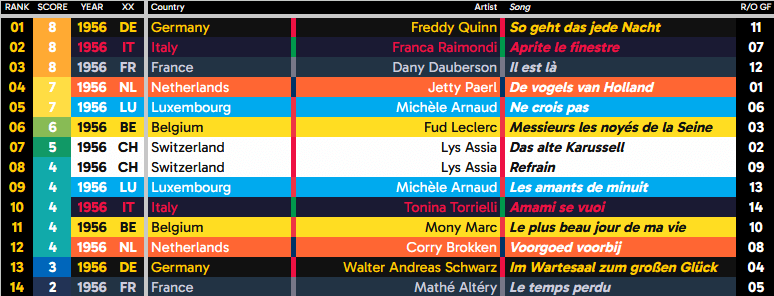
The way I rank a Eurovision year is, first I rate each song on a scale of 1 to 10, then I sort each of the songs that got the same score. I normally am not a big fan of rating things on a numerical scale, but I saw someone else who ranks Eurovision songs provide a helpful list of criteria for what each number means, so I’ve decided to use that scoring system for my own blog. In short, here’s what each score means: 10 means I absolutely adore it, 9 means I really love it, 8 means I love it, 7 means I like it, 6 means I kind of like it, 5 means I don’t like or dislike it, 4 means I don’t like it that much, 3 means I dislike it, 2 means I hate it, 1 means I hate it with a passion.
Fun fact: all seven countries in the contest have one song in the top half of my ranking, and one in the bottom half. I promise you this is a coincidence!
Rest of the show
I’ve decided that in round 2 of my Eurovision blog, I’ll split this section away from the general thoughts. There’s not much to say about the rest of the show here. We get a wonderfully language-neutral interval act, which is an imitation of bird noises whistled over a piano waltz. Unfortunately, the other interval acts this year have been lost to the sands of time.
There was no voting sequence this year. Instead, the host introduced the president of the juries this year, a Swiss man named Rolf Liebermann, who announced the winner in French: it was “Refrain” by Lys Assia. It seems to be exactly the winner the crowd expected. Then we get video footage where first a young girl passes Lys Assia her trophy, then she performs “Refrain” one last time. It’s clear that everything in Eurovision 1956 went according to plan, so it’s no wonder that the EBU decided to do it again the next year.
General thoughts:
It might be weird to say, but 1956 is my personal favorite of the grayscale years (the last of which is 1967). The reason why is because all the participating countries weren’t afraid to experiment this year, since they had no idea yet what would or wouldn’t do well in an international song contest. Sure, some of the songs are weak, but I can forgive all of them because it was the first ever Eurovision. It also helps that the contest has an artistically chosen running order, which makes the whole show feel like a musical mini-tour of 1950’s Europe. I get the same feeling from watching Eurovision 1956 that I do from watching the first episode of a TV show I love. I notice tons of early installment weirdness, but the core ideas of the show are there and have carried on to this day.
Some fans may think Eurovision 1956 is nothing more than a fest of boring chansons, which is a fair opinion because everyone’s tastes are different. But even if you don’t like the song lineup of the first ever Eurovision, hopefully we can all agree that this year deserves a lot of respect.
See you next time for, sadly, a much more boring lineup of songs.
 Cookie Fonster's stuff
The one thing I noticed fairly recently about Italian is that it has differences in consonant length, just like Finnish. I’ve been learning Italian on and off since I was about fifteen and no one ever bothered telling me that…
Looking forward to round two, I’m very interested to see your rankings. 🙂
LikeLiked by 1 person
Ah yes, Italian is one of those languages where long vowels come before short consonants, and short vowels before long consonants. Norwegian and Swedish are the same way—the difference is that the Italians are taught to distinguish words by consonant length, the Scandinavians by vowel length. So I’ve heard, anyway.
And boy has round 2 been fun, even in the grayscale years. Maybe especially in them, since my thoughts are so different now.
LikeLike
I’m already planning to do a round 2 of my reivews as well because I didn’t put a lot of effort into them at first and I think I can do much better.
I’ll be saving my detailed opinions for those reviews (I don’t think I’ll be continuing with them for a bit, I need a break after reviewing this NF season – something I’m definitely not doing next year), but I’ll say something I’ve been thinking for a while. Refrain, in my opinion, isn’t the best song of 1956 by quite a margin, but it was the most fitting winner because it’s such an agreeable song. Nobody at the top could’ve gone “you know what, this sucks and the winner was awful, so we shouldn’t continue with this whole Eurovision Song Contest thing”. And yeah, Lys Assia is just such a likeable person and she’s always been a huge ambassador for the contest and attended it every year all the way until her death, so that’s another point in her favour.
LikeLiked by 1 person
You have a good point about Refrain—it was a decent enough song, and the audience in 1956 clearly loved it, so we should definitely be thankful for it winning the contest. Did she really attend every year though? If so, that’s dedication.
LikeLike
I believe she said so herself. And, while she does have a motivation to lie, I don’t think she did.
LikeLike