
Introduction
Now the time has come for me to review the German national final for Eurovision 2025. It’s titled Chefsache ESC 2025: Wer singt für Deutschland? (Top Priority ESC 2025: Who will sing for Germany?) and it’s organized by none other than Stefan Raab, a German TV host and musician who came back to the screen in 2024 after seven years working only behind the stage. Among Eurovision fans, he’s most famous for organizing the German selection in 2010 which led to their second victory. He has a long history in Eurovision but hadn’t been involved in the contest since 2012. Most of Germany’s entries since then have been boring as hell and got bad results, so the more years passed, the more fans wanted Stefan Raab back in Eurovision. He’s back to Eurovision at long last and he says at every opportunity that his goal is for his country to win Eurovision.
Several of Stefan Raab’s decisions in this show have been questioned among fans. For one thing, the show consists of two heats, a semifinal, and a final, but in the heats the contestants didn’t sing their competing songs. Instead, they all sang covers of other popular songs or their older songs, and the juries selected who should make it to the final based on those performances. Additionally, the jury consists of only four people per show: Stefan Raab himself, his TV co-host Elton who is a music lover but doesn’t make music himself, the German singer Yvonne Catterfeld, and a different fourth jury member each show. The juries eliminate contestants in the heats and semifinal, and in the final, only the televoters decide who wins. No wait, that was changed a few days before the final, so that the juries now eliminate further down to five last songs. That’s pretty annoying because I had mentally prepared myself for a fully televote final.
I tried watching the heats live (February 14 and 15), but the covers weren’t very interesting to me, mostly just renditions of American and British pop songs. I think this was an idea that Stefan Raab insisted on, and the rest of his team didn’t question him at all because they trust every single idea he has. I was going to watch the semifinal live the next Saturday (February 22), but unfortunately that day I had to put down one of my cats. So instead, I watched the semifinal the day after—a good way to take my mind off the heartbreak of losing a pet.
The shows were all hosted by a familiar name to German Eurovision fans: Barbara Schöneberger, who hosted most of the German national finals of the past decade and seems to be the only holdover from the slop pop fests that were the last few German selections. She’s a TV and radio host from Munich, and my mom happens to be a fan of hers because of her observant humor and ability to improvise.
In this post, I won’t review the covers from the heats, nor will I split the songs between non-qualifiers and qualifiers like I did in my Supernova review. Instead, I’ll review the fourteen competing songs in their order from the semifinal, then discuss the show as a whole.
Song #1: Knightclub (qualified)
Artist: Feuerschwanz
Language: German and English
Key: B minor
In the leadup to the show, I had a gut feeling that this band was going to win. These guys (and girl) are a crazy metal band with quite a fanbase in Germany, so Stefan Raab and his crew made a wise choice by letting them participate in the contest. NDR, the northern German broadcaster who organized the German selection from 1996 to 2025, is notorious among German Eurofans for picking the safest, most boring slop pop possible, and being averse to German-language music. This is exactly the kind of music that the usual NDR crew would reject since it’s not radio-friendly enough, as proven by the Electric Callboy fiasco (which I ranted about in my Eurovision 2022 review). And be sure to listen to their newest song “Elevator Operator”, it’s almost as addictive as “We Got the Moves”. Note that Chefsache ESC 2025 was a collaboration between two broadcasters: NDR and the German branch of RTL.
Now with all that said, after having heard this song, I don’t think it’s the right choice to represent Germany in Eurovision. I would be OK enough with this winning, since it’s a well-composed and catchy rock song and a proper representation of the music people associate with Germany. But I have a few problems with this song. My biggest issue is the way the languages are mixed: the verses are in German but the chorus (the catchiest part) is in English, so the parts in German are diluted.
And plus, after the last places of “Blood & Glitter” and “Ulveham”, I worry there aren’t enough metalheads in Europe to vote for this. I’m not saying Germany should never send metal to Eurovision; I actually wish my country sent rock entries more often, since that’s a genre that people heavily associate with Germany. I just fear that if this goes to Eurovision, it could be too kitschy to attract votes, since I’m told 2025 will be yet another year heavy in televote bait. Basically, I’d be fine enough if this song goes to Eurovision, but there’s another song that would make my heart explode in happiness if it wins.
In the semifinal, after this song ended, Stefan Raab said that this song would be absolutely perfect for Eurovision, but Yvonne Catterfeld said that she wonders whether this song is the right degree of crazy for Eurovision or if it’s too crazy. I have to agree with Yvonne here.
Song #2: Like You Love Me (qualified)
Artist: Benjamin Braatz, who got slot number 2 in the heats, semifinal, and final
Language: English
Key: A♭ major, A major
I’m kind of disappointed that this national final has so many songs in English, but the good thing is, the two finalists dominating fans’ attention—“Knightclub” and “Baller”—are both at least partly in German, and the rest stand basically no chance to win.
This song is actually pretty decent, to be fair. Before the song began, Benjamin Braatz talked about how inspiring the Beatles are to him, and that shows through this song. It’s a sweet guitar ballad in 6/8 time that moves me a little bit, mostly due to the strings in the background. It’s sad in a hopeful way, not in a dreary way. His song is clearly inspired by the Beatles, but doesn’t just feel like a knockoff of their discography, more like an homage.
Song #3: If Jesus Saw What We Did Last Night (didn’t qualify)
Artist: Cloudy June
Language: English
Key: B minor
The title made me think this song was going to be a sappy religious anthem, but thankfully it isn’t. It’s basically rebellious teenager music of the 2020’s: a rock tune with some sassy edge about a steamy night of sex that would make Jesus jealous. I’m a bit outside the target audience of this, mostly because of the cursive singing. But I can actually see some appeal in this song. It’s not aggressively rocky, it’s more of a rebellious pop song with rock elements. I find it very American-sounding, which is true of far too many German entries in Eurovision, so I can’t say I’m sad it didn’t qualify. But I respect this song for telling a clear story; it does a good job conveying a theme of saying no to authority.
Song #4: I’m Still Here (qualified)
Artist: Cosby
Language: English
Key: D minor
Before the song began, we heard a snippet of the band’s cover from the heats, which seemed to be just a shouty piano ballad. Even though this song is also a ballad, it pleasantly surprised me. I’m not a fan of the cursive singing or the parts where she gets shouty, but this is a meaningful song with a message to share. It’s about the pain that the lead singer felt when her father died from smoking too much, and her desire to keep her father proud, and you can hear the emotion in her voice. The instrumental is really moving too. I can actually connect to the message a little bit, because my grandpa on my mom’s side died from smoking when I was four years old. My favorite passage of the lyrics is “One day you caught me smoking / But you never got angry / Instead, you said you’d always trust me”. I don’t think this is the right choice to go to Eurovision and it’s not playlist material, but I find this an admirable song.
Song #5: Weg von dir (didn’t qualify)
Artist: Jaln (Worthington Jalen Davis)
Language: German
Key: F♯ minor
Why the hell do so many artists have to go by mononyms in this show? It makes it annoyingly hard to find information about them—their real names, their discography, what else they’re known for. I hope the trend of artists going by mononyms dies down someday, but I don’t think it will. I also don’t get why his stage name is spelled “Jaln”; I just want to pronounce it as “Yaln”, but it’s supposed to be pronounced “Jalen”.
Anyway, out of the three German-language songs in this semifinal, this is the only one that didn’t qualify to the final. He sings very crisp and clear—great diction and sense of pitch—and respect to him for doing it in German of course. I always like when a singer’s vocals sound crisp, because it means I can understand the lyrics if I speak the language, and sing along easily if I don’t. Unfortunately the instrumental is too much of a restrained piano ballad, so his voice carries the song. I wouldn’t mind seeing him in another German national final, because he’s one hell of a good singer.
At the end of this song, Stefan Raab said he found it clever that Jalen filled in rhymes he couldn’t have done in German using English words (melodies / memories, later melodies / Batterie). And I agree, that is pretty damn clever. Thankfully he doesn’t overfill the song with English words, because that would be off-putting. He adds just enough to add some flair into the song. I’ve noticed from the way Stefan Raab talks that he’s the kind of guy who’s always overflowing with crazy ideas.
Song #6: Take the Pain Away (didn’t qualify)
Artist: From Fall to Spring
Language: English
Key: D minor
From Fall to Spring are the only artists in this selection that we saw in a previous German selection… sort of. They were in the wildcard round for the 2023 selection and got second place behind Ikke Hüftgold. Personally I think wildcard rounds to add just one more song to a national final are totally stupid. In Germany’s case, they just serve as a way for ARD to make some extra cash, which they could have been earning by putting more effort into their national final. Thankfully they’re putting proper effort into Chefsache ESC 2025!
I think this is a more accessible rock song than “Knightclub”. The problem is that it’s very derivative of nu-metal bands like Linkin Park. It’s a pretty good song, but you don’t get much new from it that you wouldn’t from another metal band. Some fans speculated that the juries purposely eliminated this rock song so that Feuerscshwanz would win instead, but I doubt that, because the only juror who seemed to truly adore this was Elton.
Song #7: Golden Child (didn’t qualify)
Artist: Jonathan Heinrich
Language: English
Key: A♭ major
I can see why this didn’t qualify, because it’s a pretty standard piano ballad. It’s decent enough for the genre, but you should know by now that I’m not a ballad fanboy. I should continue my streak of saying at least one nice thing about each of these songs, so I’ll say his singing style is distinctive and sounds sentimental and reflective.
This song got a standing ovation near the end, which would’ve suggested to me that it would qualify, but the juries all gave him some constructive criticism after it ended, so it ultimately makes sense this didn’t make it through.
Song #8: Baller (the winner)
Artist: Abor and Tynna, a brother and sister duo
Language: German, plus only one English phrase (shoot for the stars)
Key: C minor
This is like “Bur man laimi” was in Supernova: the one absolutely awesome native-language song that fits the country’s musical culture to a T, and which I really want to win this show. For me, this is the clear highlight of the Chefsache semifinal. It’s a fairly moving yet danceable dancey bop in German, which happens to be exactly Abor and Tynna’s style. All of their songs in German, actually. Take their song “Psst” for one—total boppy bop with fun melodies and a really satisfying drop in the chorus. I pretty much instantly befriended that song and it’s lived on my Spotify playlist since. They make exactly the kind of German-language music I wish I knew more of because I’ve never actually lived in Germany.
If you know me, you’ll know I badly want the German language back in Eurovision. After all the generic pop songs in English my country sent to Eurovision, this is so refreshing, like oh my god! It’s one of the two fan favorites of the national final, the other being “Knightclub”, so the final will probably be a two-horse race between them. I think this one has a broader appeal to viewers, whereas “Knightclub” appeals mostly just to rock lovers, so this stands a real chance at winning.
The way Tynna described this song (translated to English) is: “It’s a breakup song, but it’s not so much sad, more… a little angry, perhaps, but more like a song about freedom that I wrote for myself, as I went through a breakup.” It doesn’t sound like a stereotypical breakup song, it’s just totally their own style, their own interpretation of a song about breaking up. I particularly love the line “es tut noch bisschen weh, wenn ich dich wiederseh” (it still hurts a little, when I see you again)—not because of the writing of the line, but because those words flow so damn well. German is a tricky language to rhyme in because it has so many different vowels, which makes a good rhyme in German hit extra hard. The exact same is true of rhymes in Swedish, as I discussed in my Eurovision 1962 review. The German fans love this song too, as you can see in the comments of this recap video. Their performance could use a bit more work perhaps, but they have time to polish it up.
Will this win Eurovision 2025? Nah, nowhere close, there are plenty of much stronger contenders. But you know what? If this gets selected for Eurovision, I’d be so overjoyed my country sent something this good and this German-sounding that I wouldn’t even care that much. I would diaspora vote the fuck out of it, as a rest of the world voter. The crowd went wild at the end of this, Barbara Schöneberger excitedly congratulated them, and all the juries were positive too.
Song #9: This Bliss (qualified)
Artist: Leonora Margarethe Huth, who composed the song on her own
Language: English
Key: D minor, E minor
This seems like a very unpopular song in the contest, but it’s my personal favorite of the national final. I think it’s even a better song than “Baller”, I just won’t be voting for this because I badly want my country to send a song in German.
Leonora has one of the clearest musical styles of the Chefsache participants: upbeat pop songs with a tinge of jazzy gospel. I can totally see why Stefan Raab felt she was a good pick for Eurovision, he loves to write jazzy music too. She performed her older song “Good Day” in the heats, and I can see why she picked it: it’s a total feel-good party bop and a perfect way to showcase her performing skills. Before “This Bliss” began, Barbara Schöneberger pointed out her previous song was a little reminiscent of Stefan Raab’s “Wadde hadde dudde da”. You should totally try singing “Wadde hadde dudde da” over “Good Day”, it actually works perfectly.
If “Good Day” is like “Wadde hadde dudde da”, then this song is more like “Can’t Wait Until Tonight”, another Eurovision entry composed by Stefan Raab. It’s slower than “Good Day” but has the same musical spirit, and has a ton of jazzy chords without being over-the-top jazzy. It totally exudes class and I’m all for it. The further this song progresses, the more this feels like something Stefan Raab would write. The key change is done cleverly because the moment the song changes key, it also steps up in instrumental depth. I know I’m tired of my country sending songs in English every year, but I actually wouldn’t mind seeing this go to Eurovision. Too bad it doesn’t seem to stand a chance at winning the final, since “Baller” is so much more popular. When the final comes around, all my votes will go to Abor and Tynna.
Stefan Raab said at the end that this is the kind of song that appeals both to non-musicians and musicians. I can see where he’s coming from, since as a music theory nerd I eat this song right up.
Song #10: Empress (qualified)
Artist: Julika Lüer
Language: English
Key: G♯ minor, B♭ minor
Going by the way Julika described this song, I presumed it would be what I like to a call a therapy ballad (think “Bridges” by Alika). You know, the kind of song where someone (usually a woman) sings about self-improvement and getting over depression. And I was pretty much right, though it’s not too bad as therapy ballads go, mostly due to a few interesting piano chords. Julika has good control over her voice and knows when to hold back and when to give it her all. It’s one of the weaker entries of this final but as with most other songs here, I have respect for this.
My least favorite part of this song is the key change at the end: it comes out of nowhere and doesn’t add anything to the song. The key change in Leonora’s song was much better.
Song #11: Lovers on Mars (qualified)
Artist: Lyza (Lisa Subotic), whose real name I found by digging around her YouTube channel
Language: English
Key: F♯ major, G major
During the heats, Lisa covered the runner-up of Eurovision 2021: “Voilà” by Barbara Pravi. I think she made a fantastic choice here, both because it’s a great song to showcase her performing abilities, and because it proves she has good taste in music. Her French pronunciation is pretty decent, except she aspirates the P, T, and K sounds, which is a common problem with English and German speakers who learn French. Her delivery of the song is excellent, not quite as powerful as Barbara Pravi, but it’s hard to top the writer of the song. I showed my mom the performance of Voilà, and she said, “I want to give her a phonetics lesson. She sings so beautifully though.”
Barbara Schöneberger said that “Voilà” was Lisa’s first time performing on a stage in her life, which is just insane. She also said that Lisa originally comes from Montenegro, and when the juror Elton learned of this, apparently he said off the top of his head that in Eurovision Montenegro has never once given points to a German entry. I did some research to make sure, and holy fuck, Elton is right. They didn’t even give us points in 2018 when Michael Schulte got fourth place, and when Lena won in 2010, Montenegro didn’t participate. Even I didn’t know that off the top of my head, but to be fair, memorizing who gave points to whom isn’t my strong suit. That goes to show how much of a Eurovision fan Elton is, which no doubt played a part in his selection as a juror.
Unfortunately this is easily the most generic-sounding song so far. It sounds like a very safe radio pop song with a bit of country twang. It’s the only entry in this semifinal to have mainstream Eurovision songwriters: Anderz Wrethov, Julie Aagaard, and Thomas Stengaard all played a part, together with artisten själv… sorry, I mean the artist herself. I would say she deserved a better song. It’s possible that Lisa was handed this song from the usual crew of songwriters, but the fact that her name was on this makes me not so sure. Maybe she just had a small amount of input on this song?
Song #12: Nothing Can Stop Love (qualified)
Artist: Moss Kena
Language: English
Key: E major
Now we have a British guy living in Berlin who doesn’t seem to speak much German, but is making an honest effort to learn it. He sings a ballad that’s as sappy as you’d expect from the title. He can sing, yes, but oh god this is so ballady. It’s the absolute definition of a DAF ballad, a term that Erica Dakin coined in her review of 1988. DAF stands for “dull as fuck”. There’s no drum beat throughout the entire song, so I guess it’s trying to be a minimalist ballad, bud it doesn’t really work. Maybe it could work as jury bait, but I’d much rather my country send something televote-friendly for once.
Song #13: These Days (qualified)
Artist: The Great Leslie, which is a band, not one person named Leslie
Language: English
Key: A minor
Weirdly enough, this song gives us even more British representation, though this band seems to be a mix of Brits and Germans. Two of the band members said in English, “It’s kind of like a funky rock pop. It’s disco, disco indie we’d call it.” “In other words, it’s a complete mess.” which is an extremely British thing to say.
And yeah, their description is spot on. It’s creatively composed but also kind of messy. It might fit better as a British entry than a German entry, but either way it sounds like off-brand Måneskin. That band frustrates me in a way, because their songs in Italian are so much better than their songs in English, and yet they favor singing in English these days.
Song #14: Golden Hour (didn’t qualify)
Artist: Cage (Karolin Gärtner)
Language: English, like far too many songs here
Key: F♯ minor
After a streak of six songs that qualified, the semifinal ends with a non-qualifier. At first I wasn’t sure why the song didn’t qualify, but after the juries were generally a bit critical towards this, it makes sense why. She’s a great singer and the song has a nice bouncy rhythm. It’s almost like a girlbop, but more mature and subdued. Maybe the song being subdued is the problem, since it’s not quite as groundbreaking as the other songs we’ve heard. I’d still say this is quite a bit nicer than some songs that did qualify.
I’m not a fan of her shouty notes near the end, because even though she hits them well and doesn’t over-shout them, they don’t add much to the song. To make showy notes click with me, you have to really make them add to the song, like Jamala did in “1944”. Better yet, Tina Karol’s “Show Me Your Love” is my go-to example of a showoffy note done to perfection.
Semifinal thoughts:
Yes, there were some notorious sound issues (especially in Feuerschwanz’s song), but I’m happy enough with the production of the semifinal otherwise. Some fans (including some who can speak German) felt there was way too much yapping between the songs, but I didn’t mind it at all. But it probably helps that I watched the semifinal over the course of a few days after the show. I was really hoping for more songs in German, but I’m happy with the variety of musical styles we have here. And I’m really happy that the token songs in German are actually interesting and not dull pieces of filler.
Barbara Schöneberger is a fantastic host as always—she knows how to engage the audience, contestants, and even the jurors. Her voice is a bit shouty, but I don’t think there’s much she can do about that. As for the jurors, Stefan Raab was obviously in his element while judging the songs and was constantly bursting with ideas and thoughts. Yvonne Catterfeld is my personal favorite of the jurors—she praises contestants for what they did well, gives constructive criticism without coming off as mean, and overall seemed to really be enjoying herself. As far as I know, she had never been involved in anything Eurovision-related before,* but she felt totally at home in this event.
Elton was the opposite of Yvonne: he had an air of “my buddy Stefan dragged me into this but I’d rather be somewhere else” and often didn’t seem sure how to feel about the songs. So I’m not surprised he declined to join the jury in the final. His reason for not joining was “wegen eines privaten Termins” (because of a private appointment) according to eurovision.de. I can imagine that Stefan Raab asked the other jurors to join him one more time for the final, Yvonne said “sure, I’d love to!”, but Elton was like, “nah, I have other things to do on Saturday”, so he dragged in Conchita Wurst as a substitute. Max Giesinger was a decent enough guest juror, I don’t have much thoughts about him.
For those who can’t speak German or didn’t watch the show, I made a nice little spreadsheet summarizing the jurors’ thoughts on each song. Here it is:
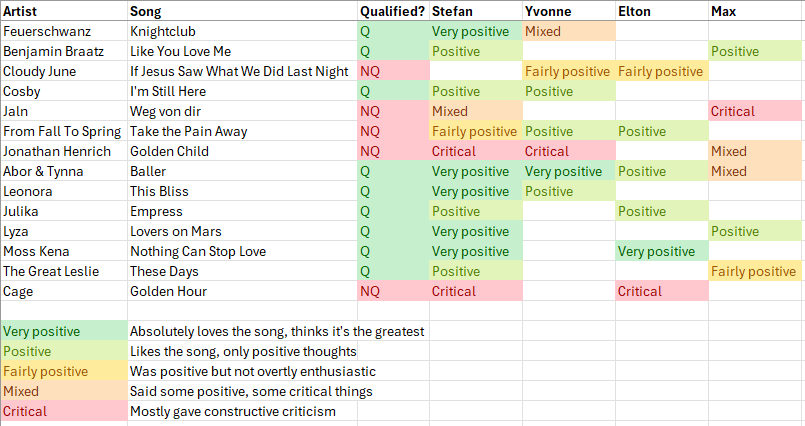
It’s a good sign that Stefan and Yvonne, the two jurors who will return to the final, were very positive about “Baller”. Max was mostly positive about it too, but he took a moment to tell them their singing could use a little improvement, so I had to list his reaction as mixed. Elton felt that “Nothing Can Stop Love” was too good for Eurovision, to which Stefan replied he didn’t expect Elton to love it.
* Unless you count her participation in Stefan Raab’s spinoff contest, Bundesvision 2015.
Run-through of the final:
The order of the songs in the final was:
- These Days
- Like You Love Me
- This Bliss
- Knightclub
- Nothing Can Stop Love
- Baller
- I’m Still Here
- Lovers on Mars
- Empress
The grand final of Chefsache took its sweet time with each song. Each contestant first performed a cover of a different song than from the heats, then they had a few interviews, then they performed their competing song, and finally the juries discussed each one. I think Conchita Wurst was a better jury member than Elton, because not only does Conchita live and breathe Eurovision, but she was clearly more invested in the show than Elton was. To be fair, Elton is a big Eurovision fan as well, but he just didn’t seem that invested. Conchita knew how to give constructive criticism as well, as proven by her thoughts on “Like You Love Me”. Feuerschwanz was fourth in the running order and their song was the first to wake up the audience; their cover was also one of few that didn’t feel like filler, since they put an interesting spin on an Ed Sheeran song. (Speaking of which—why do Germans love American and British music so much more than their own? That’s the impression I got from watching this selection.) However, Stefan and Yvonne seemed mixed about “Knightclub” in the end, even though Stefan went off about how great it was in the final.
Abor and Tynna came sixth in the order and their song was blatantly the audience’s favorite. Stefan Raab said it’s the most modern song of the contest and claimed it’ll easily overcome language barriers. Nico Santos (the guest juror) said that it was his favorite of the final, to which the audience cheered, and said it would be so cool if siblings from Austria went to Switzerland competing for Germany—a combination of the DACH countries.
After the juries decided which songs to eliminate, Stefan Raab said that he didn’t want to have to eliminate almost half of the songs. I’m not sure if he just means it was a difficult choice, or if his statement implies the rule change was the result of executive meddling from NDR. Anyway, the songs that made it through the last round were These Days, This Bliss, Nothing Can Stop Love, Baller, and Lovers on Mars. When Barbara announced the fourth qualifier, she said (translated to English) “And this decision probably won’t surprise anyone… Abor and Tynna made it!” If it wasn’t yet obvious who was going to win this thing, now it was.
I find it these choices of qualifiers a bit odd, and it’s especially strange that the juries eliminated Feuerschwanz. I hate conspiracy theories and won’t endorse any about this elimination, but I will say some fans suspect that the addition of a superfinal was done so the juries can eliminate Feuerschwanz. I feel bad for the guys from Feuerschwanz, because even though I’m not a big fan of their song, they seemed stoked about this opportunity to go to Eurovision.
As the voting time window was open, Yvonne Catterfeld sang a groovy pop song in English (was she lip-syncing?) and then Stefan Raab performed a crazy comedic dance song in German called “Rambo Zambo”. In the final vote results, Barbara presented a bar chart of the voting percentages each song got—the top two were 34.9% and 31.1%. Then she cut to the chase and revealed who won, and I love the way she did it. She said that the winner of the national final was not one person, but two, and at that moment the audience knew who won. It wasn’t a big surprise who won in the end, but the margin was narrower than I expected. In second place was Lyza with “Lovers on Mars”.
My full ranking
Here’s how my opinions on the Chefsache songs stack up:

It was tough to decide who my favorite of the selection was, but eventually I went with Leonora because her song is a snazzy composition that beams with class. I tried to give 20 votes to Abor and Tynna (would have cost €4) but the voting system broke for me, as it did for many other international viewers. As you can see, this was a pretty decent national final: 5 is my neutral rating for songs, and half the songs are above it.
General thoughts:
Let me start by saying I am absolutely delighted that my country is finally sending a song in German to Eurovision, for the first time since 2007. And I think the song lineup and presentation are both better than people give credit. It’s a far stronger lineup than the last few German national finals, especially the trainwreck of 2022 (the year of Callboygate) and the generic pop fest of 2024, and I came away from it with two keepers: the winner and one other song, just like Supernova.
However, I really do not like that the producers of the show made so many last-minute changes to the rules. It pretty much turned the show into a game of Calvinball, so I have to question the legitimacy of the end result. Stefan Raab claimed in this press conference that it was always the plan to eliminate a few more songs in the semifinal, and his team debated whether to narrow it down to 3, 4, or 5 songs before deciding on five, but if that’s true, then this should have been communicated. He also said that in the conference that his next step is to promote the winning song across Europe, so his work isn’t done yet.
I wonder which contestants in the heats had amazing songs planned that we never got to hear because their covers got them eliminated, and I wonder how well Feuerschwanz would have done if the rules for the final hadn’t been changed. These rule changes dampened the fun of following Chefsache because I felt I could no longer trust the initial rules. But what’s done is done, and despite everything, I vastly preferred this national final to the usual NDR pop fests. I can guarantee I’ll spare at least five votes for Abor and Tynna when the Eurovision final rolls around.
 Cookie Fonster's stuff