
Introduction
It’s now time for me to review my first national final of the year! I’m not going to watch all of the national selections, oh no, nowhere close. But there’s a few I have planned to watch (see this post) and Latvia’s is one of them! I don’t know much about the prior Latvian selections, but I do know that this one has a higher than usual portion of songs in Latvian (5 out of 20 fully in Latvian,* 2 in a mix of English and Latvian), which is really cool because I know very little about the language and look forward to getting more acquainted with it. I also know that Latvia got a big confidence boost in Eurovision after Dons brought them to the grand final for the first time since 2016, which is why I chose to watch this selection.
Supernova 2025 was originally going to have 20 songs compete, but “Monster” by Grēta was withdrawn because the singer was sick. The semifinal took place on February 1, and ten songs qualified to the grand final on February 8. I’m not just going to review the songs, but I’ll also rank them with a list at the end! I plan to do this for every Eurovision-related blog post I do from here on out.
Spoiler alert: there’s one song from the selection that I immediately fell in love with the moment I first heard it. I have been listening to that song over and over again for the entire past week.
* OK, technically “Ramtai” has a tiny bit of English.
Song #1: Lovable
Artist: Marta Grigale
Language: English
Key: A major
There are several songs in this year’s Supernova that I’d describe as lovable. This is not one of them. It’s just a mediocre dancey song with singing that’s just breathy enough to bug me. It’s not awful, but it doesn’t do much for me and I’m not surprised it didn’t qualify. At least the 12/8 time signature is a bit nice.
(#2 Tepat qualified to the final)
Song #3: Fit Right
Artist: Justs Sirmais, returning from Eurovision 2016
Language: English
Key: F minor
I don’t remember Justs’ song from 2016 all that well, but I swear I remember him being a better singer than this. I relistened to “Heartbeat” from 2016 then gave this another listen. And yeah, he pretty much flubbed his performance here. I quite like the electronic instrumental, but I don’t like the parts where it pauses, and his raggedy singing style doesn’t fit over it. It gets a little better as it progresses, and I think I like the song better than “Lovable”, but it doesn’t really inspire passion in me.
Song #4: Zelts
Artist: KoBra (Katrīna Kovaļuka, Krišjānis Brasliņš)
Language: Latvian, a language that’s growing on me thanks to Supernova
Key: B minor
This is the non-qualifier I’m saddest about. It’s a moody duet ballad with a good amount of harmonies and sounds properly melancholy rather than ballady, mostly because of the guitar. I think guitars are an easy way to make a ballad appeal to me.
Before each song in the semifinal, we heard a short interview with each of the contestants (in Latvian of course). I can’t speak Latvian, but I could tell that these two had some good banter together, and their chemistry is reflected on stage. The man and woman’s voices here interact in many different ways. Sometimes they alternate, sometimes they sing the same notes, sometimes they sing an octave apart, and their voices shine best when they harmonize. The harmonic parts totally win me over and remind me of “Calm After the Storm”, which is one of my favorite ever Eurovision songs.
If you know how much I fucking adore “Calm After the Storm”, you might think I love this just as much, but unfortunately several things about it hold it back. As the song progresses, I start to wish they harmonized more often and didn’t sing an octave apart as much. Then I’m left at the end feeling their voiced interacted in too many different ways. The song has some great ideas in there, but also has a few sections that don’t really add anything. I do like this overall, even though I don’t think I’d add it to a playlist, and I’d love to see KoBra come back to a future Supernova and fine tune their style a little bit more.
Song #5: Electric Love
Artist: Adelina Jurevica
Language: English
Key: B minor
I think this sounds and looks like a Melodifestivalen entry. It’s dancey and heavily choreographed, and for me it goes in one ear and out the other. I don’t dislike it, I just don’t really care for it.
(#6 Citi Zēni, #7 Emilija, #8 Bel Tempo and Legzdina, #9 Palú, #10 The Ludvig qualified to the final)
Song #11: Stronger
Artist: Luka (Elizabete Lukaševiča)
Language: English
Key: F♯ minor
This song is also trying to be a Melodifestivalen entry in music and looks, but because her vocals sound slurred and vaguely croony, it sounds like a Melfest non-qualifier instead of a Melfest winner. OK, the instrumental gets better as it progresses, but I still don’t like this at all. (Can you tell the Swedes have made me know way too much about their music?)
(#12 Chris Noah qualified to the final)
Song #13: Domāju, tu nāc
Artist: Toms Kalderauskis
Language: Latvian
Key: F minor, I’m pretty sure, but deciding the key of this was tough
Out of the seven songs in Latvian, only two didn’t qualify to the final, and this is the second. This is a dreary, unusually deep-voiced ballad, and my paper notes say that I feel I am missing something by not understanding the lyrics. This is a bad sign, because there are plenty of songs in languages I know nothing about where I feel as though I can understand the whole song, simply because of the way they’re sung. A great example is “Az én apám”, my winner of Eurovision 2019 (which was fucking robbed by the way). Likewise, there are several Latvian-language songs in this show where I am happy to let the music speak for itself, and this isn’t one of them. This is probably good for ballad lovers, but it’s not my cup of tea.
Withdrawn song #14: Monster
Artist: Grēta Grantiņa
Language: English
Key: B♭ minor
Unfortunately, Grēta fell ill a few days before the Supernova semifinal and stepped out of the contest. The numbers in the running order were changed to accommodate this, so that the next song is numbered 14 and the final song is numbered 19. This is a fast-paced pop song with interesting percussion and a very 2020’s sounding trap beat, but it’s a little difficult to rank this when we don’t have a live performance to go off of. I’ll include this somewhere in my rankings anyway. I don’t think I love this, but I do have a good time listening to it, mostly because of the boppy beat and the quiet bridge section.
Song #14: Something in the Water
Artist: Julianna Tīruma
Language: English
Key: E minor
I’m in two minds about this song, because I love the instrumental but hate her singing style. The instrumental is exactly the kind of moody guitar music that the Latvians seem to love. It’s mellow and atmospheric and the raindrop synths really add to it. But Julianna has that super-annoying breathy style of singing where I can barely understand a word she things, and that reminds me of songs I despise such as “Growing Up Is Getting Old”. That said, the more I listen to this, the more attention I pay to the music instead of the vocals, so I actually like this more than I hate it. Still, I definitely cannot say I love it.
(#15 Tautumeitas qualified to the final)
Song #16: Chemical
Artist: Rūta Dūduma
Language: English
Key: A minor
I think this did not benefit at all from coming right after “Bur man laimi”. I know this because when I watched the semifinal live, I was so in awe at how fucking awesome song #15 was that I pretty much spaced out through the next two songs.
This song did feel like a letdown after the folk choir, but after relistening to it enough times, it’s actually a very decent effort. It starts as a ballad that’s more melancholy than ballady, and gradually transitions into a dance song. She’s a very good vocalist and gives it her all on stage, both in the ballad and dance parts, so overall I have respect for this entry. I suppose it wasn’t impactful after “Bur man laimi”, which must be why it didn’t qualify.
Song #17: Scarlett Challenger
Artist: Katrīna Gupalo
Language: English
Key: B major
This lady has a very nice and simple black dress, but right when the song begins I already don’t like her slurred singing style. Just like the last song, this starts as a ballad then becomes dancey halfway through, but her singing sounds breathy and muddy instead of crisp like the last singer. The instrumental gains a cool electronic beat in the last minute, but otherwise I’m not a big fan of this.
(#18 Sinerģija and #19 Markus Riva qualified to the final)
Finalist #1: Romance Isn’t Dead
Artist: Chris Noah (Krists Indrišonoks)
Language: English
Key: A minor
Most of the songs in English here are dancey pop except for this, which is an indie rock song with a very rock-sounding voice, if that makes sense. It’s fairly good, but a bit restrained and there are much better indie rock songs here. This one I only appreciate if I’m in the right mood. Still not a bad effort and it deserved to qualify.
Finalist #2: Delusional
Artist: Palú (Olga Palušina)
Language: English
Key: A minor
This song has quite a few good ideas, but overall it’s too unfocused for me. I think I’d like it more if it didn’t flit between so many musical genres, and instead picked one or two to alternate between or blend. Think of “Cha Cha Cha”, which perfectly mixes hectic rap in the first half and dancey bop in the second half, or going back into the 1970’s, “Disco Tango”, which blends the two genres in its title to perfection. Or I could also like it more if the whole song was more like the synthy intro, which is my favorite part. This song switches around between synth pop, alternative rock, symphonic metal, and even cuckoo clock music for a few seconds, which is just too much for me.
Finalist #3: Bound by the Light
Artist: Sinerģija
Language: English and Latvian
Key: D minor (verses), A minor (chorus)
Now we have two songs in a row that sound totally unfocused to me. This is a ballad in 6/8 time that sounds a bit like an Irish folk tune, probably due to the prominent cello. Most of it is in English except for the whispered bridge in Latvian. It’s a little bit interesting but forgettable overall, and the vocals sound just a tinge slurred. At the end, the singer whispers “we are everyone” and I’m left not understanding what this song was supposed to be about.
Finalist #4: Ramtai
Artist: Citi Zēni, returning from Eurovision 2022
Language: Latvian, with a tiny portion rapped in English
Key: E♭ minor
It’s hard to believe this is the same band that sang “Eat Your Salad” in 2022—this song has pretty much nothing in common with their last one. I can sense a tiny bit of groovy chords here and the rapping voice sounds familiar, but otherwise it’s a totally different kind of song. They’re not even performing it as a band of instrumentalists, but rather with the lead singer accompanied by the other guys wrapped in what looks to be coconut flakes. Instead of a corny (yet super-funky) disco tune, they give us a pacy dance song that reminds me of last year’s Lithuanian entry “Luktelk”. It’s actually pretty good as dance songs go, and although my notes say I feel like I need to understand the lyrics to fully appreciate it, upon a second listen I think I only said that because “Eat Your Salad” is so lyrics-oriented.
While the song is nice enough to listen to, it doesn’t cross the line into love and I’m not a fan of the rap section. Also, points down for the title turning out to be a nonsense word, which is disappointing for those who don’t speak Latvian. Still, it’s a pretty decent effort.
Finalist #5: Sadzejot
Artist: Tepat
Language: Latvian
Key: F♯ minor
Now’s a good time to mention a quirk of the Latvian language I’ve grown to find charming: the letter O is pronounced as a diphthong, notated as /uɔ/ in the IPA, which feels unusual to me. Yes, I know the English language loves to represent diphthongs using single vowel letters, but I’m used to thinking of that as unique to English, not a feature of other languages. Maybe that’s part of why I feel Latvian has a bit of Finnish in its sound, because that language has a similar “uo” diphthong.
This song is exactly the kind of music I associate with the Latvian language, and I mean it in a good way. It sounds a little freeform and quirky, and thus suits the rhythm of the language well, which I’d also describe as quirky.* I don’t think this would do well in Eurovision for the same reason “Aijā” didn’t qualify: it’s a gradual grower, not one that instantly grips me (though others may disagree). But as with “Aijā”, the more I listen to it the more I love it. I love the mellow indie rock sound and the odd directions the bass goes in, as well as the hints of synth solos. The dissonant chords in the chorus are an acquired taste, but it didn’t take long for me to acquire it. One chord I find really interesting is the usage of F♯ major in the chorus. The bassline does not play F♯ there, but rather A♯, the middle note of the chord, so it doesn’t sound like a shift in major key but rather a step up in unease. The whole song sounds a little uneasy, and it might not be to everyone’s taste but I mean it as a compliment.
I’ve decided to add this to my Spotify playlist because I feel it’s the kind of song I’ll appreciate the more I listen to it, but I think I’d have to be in the right mood to listen to it on my own time. I think this and “Bur man laimi” will be my two main keepers from this selection. My fellow reviewer Vlad described this as a song specifically designed for him to love, and I don’t know why but I can totally see that. The lyrics are also rather emotional; looking at a translation, they’re about a woman who struggles to find the right words to say to her love interest and use a lot of metaphors about nature.
* To be fair, I probably think Latvian sounds quirky since I don’t know much about the language. I used to think Swedish was a funnier-sounding language than Norwegian, but now that I’ve been exposed to way more Swedish, I now feel the opposite.
Finalist #6: Līgo
Artist: The Ludvig (Jēkabs Ludvigs Kalmanis)
Language: English and Latvian
Key: A minor
This song tries to be a blend of dancey pop with a club beat and ethnic choir music, but I don’t think it works all too well. I kind of like the dancey beat, but the pop singing in English and the ethnic choir in Latvian are just too odd of a match for me, and way too much of the backing vocals are pre-recorded. It’s not bad to listen to, but I don’t get why any fan thought “Bur man laimi” didn’t pull off the ethnic style so much better.
Finalist #7: Bigger Than This
Artist: Markus Riva
Language: English
Key: D minor
This is a dancey pop song with a club beat that will probably get a fair amount of votes because the guy is shirtless and muscular. I can’t say it does much for me, it’s too clubby for me. It’s also overstaged and the part where the backing dancers lift him without him singing irritates me.
Finalist #8: Bur man laimi (the winner)
Artist: Tautumeitas, a Latvian folk music group whose name means “folk girls”
Language: Latvian
Key: B minor and E major in alternation
THIS IS EXACTLY WHAT I WANTED LATVIA TO SEND TO EUROVISION AND IT WON!!! I fell in love with it the moment I first heard it and have been listening to it over and over again ever since. I love it so much, in fact, that it could well become the “Europapa” of the year for me. Yes, I know this is an ethnic song and “Europapa” isn’t, but both songs showcase their country’s culture in a way Eurovision had never seen before, both are native-language songs, and both are insanely addictive. Latvia had never once sent their ethnic music to Eurovision before—the closest is a snippet of the 2003 interval act, which was a lovely little peak at their folk music. And now we have this amazing opportunity for them to show off the traditional side of their music, just like their northern neighbor Estonia did last year.
In their interview before the song started (both in the semifinal and final), the girls seemed so excited to show off their song. I can’t speak or understand Latvian, but I’m pretty good at catching internationalisms in European languages, so I caught one of the girls saying what sounded like “Latvian culture”. That alone made me realize I was in for something exciting. And boy oh boy did they deliver! My fellow Eurovision reviewer Karina told me she loved the studio version but was worried the girls would flub their live performance: it turns out they absolutely nailed it, and thus she and I both rooted for this to win. The singers interact with each other and express themselves while singing and harmonizing beautifully. They’re such talented singers and they present a style of music we’ve never once had compete in Eurovision before!
The song begins with the singers proving their vocal skills by making some gorgeous chords, then some intriguing percussion kicks in. Then comes the main melody which is in an even rhythm, as is common in eastern European folk music (see also “Solovey” and “Shum”). The second melody has the absolute craziest harmonies and is in more of a freeform rhythm, then the song alternates between melodies 1 and 2 and keeps getting more and more awesome. After more and more buildup and an increase of harmonies, at 2:30 minutes in we get my favorite part of the song: the girls sing the gorgeous chords from the start once more, set to a perfect combo of bass and percussion to keep me intrigued. That section sounds nothing short of heavenly. Then they sing the first melody one last time as a few of the girls’ singing explores new directions.
When this song ended, I instantly added it to my Spotify playlist and have been addicted to it since. Even if this hadn’t won Supernova, I’d have been happy I came away with such an amazing song. Who could’ve ever guessed that Latvian folk choir music would win me over so easily? Not me, and that’s what I love about Eurovision.
Now that this won Supernova, I could see it becoming a fan favorite much like “Shum” by Go_A did. That’s probably the most comparable Eurovision song to this, but even then this is a totally unique song that I’m very glad is getting a spot in Eurovision. I’m curious whether this song won the jury, televote, or both. We’ll probably know in a few days, after which I’ll edit this post.
EDIT: Holy fuck, turns out it won neither the jury nor televote: second place in the televote and third in the jury. Now that’s a plot twist if I’ve ever seen one. It also turns out this, “Heartbeat”, and “Ramtai” had a three-way tie, which was of course broken by the televote rankings. I couldn’t stop laughing when I learned of this, because it was completely unexpected but has no negative consequences.
Finalist #9: The Water
Artist: Bel Tempo and Eliza Legzdina
Language: English
Key: B♭ major
This song starts off melancholy in a way I’d expect from Latvia, with some moody synth chords and a muffled piano. Unfortunately the song stays a little restrained throughout. I’m not a fan of the female singer’s breathy singing; I prefer the expressive vocal style of the male singer, though he doesn’t get a solo till over halfway through. It’s not good enough that I’d keep it, but if it had a more powerful instrumental, perhaps I could live with the woman’s breathy singing and add it to a playlist.
Finalist #10: Heartbeat
Artist: Emilija Bērziņa
Language: English
Key: B♭ major
I was scared as shit that this could win Supernova, because midway through the semifinal voting it was revealed to be leading the televote (by a rather narrow margin, to be fair). Somehow it landed second place, which was good in the end because I absolutely fucking screamed when Tautumeitas won (and saved the recording). This is a generic mostly four-chordy pop song in English and the more I listen to this, the more things annoy me about it… the slurred vocals, the dull beat, most of all her “heart be-e-e-at” singing. What on earth does anyone see in this song? To be fair, I don’t hate the song, I was just scared of it winning the selection. And since it didn’t, I never have a reason to listen to it again. We haven’t seen the full results yet—I bet it was the juries who prevented this from winning.
EDIT: Apparently the televoters prevented this from winning: this was their third place and the juries’ second. I guess I shouldn’t be too surprised the juries ranked this higher than “Bur man laimi”, they’re notoriously known to tank ethnic songs.
EDIT 2: After Supernova 2025, Emilija put out a really sweet Instagram post congratulating Tautumeitas for their victory, praising their song and performance, and saying she was absolutely joyed to score second place. Her song still isn’t my cup of tea, but I really respect her for doing this, and that may be part of why she has such dedicated fans.
My full ranking
Instead of just saying who my favorite is, here’s a full ranking of this national final:
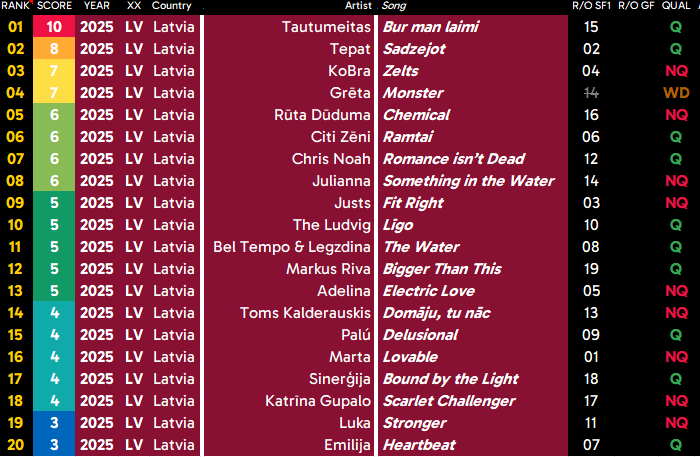
I feel like most of the songs from 7th to 18th place could be shuffled around, but I made this ranking after the semifinal and can’t be bothered to change it. For a recap of what the ratings mean, see the rankings in my 2023 final review.
One thing you can notice from this ranking is that this national final had no truly awful songs, which is great! And impressive considering that just four years earlier, this country thought it was a good idea to compete with “The Moon Is Rising”, very close to my least favorite Eurovision song of all time. Latvia has learned a lot those past few years! I’m not too confident on the rankings of my 5’s and 4’s, but that’s usual. It’s also quite curious that the songs that qualified seem to have no correlation to how much I like them.
General thoughts:
As you can see from my rankings, most of the songs in this national final weren’t great, but the ones I did enjoy I’m very happy I discovered. Even the songs I rated 6/10, I wouldn’t mind returning to now and then. And oh my god, I am so fucking happy about the song that won. I’m absolutely stoked for Latvian fans that they get to be represented by a native-language song for the first time since 2004.
Although I can’t speak Latvian, I could tell this was a professionally hosted show where everything went as planned. The hosts quickly ran through the show in the semifinal, but took more time between each song in the final because there were fewer entries. The semifinal had interviews with the contestants before each song, whereas the final had them film videos after qualifying where I assume they talked about how they were preparing for the grand final. I totally agree with the observation some fans have made that northern Europe hosts their national finals efficiently, whereas southern Europe lets their shows drag on and on and on. Since Latvia is quite far north on the map, it’s no surprise they hosted such an efficient show. And as someone whose current work schedule doesn’t permit much free time, I think northern European national finals suit me best.
The hosts came across as both friendly and professional. I’m not a fan of the female host’s pink dress in the semifinal, so I’m quite happy she traded it for an elegant red dress in the final. It looks very similar to Petra’s dress from 2024 semifinal 2. At the start of both the semifinal and final, the male presenter briefly welcomed the audience in English. In the final, he even gave a shoutout to American viewers and said “I know you’re watching”, and I felt so spoken to. But knowing this shoutout, I wish the results sequence had a scoreboard so that international viewers could more easily figure out what was going on. Since there wasn’t a scoreboard, I eventually figured out that they were eliminating the contestants one by one without going through the jury and televote results. And the male host did say “the third place” in English near the end, so that helped a bit.
I should also say I quite enjoyed the interval act where Aminata sang a rearranged version of “Love Injected”, the most recent Latvian entry to score in the top 10. Either the song is growing on me, or it just sounds nicer with a more acoustic arrangement.
In the end, the results came down to Emilija and Tautumeitas. My heart was pounding like crazy till we had the winner, after which I screamed “YES!” over and over again. I even filmed my reaction to keep it saved. Thankfully I was home alone when they won, because you better believe I screamed my ass off.
See you again in three weeks where I review a national final that won’t have a language barrier: Chefsache ESC 2025: Wer singt für Deutschland? We got the list of competing artists, so I’ve lately been exploring their discographies and I’m really impressed by the variety of musical styles Germany selected. I’m absolutely stoked that my country is finally taking Eurovision seriously, but I’ll save further thoughts for my next blog post.
 Cookie Fonster's stuff